Your First Cat: The Checklist, the One-or-Two Question, and the First 72 Hours
Most first-cat problems aren’t gear problems — they’re sequence problems. The two decisions that matter happen before the shelter visit, the sanctuary room matters more than anything you can buy, and the kit itself is about $100–250 spent on a short list. Here’s the whole sequence, grounded in what this month’s new owners actually got wrong and right.
Some links below are affiliate links. If you buy through them, MeowTested may earn a small commission at no extra cost to you, including as an Amazon Associate, where we earn from qualifying purchases, and as a partner of Whisker, the maker of Litter-Robot. We only recommend products that pass our Fit Analysis — and we publish the ones that don't.
Read enough first-cat threads and the same arc repeats: the research goes into the shopping cart, and the trouble comes from everything around it. One new owner this month lost a newly adopted cat inside her own apartment for two days — her words: “my biggest mistake was not letting them out in the closed room I made for them I let them out into the open house.” The gear was fine. The sequence wasn’t.
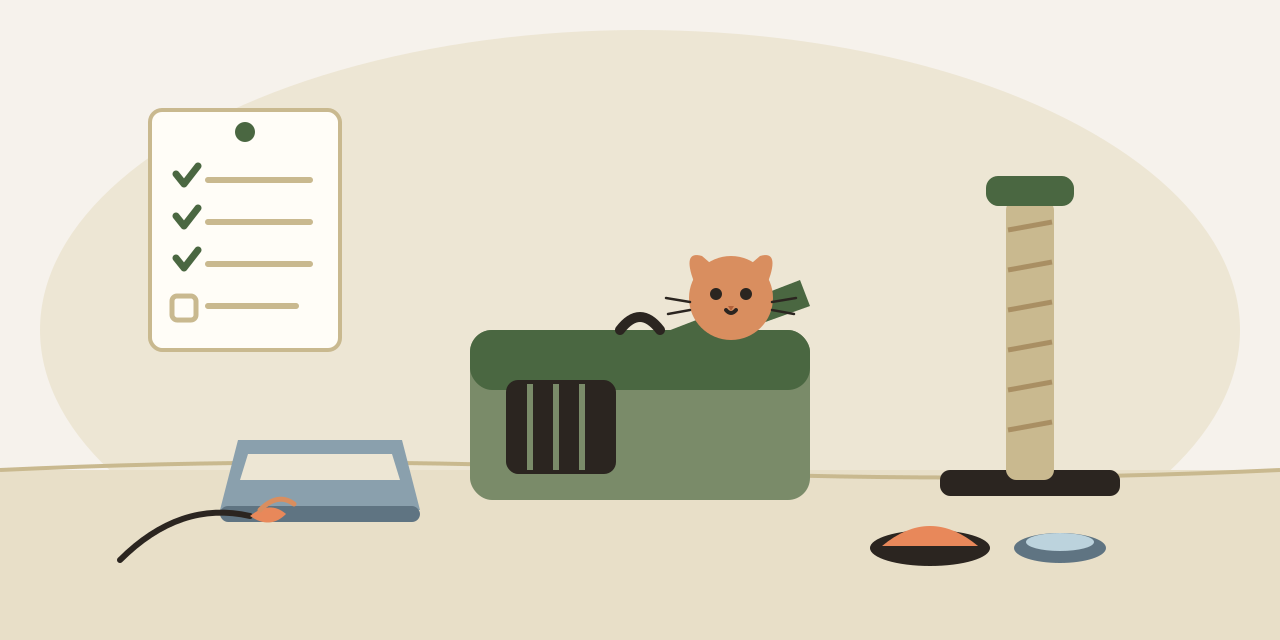
So this page runs in sequence. Before the shelter: decide one cat or two, and kitten, adult, or senior — both answers depend on your hours, not your heart. Before pickup: set up one closed room with the box, food, water, a hiding spot, and a carrier that stays out with the door off. The first 72 hours: hiding is normal, day-one regret is normal, and not eating past a day or two is the one thing that means a vet call, not patience.
The kit lands around $100–250, and most of it is covered in depth on pages we’ve already written — fountains, feeders, litter boxes and mats, toys. What’s below is the map, plus the three things no other page here covers: the carrier, the scratching post, and the warm spot the cat owns.

One cat or two? Decide before the shelter visit
This is the question the shelter will ask you on the spot, and answering it there is how people end up overwhelmed. Two prospective owners asked it in the same week this month: one grew up with dogs and wants an adult cat for company but worries “2 cats would be a little overwhelming for me at first,” and another was told “2 cats would be better since they could play with themselves.”
The honest version has three cases, not one answer:
- Two kittens from the same litter is the easy case. They burn their energy on each other, they already know how to share space, and the extra cost is mostly a second food bowl and a second litter box — the gear doubles at the cheap end, not the expensive end.
- Two adult strangers is the hard case. That’s not a starter project; it’s a multi-week structured introduction, and it fails on speed more than on the cats. If that’s the road you’re on, read our introduction guide first — it exists because so many of these go wrong.
- One adult cat is a fine answer for a 9-to-5 household. The “cats are miserable alone” framing mostly describes kittens and bonded pairs. A confident single adult with a window, a feeder on a schedule, and a work-hours setup does well — and “overwhelming at first” is a legitimate reason to start with one. You can add a second cat later; you can’t easily subtract one.
If you do take two, the supply rule is boxes and bowls scale with cats: two boxes plus a spare (the n+1 rule), two food stations far enough apart that neither cat can guard both.
Kitten, adult, or senior? Match the cat to your hours
Kittens cost time more than money. The most clear-eyed quote of the month came from a first-time owner two weeks into a 4-month-old: “Before adopting I did tons of research on foods, toys, supplements, schedules, training, desensitization, but I did not expect the mental tiredness playing with a cat brings.” A kitten needs multiple play sessions a day for a year or more, and a kitten alone in an empty apartment for nine hours is how you get the 3 AM zoomies and the shredded blinds. If your days are long, a kitten is the hardest version of this — consider two littermates or an adult instead.
Adults are the known quantity. The shelter can tell you the actual personality — lap cat, independent, good with dogs — because it’s already formed. For a first cat, that information is worth more than kittenhood.
Seniors are the underrated first cat. One first-timer this month posted their entire pre-adoption Amazon order for a senior cat — scratch post, feeder, fountain, stainless box, tower, wand — and asked what was missing. Mostly nothing; what changes for a senior is height and warmth, not the list. Pick a litter box with a low entry (arthritic cats stop using boxes they have to climb into), keep beds and perches at floor level rather than buying the 60-inch tower, and give them a warm spot — our heated bed guide has a senior-specific section, and a simple self-warming bed covers it without a cord. A senior sleeps more, asks less, and is usually the last cat adopted at the shelter. For a quiet household, that’s a feature, not a compromise.
Rule one: the sanctuary room, set up before pickup
If you take one thing from this page: your cat’s first home is one room, not the house. Pick a quiet room with a door — a bedroom, an office, even a large bathroom — and set it up before the cat arrives: litter box in one corner, food and water in the opposite one (cats won’t eat next to the box), a hiding spot or two, and the carrier on the floor with its door off.
The owner who skipped this step spent two days not knowing whether her new cat was still in the apartment. The thread reads as a search-and-rescue, and the two tricks that resolved it are worth keeping: a line of flour across doorways shows you paw prints by morning, and a second food plate and litter box tell you whether an unseen cat is eating and using the box. Good tricks — and the sanctuary room makes them unnecessary, because a cat in one room can only be in that room. (It happens with kittens too: another new owner tore apart a guest bedroom this month before finding the kitten had been inside it the whole time. They are astonishingly good at this.)
The carrier belongs in the room with the door off because a carrier that only appears for vet visits becomes a trap, and a carrier that’s furniture becomes a den. One owner this month accidentally crate-trained her kitten exactly this way — it just stayed out, and the kitten chose it as a bed. That’s the whole method, and the top-load design earns its keep here too: on vet day, a cat that won’t walk in can be lowered in from above, which matters double if kneeling on the floor to wrestle one isn’t something your body does (one owner with arthritis this month couldn’t reach her cat under the bed during a fire alarm — her best answer was a carrier the cat already slept in).
How long in the room? Days at minimum, often a week or two — the cat tells you, by eating confidently, using the box, and starting to nose at the door. Opening the door on day one because the hiding made you feel guilty is the most common way this goes wrong.
The before-pickup checklist
| What | Why it’s on the list | The honest note |
|---|---|---|
| Top-load carrier — Amazon Basics 23", around $50 | The ride home, then the den in the sanctuary room with the door off. | Top-load beats front-only every time someone has to load an unwilling cat. The 19" version fits kittens and small cats but goes in and out of stock. |
| Litter box — large, open, around $15–25 | A plain open box is what shelters use and what cats prefer; covered boxes trap smell inside. | Low entry for seniors. Two cats = two boxes plus a spare. The box, scoop, and mat system lives on our litter mat page. |
| Unscented clumping litter — Dr. Elsey’s Ultra, around $23 for 40 lb | Unscented because scent is for you, not the cat — and new cats refuse boxes over less. | It’s the litter we run in our own two-cat household, for years now. |
| The shelter’s food | Whatever they were eating, for the first two weeks. A new home and a new diet at once is how you get a sick cat. | No link on purpose — buy the brand the shelter names, then transition slowly if you want to switch. |
| Water — a plain bowl now, a fountain soon, around $28 | Cats chronically under-drink, and running water genuinely helps most of them. | The bowl is fine for week one. When you upgrade, the fountain roundup is ranked by what stays clean, which is the whole game. |
| Scratching post — SmartCat Ultimate 32", around $70 | Day one, not after the couch has been claimed. Tall enough for a full stretch, heavy enough not to tip. | This is the one item people cheap out on and regret — a short, wobbly post teaches the cat the sofa is better. |
| One interactive wand — Da Bird, around $21 | The bonding tool. Play is how a shy cat decides you’re safe. | Skip the 30-piece toy variety pack; one wand that moves like prey beats all of it. More on rotation and night routines in the toys guide. |
| A warm hide — Aspen self-warming bed, around $18 | The sanctuary room needs a spot the cat owns. Self-warming means no cord to chew. | A cardboard box with a blanket also works, and plenty of cats pick the carrier. Let the cat vote. |
| Automatic feeder — PETLIBRO 5G, around $80–90 — *optional* | The 9-to-5 single-cat answer to meal timing, and a dawn-feeding schedule you don’t have to wake up for. | It portions meals; it doesn’t fix behavior. An owner this month ran one on a night schedule and the 4 AM wake-ups continued. Full picks in the feeder guide. |
| Pheromone diffuser — FELIWAY MultiCat, around $25 — *two-cat homes only* | An aid that may lower tension during a two-cat introduction. | The evidence is genuinely mixed and the multi-cat homes in the threads are blunt that it is not a cure. Skip it entirely for a single cat. |
The gear no other page here covers
Amazon links — prices change, check current pricing. The rest of the kit (fountain, feeder, litter system, toys) has full guides linked throughout this page.
Buy this firstAmazon Basics 2-Door Top-Load Carrier, 23"
The ride home and then the den: two doors, so it lives in the sanctuary room with the front open, and a top hatch so an unwilling cat loads from above. Around $50. Too long for most airline under-seat rules — this is the car-and-home carrier.
Check price on Amazon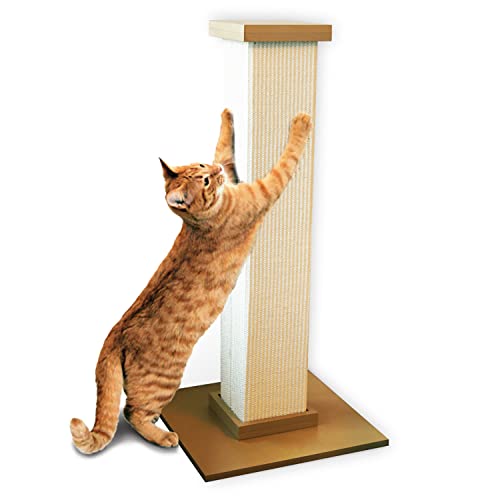 Before the couch decides
SmartCat Pioneer Pet Ultimate Scratching Post, 32"
Tall enough for a full vertical stretch, sisal-wrapped, and heavy enough that it doesn’t tip mid-scratch — the three things the $25 posts get wrong. Around $70, and it outlives several cheap ones.
Check price on Amazon The bonding tool
GoCat Da Bird Wand
The wand that moves like prey, which is why it keeps showing up in owner threads as the toy that always works. Around $21. One of these beats a basket of fuzzy mice.
Check price on Amazon The spot the cat owns
Petmate Aspen Self-Warming Bed
Reflects body heat with no cord — safe to leave in the sanctuary room unsupervised from day one, and floor-level for seniors. Around $18.
Check price on AmazonThe first 72 hours: hiding, not eating, and day-one regret
Hiding is normal, and it can last longer than you think. The two most common first-week posts are some version of “she got out of the carrier and teleported underneath the dresser” and, a week in, “he tolerates occasional petting … but he continues to hide from us.” Neither cat hates anyone. Days of hiding is standard; weeks is common for shy adults. Your job is boring: keep the room quiet, sit on the floor at the cat’s level without reaching, let meals do the introductions.
Set your expectations in months, not days. The best-case story this month was an owner whose terrified shelter cat took two months to allow a touch and five to become a lap cat — “After two months she allowed me to carefully touch her as she was rubbing against my legs.” That’s not a failed adoption; that’s how trust is built with a cat that starts scared.
Day-one regret is so common it has its own thread genre. “I was fine and then I got hit with massive regret and anxiety about it” — posted the day after adopting, by someone whose setup was complete. It has a name (the adoption blues), it peaks in the first week, and it fades as the routine forms. Knowing it’s coming is most of the cure.
The one real red flag is food. A cat that hides but eats is settling in; a cat that won’t eat is a problem. Call the vet if an adult cat goes much past 24–48 hours without eating — cats metabolize body fat badly, and a fasting cat can slide into liver trouble (hepatic lipidosis) surprisingly fast. For a kitten, don’t wait a full day. This is the reason the shelter’s familiar food is on the checklist: one less reason to refuse a meal.
A biting kitten is playing, not failing to bond. The owner struggling with a 10-week-old that bites every hand has a play-redirection problem, not a broken kitten: hands stop being toys the day a wand becomes the toy. And one specific note that comes up more than you’d expect: if you’ve adopted a white cat, especially blue-eyed, and she doesn’t react to your voice, she may simply be deaf — congenital deafness is disproportionately common in white cats. One new owner discovered exactly this; deaf cats do fine indoors, you just switch to floor stomps and light signals instead of calling.
Budget for the vet before the gear. The saddest threads in any adoption forum are owners surrendering a young cat over a treatment bill. Before you spend $250 on the kit, know where $500–1,000 would come from if the first-month vet visit finds something — that cushion is more important than anything in the cart.
If the cat found you first
A steady share of first cats aren’t chosen — they show up. A stray adopts your porch, your dog walks one home, your kids are already naming it. The sequence gains two steps and otherwise stays the same: first, a vet or shelter scans for a microchip (free, five minutes) — a friendly, healthy cat is often someone’s indoor-outdoor cat, and keeping it is a bad surprise for a family three streets over. Second, post in local lost-pet groups and give it a few days. If nobody claims the cat, congratulations: sanctuary room, checklist, vet visit for vaccines and a health check, and you’re a cat owner by the normal route from here.
The December asterisk: lilies, tinsel, and ribbon
A lot of first cats arrive in December, which is also the month homes fill with the three things most dangerous to them. Lilies are the non-negotiable one: every part of a true lily — petals, leaves, even pollen dusted on fur — can cause fatal kidney failure in cats, and holiday bouquets and centerpieces are full of them. No lilies in a cat household, full stop. Tinsel and ribbon are the surgical ones: cats eat them, and a swallowed string becomes a linear foreign body that saws through intestine — curling ribbon on gifts is the classic offender. The ASPCA’s holiday safety list covers the longer tail (poinsettias are overrated as a danger; chocolate, alcohol, and a climbable tree are not). If your new cat arrives with the decorations, keep the sanctuary room running until the decorations leave.
Where to go next
This page is the map; the depth lives on the pages it points to.
- Water: the easy-to-clean fountain roundup — ranked by what stays clean, because that’s what decides whether a fountain survives in your house — and how to clean one when you get there.
- Litter: the box-scoop-mat system, and what to do when the box smells despite doing everything right.
- Feeding: automatic feeders for the 9-to-5 schedule.
- Play: the interactive toys guide, including the night-routine section for the cat that won’t let you sleep.
- Thinking about an automatic litter box? Not a first-week purchase — but the worth-it math has a calculator for when the novelty of scooping wears off.
- Adding a second cat later: the introduction guide, written for exactly that project.
First-cat questions, answered plainly
How much does a first-cat setup cost?
Plan on $100–250 for the full kit: carrier, litter box and litter, scratching post, a wand toy, bowls or a fountain, and a bed. The adoption fee itself usually runs $50–200 and typically includes spay/neuter and first vaccines, which is several hundred dollars of vet work — adopting is genuinely the cheap route. The real budget line most people skip is a vet cushion for the first-month checkup and surprises.
Should a first-time owner get one cat or two?
Two kittens from the same litter: an easy yes if you can afford double food and boxes — they entertain each other. Two unrelated adults: no, that is an advanced project. One adult cat: a perfectly good answer, especially for a 9-to-5 household, and feeling like two would be overwhelming is itself a good reason to start with one.
How long will a new cat hide?
Days is typical, weeks is normal for shy adults, and a couple of months to full confidence is not a failed adoption. Hiding with confident eating is settling in on schedule. Don’t pull the cat out of hiding spots; let food, routine, and floor-level sitting do the work.
What do I actually need on day one?
Carrier, litter box, litter, the food the shelter was feeding, a water bowl, one closed room, and a hiding spot — a cardboard box works. Everything else, including the fountain, the feeder, and the tower, can arrive in week two. The scratching post is the one thing worth having on day one, before the sofa gets claimed.
When should I worry that my new cat isn’t eating?
An adult cat that refuses food for more than 24–48 hours needs a vet call, not more patience — cats can develop liver problems from fasting faster than dogs or people. For a kitten, call within 24 hours. Keep feeding whatever the shelter fed to remove one variable, and offer meals near the hiding spot without hovering.
Is a senior cat a bad choice for a first-time owner?
Usually the opposite. A senior’s personality is fully known, the energy demands are low, and they’re routinely passed over at shelters. Adjust the gear, not the expectations: a low-entry litter box, floor-level beds with warmth, and no need for a 60-inch tower. Budget-wise, assume more frequent vet checkups than a young adult would need.