Introducing a New Cat: The Gear That Buys Time, and What It Can’t Fix
Most failed cat introductions fail on speed, not on the cats. The gear — a real barrier, a pheromone diffuser used honestly, a camera, a feeder that can’t be bullied — exists to slow everything down and lower the stakes. What each piece actually does, matched to a cat-vs-cat or cat-vs-dog household.
Some links below are affiliate links. If you buy through them, MeowTested may earn a small commission at no extra cost to you, including as an Amazon Associate, where we earn from qualifying purchases, and as a partner of Whisker, the maker of Litter-Robot. We only recommend products that pass our Fit Analysis — and we publish the ones that don't.
A cat introduction is a construction project, and almost everyone starts demolition too early. The pattern in this fall's advice threads is the same one shelters describe: the new cat comes out of the carrier into the whole house within a day or two, there's a bad first meeting, and then the household spends weeks trying to un-ring that bell — one owner a month into a stalled kitten introduction was already wondering if she'd ruined her resident cat's life.
Gear can't do the introduction for you, but it does three jobs well. A real barrier makes slow possible: for cat-vs-cat that means a 60-inch gate with no pet door or a screen door, because a standard gate with a cat flap is a revolving door; the flap version — like the Carlson 36" walk-through — is strictly a cat-vs-dog tool. A pheromone diffuser lowers the ambient temperature — it's an aid, around $25 to start, and the multi-cat homes in the threads are blunt that it is not a cure. And a cheap camera like the Petcube Cam 360 tells you the truth about what happens when you leave, which is how one three-cat household discovered their “settled” introduction was actually all-day harassment.
The honest part: if blood has been drawn, gear is no longer the conversation — that's a vet visit (pain makes cats aggressive) and a behaviorist. More on both below.

Why introductions go wrong (it’s almost never the cats)
Read enough introduction threads and a shape emerges. It is rarely two incompatible animals. It is speed.
Cats negotiate territory through scent and routine, on a timescale of weeks. Humans negotiate through introductions, on a timescale of minutes. When the two clash, you get this fall's crop of threads: a resident cat who stopped being herself after a kitten arrived; a newly adopted two-year-old who slipped past a screen door and went straight for a toothless 13-year-old resident; a three-cat home two years into a cold war; a couple merging two cats with two cats; and households adding a cat to a dog's home, or the reverse, in both directions.
Two things stand out across all of them. First, the households that recovered did it by going backwards — re-separating completely and restarting as if the cats had never met. A bad first impression isn't permanent, but it does reset the clock. Second, the single most common point of failure is a barrier that wasn't really a barrier: a door opened “just for a second,” a gate a cat could clear, a screen not latched. The gear on this page exists mostly to remove that failure point.
One expectation-setting note, because the month-in despair in that first thread is so common: shelter behavior teams talk about introductions in terms of weeks to months, with seniors, under-socialized adults, and multi-cat merges at the long end. A month in with no bloodshed and some tolerance at a distance isn't failure. It's roughly on schedule.
The setup: base camp first, barrier second
The method is the same whether the resident is a cat or a dog; only the barrier changes (next section).
1. Base camp. The new cat gets one room — door closed, litter box, food, water, hiding spots, something that smells like them. This is home for days at minimum, often a week or two. The new cat decompresses; the resident learns there's someone behind the door without having to do anything about it.
2. Scent before sight. Swap bedding between the cats every day or two. Feed both sides of the closed door, far enough back that eating stays relaxed, moving the bowls closer over several days. The goal is a simple association: that smell means dinner, not danger.
3. Sight without contact. This is where the barrier earns its price. Crack the door against a latch, or better, swap the door for a tall gate or screen so the cats can see each other with zero chance of contact. Keep sessions short and end them on a calm note — a treat, a wand toy, lights out.
4. Supervised time, then boring normalcy. When barrier sessions are reliably boring, graduate to short shared sessions with the barrier open and an exit route for everyone. Escalation means going back a step, not pushing through. The finish line isn't friendship; it's two cats who can share a house without either one organizing their day around the other.
The steps are simple. What makes them work is that nobody skips one — which, in a busy household with a door that has to open sometimes, is exactly what gear is for.
Match the gear to the household
| The job | Household | Rough price | |
|---|---|---|---|
| 60" gate, no pet door | Sight without contact, cat-proof height | Cat vs cat | around $115 |
| Carlson 36" gate with cat flap | Cat-only escape routes past the dog | Cat vs dog only | around $50 |
| FELIWAY MultiCat diffuser | Lowers ambient tension; an aid, not a fix | Either | around $25 + refills |
| Petcube Cam 360 | See what actually happens when you leave | Either | around $35 |
| Furbo 360° Cat Camera | Premium cam: tracking, treat toss, no subscription | Either | around $140 |
| SureFeed microchip feeder | Ends food guarding — one cat’s bowl, enforced | Multi-pet | around $170 |
| Vet + behaviorist | Anything involving blood or injury | Either | varies |
The barrier question: cat-vs-cat is not cat-vs-dog
This is the most common gear mistake in the threads, so it gets its own section.
Cat vs dog: a gate with a cat flap is the right tool. The Carlson 36" extra-tall walk-through is the standard version — a sturdy metal gate the dog can't pass, with a small pet door the cat can. It gives the cat what behaviorists actually prescribe for cat-dog households: guaranteed dog-free territory and an escape route that doesn't require outrunning anyone. The kitten-meets-senior-Shih-Tzu and stray-meets-resident-dog households are exactly who it's for. Around $50.
Cat vs cat: that same gate is a revolving door. The new cat goes through the flap; the resident goes over the top. For cat-to-cat introductions the barrier has to be tall enough that neither cat clears it and solid enough that neither goes through it — which in practice means a 60-inch gate with no flap (the retractable mesh versions run around $115; worth it for a doorway you use constantly) or the community's budget answer, a cheap screen door mounted in the base-camp doorway. The screen gives full-time visibility with zero contact and costs about $40 at a hardware store.
Two honest caveats from the threads. A sufficiently motivated cat can defeat mesh — climbing or bulldozing — so treat any gate as a supervision tool, not a substitute for a closed door when you're out. And latch discipline matters more than the barrier itself: the worst incident in this cycle happened in the seconds a screen door stood open.
Pheromone diffusers: an aid, not a fix
Pheromone diffusers are the most recommended and most oversold product in any introduction thread, so here is the calibrated version.
They plug into an outlet and release a synthetic version of feline facial pheromones — the “this place is safe” scent cats leave when they rub their cheeks on furniture. FELIWAY MultiCat mimics the mother-cat appeasing pheromone and is the one aimed specifically at tension *between* cats, which makes it the default for introductions; FELIWAY Optimum is the newer general-stress blend, the better pick when the problem is one anxious cat rather than a feud. Run one in each cat's main room starting about a week before the new cat arrives. Around $25–30 to start, and budget for refills — a kit covers roughly a month.
The honest framing: the evidence (and the thread record) says *aid*, not *fix*. Plenty of owners report visibly softer body language; an eight-cat household in this cycle ran multiple diffusers alongside ten litter boxes and segregated rooms and still ended up rehoming two cats. A diffuser lowers the temperature a few degrees. It does not renegotiate territory, and at roughly $25 a month it's worth deciding within a couple of refills whether it's earning its outlet.
One distinction worth making, because the plug-in format invites confusion: a pheromone diffuser is not an air freshener, and air fresheners are not neutral. In our own two-cat household, an ordinary plug-in scent diffuser turned out to be quietly stressing one of our cats — removing it was part of what finally resolved her litter box avoidance. During an introduction, when everyone's stress budget is already spent, strong artificial fragrance is a cost. Unscented home, pheromones only.
A camera answers the question you can’t be home for
Every introduction eventually reaches the same cliff: the cats seem fine supervised, and you need to leave for work. The gap between “seems fine when I'm watching” and “is fine” is where introductions quietly fail — and it's invisible without a camera.
The three-cat household in this cycle is the case study: things looked settled until the owner checked the home cameras and found the resident cat being harassed all day — blocked from the litter box, blocked from food — while every human was out. That's not a detail. Unseen resource-blocking is how a “completed” introduction turns into outside-the-box accidents, hiding, and weight loss months later, with nobody able to say why.
What to actually watch for on the feed: one cat stationing itself near the litter box or food bowl, doorway ambushes, a cat who only moves through the house when the other is asleep, and chase sequences that only run one direction. Any of those means the introduction isn't done, whatever it looks like at 7pm.
The budget answer is the Petcube Cam 360 — around $35, pans the whole room, and one pointed at the litter box area plus one at the feeding area covers the two flashpoints. The premium pick is the Furbo 360° Cat Camera (the no-subscription version), around $140 — auto-tracking, color night vision, two-way audio and a treat tosser, and it's the one we already recommend in our leaving-a-cat-alone guide. For a straight surveillance job during an introduction, the $35 answer is genuinely enough.
Guarded resources: the feeder, the boxes, the map
Most post-introduction misery is resource competition wearing a costume, and it responds to logistics better than to time.
Food. If one cat bullies the other off a bowl — or just steadily eats both portions — the fix that doesn't require training anyone is the SureFeed Microchip Feeder: it reads a cat's microchip and only opens for its owner. Around $170, which stings until you price repeated vet visits for the cat who's being starved or the one doubling in size. It's the same unit we recommend in our automatic feeder guide. Worth saying plainly: it fixes *food* guarding only — a feeder can't stop litter box guarding.
Litter. The rule shelters use is boxes = cats + 1, and during an introduction the *map* matters as much as the count: boxes in different rooms, at least one per cat's core territory, none in a dead-end a bully can camp. A cat who has to cross the new cat's territory to pee will eventually stop making the trip — our litter box smell guide covers placement in more depth.
Territory. Add vertical space — trees, shelves, window perches — so the cats can share a room without sharing a floor. Height lets a nervous cat observe instead of hide, and two cats three feet apart vertically are, as far as they're concerned, in different rooms.
If a fight has drawn blood, the next purchase is not a gate. First a vet visit for the aggressor as well as the victim — pain and illness are behind a surprising share of sudden aggression, especially toward a new animal. Then a certified cat behaviorist (IAABC is the credential to look for); a few hundred dollars of professional eyes on your actual layout routinely beats another thousand in gear. And if months of honest work have produced two animals who are both miserable, rehoming one — ideally through the rescue you adopted from — is not failure. The hardest threads this fall are the ones where everyone can see it’s the kind option and nobody wants to say it first.
The introduction kit, priced
As an Amazon Associate, MeowTested earns from qualifying purchases. Prices move — treat these as bands and check current pricing.
The default aidFELIWAY MultiCat Diffuser Kit
The multi-cat-tension formula — start it a week before arrival, one per main room. An aid that lowers tension, never a fix on its own. Around $25 to start, refills ongoing.
Check price on Amazon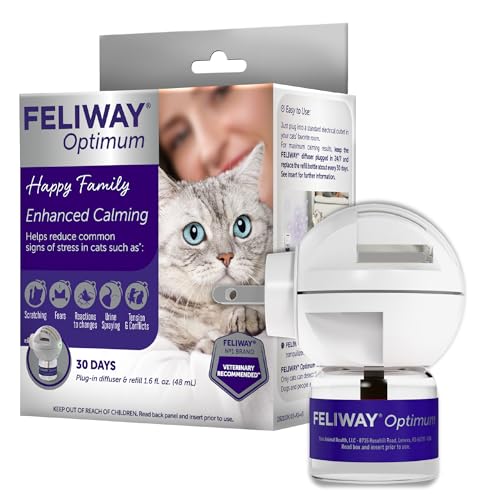 For one anxious cat
FELIWAY Optimum Diffuser Kit
The newer general-stress blend — the better pick when the problem is a single stressed cat rather than tension between two. Around $30.
Check price on Amazon Cat-vs-cat barrier
Reinforced 60" cat gate (no pet door)
Tall enough that neither cat clears it, no flap to walk through, retracts out of the doorway when off duty. Supervision tool, not a substitute for a closed door. Around $115.
Check price on Amazon Cat-vs-dog only
Carlson 36" gate with small pet door
The cat flap gives the cat dog-free territory and an escape route — and defeats the purpose entirely in a cat-to-cat introduction. Around $50.
Check price on Amazon The $35 truth-teller
Petcube Cam 360
Pan-tilt coverage of a whole room. One on the litter area, one on the feeding area, and you know what actually happens while you’re out. Around $35.
Check price on Amazon Premium cam
Furbo 360° Cat Camera (no subscription)
Auto-tracking, color night vision, two-way audio, treat toss — the no-ongoing-cost version. Around $140.
Check price on Amazon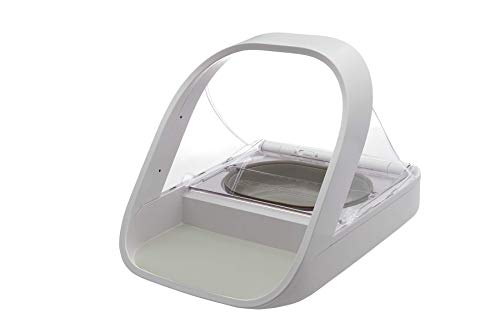 Ends food guarding
SureFeed Microchip Pet Feeder
Opens only for the chipped cat it belongs to. The no-training fix for a bullied eater or a food thief in a multi-pet home. Around $170.
Check price on AmazonIntroducing a new cat: FAQ
How long does it take to introduce a new cat?
Weeks to months, and the range is honest: a confident kitten meeting an easygoing adult can settle in two or three weeks, while a senior resident, an under-socialized adult, or a multi-cat merge can take several months. Progress is measured in boring barrier sessions and relaxed eating, not in cuddling. A month in with no injuries and wary tolerance is on schedule, not failing.
Do pheromone diffusers actually work for introductions?
As an aid, yes for many households — softer body language, less ambient tension. As a fix, no. Multi-cat homes in the advice threads have run several diffusers through failed introductions; the diffuser lowers the temperature, it doesn’t renegotiate territory. Use the multi-cat formula, start it a week early, and pair it with a real barrier and slow steps rather than expecting it to carry the introduction.
Can I use a regular baby gate to separate cats?
For cat-vs-dog, yes — ideally one with a small cat door, so the cat gets dog-free territory and an escape route. For cat-vs-cat, a standard-height gate fails twice: most cats clear 36 inches easily, and a cat flap is just a doorway. Cat-to-cat barriers need to be around 60 inches with no flap, or use a screen door, so the cats can see each other without any chance of contact.
Should I just let the cats fight it out?
No. “They’ll work it out” works for minor posturing — hissing, swatting, growling at a distance — which is normal negotiation. Actual fights, with blood, torn fur, or one cat persistently stalking the other, make the relationship worse every time they happen, and each bad fight resets the introduction further back. Separate, restart the slow process, and if blood has been drawn, involve a vet and a behaviorist.
How many litter boxes do I need with two cats?
Three — the shelter rule is one per cat plus one. Placement matters as much as count during an introduction: spread them across rooms so each cat has a box inside its own comfortable territory, and avoid dead-end spots where one cat can camp and block access. Litter box guarding is one of the most common invisible failure modes, and a camera is often how owners discover it.
When should I give up and rehome?
After honest work, not instead of it: a proper restart with full separation, a slow reintroduction over months, a vet check to rule out pain-driven aggression, and ideally a session with a certified behaviorist. If after all that both animals are still chronically stressed — living in shifts, one cat hiding its life away — rehoming one through your rescue or shelter is a humane outcome, and the people who’ve been through it consistently say they waited too long, not too little.