Best Automatic Cat Feeders (2026): Fire Yourself as the Food Dispenser
The cat waking you at 5 a.m. is not broken, and neither are you — you are just the most reliable food dispenser in the house. Which timed feeders actually hold a schedule, what the portion settings really mean, and the one feeder that solves multi-cat food theft.
Some links below are affiliate links. If you buy through them, MeowTested may earn a small commission at no extra cost to you, including as an Amazon Associate, where we earn from qualifying purchases, and as a partner of Whisker, the maker of Litter-Robot. We only recommend products that pass our Fit Analysis — and we publish the ones that don't.
An automatic feeder does two jobs, and the second one is the reason to buy it. The obvious job is dispensing measured meals on a schedule. The quieter job is breaking the association between *you* and *food* — which is the actual fix for the cat who stands on your chest at 5 a.m., because a cat cannot negotiate with a machine that opens at the same minute no matter how loudly it yells.
For most homes, the PETLIBRO Granary WiFi (5L) is the buy. Up to 10 scheduled meals a day, a sealed hopper that keeps kibble from going stale, a low-food sensor, and an app for adjusting the schedule without re-learning button combinations every time. It handles any feeding cadence a vet is likely to recommend.
If you would rather skip the app entirely, the button-programmed Granary does the core job for less — six meals a day, the same sealed-hopper design, no Wi-Fi dependency at all.
Multi-cat homes with a food thief need a different machine entirely. A scheduled feeder cannot stop the wrong cat from eating the meal; the SureFeed Microchip Feeder opens only for the registered cat's microchip, which is the only honest answer when one cat is on a prescription diet or one cat is stealing the other's dinner.
And know what a feeder cannot do: it will not fix a cat who wakes you for attention rather than food, it will not portion wet food through a hopper, and it will not stop overfeeding if nobody ever weighs what "3 portions" actually dispenses.

The 5 a.m. cat is a feeder problem wearing a behavior costume
The threads on r/CatAdvice this month read like a support group. One owner has not slept in their own bed in two years because of pre-dawn demands; another describes a kitten "driving me crazy at night". The pattern underneath both is the same and it is not mysterious.
Cats are crepuscular — wired to hunt at dawn and dusk — and somewhere along the way your cat ran the experiment and confirmed the result: *waking the human produces breakfast.* Every groggy 5 a.m. scoop of kibble is a reinforcement, and cats are patient scientists. You cannot out-stubborn this by ignoring it occasionally, because intermittent reinforcement is the strongest kind — ask any casino.
What a scheduled feeder changes is the target of the behavior. When breakfast reliably appears from a machine at 5:30 a.m. whether or not any human is awake, the cat's dawn energy redirects from your face to the feeder. Owners consistently report the cat starts waiting by the machine instead. Two honest caveats, because this is a behavior change, not a light switch: it typically takes a couple of weeks, and things often get briefly *worse* before better — the cat escalates the old strategy before abandoning it. Hold the line. If you feed the last meal of the evening late — right before your own bedtime, ideally after a play session — you stack the deck further, because a cat that has "hunted" and eaten is running its natural wind-down sequence.
The one case a feeder will not fix: the cat who wakes you for attention, warmth, or door service rather than food. If your cat ignores a full bowl at 5 a.m. and yells anyway, the machine solves nothing — that cat needs its energy budget spent, which is a job for enrichment, not hardware.
How automatic feeders actually differ
The category looks crowded, but nearly everything on the market is one of three machines.
Hopper feeders — the PETLIBRO Granary family, the PetSafe units, and a hundred lookalikes — store dry food in a reservoir and dispense it through a rotor in fixed increments called "portions." This is the right machine for scheduled dry-food meals, and the details that separate a good one from a frustrating one are unglamorous: how well the hopper seals (stale kibble is the most common complaint in the category), whether there is a low-food warning before the machine runs empty on day two of your weekend away, and whether the schedule survives a power blip. Note what the design implies: hopper feeders are for dry food only. Kibble shape matters too at the extremes — very large or oddly shaped pieces can bridge inside a dispensing rotor, which is worth checking against the manufacturer's stated kibble-size range if you feed an unusual formula.
App-controlled versus button-programmed is a real fork, not a gimmick tax. The app models (the Granary WiFi among them) let you adjust tonight's schedule from the couch, see feeding logs, and get low-food alerts on your phone. The button models make you program at the machine, and in exchange they have no Wi-Fi dependency, no account, and nothing to stop working if the manufacturer's cloud has a bad day. On PETLIBRO's listings the schedule runs on the device itself once set, so a router reboot does not skip a meal on either type — but if you distrust app ecosystems on principle, the button Granary gives up very little.
Portion granularity is the spec that actually matters for cats. A "portion" on these machines is a small fixed scoop — useful because cats do better on several small meals than one or two large ones, which loosely mimics how they would eat as hunters. A machine that can schedule 6 to 12 small meals lets you split the same daily ration into a cadence that keeps the cat occupied and the begging suppressed. The PetSafe Healthy Pet Simply Feed goes one further with a slow-feed mode that trickles a meal out over about 15 minutes — the honest answer for the cat who inhales dinner and deposits it on the rug four minutes later.
Multi-cat homes: the schedule is not the problem, the thief is
Every scheduled feeder shares one blind spot: it controls *when* food appears, not *who eats it*. In a one-cat home that distinction never comes up. In a two-cat home it is usually the entire problem — the resident vacuum cleaner finishes their own bowl and then the other cat's, and the shy cat, the senior, or the cat on prescription food quietly loses out.
There are two different fixes for two different situations. If both cats eat the same food on the same schedule and just need *separate stations*, the dual-tray Granary splits each scheduled meal into two stainless bowls from one hopper — cheap, simple, and enough when neither cat is a committed thief.
If one cat genuinely must not eat the other's food — a prescription diet, a weight-management plan, or plain relentless theft — the only machine that actually enforces the rule is the SureFeed Microchip Feeder. Its lid opens only when the registered cat's implanted microchip (or a collar tag) is at the bowl and closes when the cat leaves. It works with wet or dry food, and because the bowl sits under a sealed cover between visits, wet food stays presentable for hours rather than minutes. The tradeoffs, stated plainly: it is a gated bowl, not a scheduled dispenser — it will not portion out meals over the day — and it costs several times what a basic hopper feeder does. Some households end up running one of each: a scheduled hopper for the free-feeding cat, a microchip bowl for the one on a diet.
Which feeder for which situation
| Your situation | What to get | Why |
|---|---|---|
| One cat, dry food, and a 5 a.m. problem | PETLIBRO Granary WiFi 5L | Up to 10 scheduled meals a day, sealed hopper, low-food sensor, app control for schedule tweaks. The default answer. |
| Same job, no apps in the house | PETLIBRO Granary, button model | Six meals a day programmed at the machine, same sealed hopper and low-food sensor, zero Wi-Fi dependency. |
| Two cats, same food, need separate stations | PETLIBRO dual-tray Granary | One hopper, a splitter, and two stainless bowls, so a scheduled meal lands in two places at once. |
| A cat who inhales food and throws it back up | PetSafe Healthy Pet Simply Feed | Slow-feed mode dispenses a meal gradually over about 15 minutes; schedules up to 12 meals with portions from 1/8 cup. |
| One cat must not eat the other's food | SureFeed Microchip Feeder | Opens only for the registered cat's microchip. The only machine here that controls who eats, not just when. |
| The cat wakes you but ignores food | Not a feeder problem | That cat wants attention or play, not breakfast. Start with our enrichment guide instead. |
What we would buy
Selected on published specifications, listing details, and the category tradeoffs described above. MeowTested has not bench-tested automatic feeders and claims no measurements of our own; dimensions and capacities are manufacturer figures pulled from Amazon product data, verified the day this was published. Prices move constantly, so we do not quote them.
Start herePETLIBRO Granary WiFi (5L)
The default answer for one cat on dry food. A sealed 5-liter hopper with freshness preservation, up to 10 scheduled meals a day, a low-food sensor, and app control with feeding logs. The schedule lives on the device once set, so a flaky router does not skip breakfast. Listed at 13.4 x 7.5 x 7.5 inches and 4.4 lb.
Check price on Amazon Best value
PETLIBRO Granary (button model)
The same sealed-hopper design programmed with buttons instead of an app: up to six meals a day, a low-food sensor, and no account, cloud, or Wi-Fi anywhere in the loop. What you give up is remote schedule changes and phone alerts; what you keep is everything that matters at 5:30 a.m. Listed at 13.6 x 7.5 x 7.5 inches and 4.4 lb.
Check price on Amazon Two bowls, one schedule
PETLIBRO Dual-Tray Granary (2 cats)
One 5-liter hopper feeding two stainless bowls through a splitter, with up to six meals a day and a 10-second recorded meal call. The right tool when two cats eat the same food at the same times and just need their own stations — and the wrong one when one cat steals, because nothing stops a determined thief from visiting both bowls. Listed at 14.2 x 10.2 x 7.7 inches and 5 lb.
Check price on Amazon For the food inhaler
PetSafe Healthy Pet Simply Feed
The scarf-and-barf specialist. Schedules up to 12 meals a day with portions from 1/8 cup to 4 cups, and its slow-feed mode dispenses a meal over roughly 15 minutes so a gulper physically cannot inhale it. Battery operated, with a 24-cup hopper that is more capacity than most single cats need — which is exactly the point for longer weekends away. Listed at 18.5 x 8.7 x 12.4 inches and 4.6 lb.
Check price on Amazon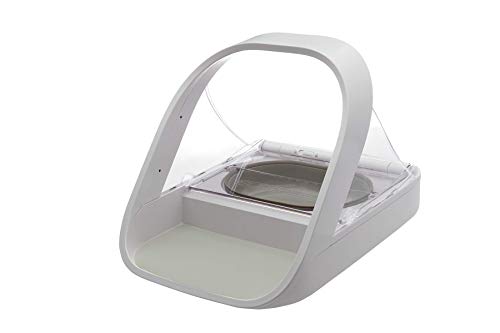 Multi-cat referee
SureFeed Microchip Pet Feeder
The machine that controls who eats. The lid opens only for the registered cat's implanted microchip or included collar tag, then closes behind them — food theft simply ends. Takes wet or dry food, and the sealed cover keeps a wet meal presentable far longer than an open bowl. It is a gated bowl rather than a scheduled dispenser, and it costs accordingly; buy it for prescription diets, weight management, or a bullied slow eater, not for scheduling. Listed at 12.9 x 7.8 x 10.2 inches and 3.3 lb.
Check price on AmazonWeigh what a "portion" actually is before you trust the schedule. Every hopper feeder dispenses in its own fixed increments, and the same portion count delivers a different weight of food depending on your kibble's size and density. The five-minute fix: run one day's schedule into a bowl, weigh it on a kitchen scale, and compare against the feeding guide for your cat's target weight — then check it again whenever you change foods. An automatic feeder automates whatever you told it, including overfeeding, and a cat gaining silent ounces on a perfectly kept schedule is the category's quietest failure mode.
Frequently Asked Questions
Will an automatic feeder actually stop my cat waking me at 5 a.m.?
If the waking is about food, usually yes — but expect two to three weeks, and expect it to get briefly worse before it gets better, because the cat will escalate the old strategy before giving up on it. Schedule the first meal at or slightly before the usual wake-up time, never respond to the yelling with food yourself, and move the feeder away from the bedroom so the anticipation happens somewhere else. If the cat ignores a fresh meal and keeps yelling at you anyway, food was never the motive and the fix is play and enrichment, not hardware.
Can I use wet food in an automatic feeder?
Not in a hopper feeder — augers and rotors are built for dry kibble only. The SureFeed's sealed bowl keeps a wet meal fresh enough for a normal mealtime rhythm, and refrigerated wet-food dispensers exist as a category, but for scheduled multi-meal wet feeding over a full workday there is no great answer at a sane price. Most households land on scheduled dry meals from a hopper plus wet food served in person — which has the side benefit of keeping one positive food association attached to you.
What happens when the power or Wi-Fi goes out?
Check both halves separately, because they fail differently. Wi-Fi: on the models here, the schedule runs on the device itself once set, so losing internet costs you the app and alerts, not the meals. Power: the PetSafe runs on batteries outright, and PETLIBRO's units are designed to take backup batteries alongside the adapter — confirm the current listing's wording before you rely on it for a week away. For any feeder, the honest safeguard for longer absences is the same one it has always been: a human who checks in every day or two.
How many meals a day should the feeder dispense?
More, smaller meals beat one or two big ones for most indoor cats — several small feedings loosely mimic natural hunting rhythm, keep the begging window short, and smooth out the energy spikes. Four to six small meals is a common pattern the machines here handle easily. The total daily amount matters far more than the count, though, and that number should come from your vet and your cat's target weight, not from the feeder's defaults or the bag's most generous column.
Won't my cat just break into the hopper?
The sealed-lid designs here hold up to casual crime — the lids latch and the dispensing paths are baffled so a paw cannot fish kibble out. A genuinely determined cat with unsupervised time can defeat almost anything lightweight, so the practical answers are placement (against a wall, not on a counter edge where the whole unit can be shoved off) and boredom management. A cat with nothing else to do will treat the feeder as the day's puzzle — our guide to keeping a cat busy has cheaper puzzles.
Where this fits in the bigger routine
A feeder buys back your mornings, but it works best as one piece of a routine that gives the cat's day some structure. If your cat is alone through the workday, the feeder's midday meal pairs naturally with the ideas in how to entertain a cat while you're at work — a scheduled feed is an event in an otherwise empty afternoon. For trips, a feeder extends how long a cat can comfortably manage, but it does not replace a human: our guide to leaving a cat alone while traveling covers where that line sits. And since more scheduled dry food means more thirst, a cat drinking enough matters more, not less — the case for a fountain your cat will actually use is the same case as the feeder: machines are more reliable than memory.
None of this is complicated. Decide the daily ration with your vet, split it into small scheduled meals, weigh what the machine actually dispenses once, and stop being the button your cat presses at 5 a.m.