Low-Arousal Cat Enrichment: What Works When Chasing Is Off the Table
Two very different owners end up needing the same shelf: the one whose vet has restricted their cat's activity, and the one who owns three cat trees, a laser, four wands and a tunnel and still has a bored cat. Neither problem is solved by another chase toy.
Some links below are affiliate links. If you buy through them, MeowTested may earn a small commission at no extra cost to you, including as an Amazon Associate, where we earn from qualifying purchases, and as a partner of Whisker, the maker of Litter-Robot. We only recommend products that pass our Fit Analysis — and we publish the ones that don't.
Play is one kind of enrichment. It is not the only kind, and it is the only kind most cat toy shelves sell. A cat's day in the wild is mostly not chasing: it is patrolling, sniffing, watching, and working out where food is. Those four things are all available to a cat lying completely still, and they are the ones people skip.
The three levers that work without a heart rate going up:
- Scent. The most underused and the best supported. In a study of 100 cats, 79% responded to silver vine against 68% to catnip, and of the cats that did not respond to catnip at all, roughly three quarters still responded to silver vine. If catnip does nothing for your cat, that is a fact about catnip, not about your cat
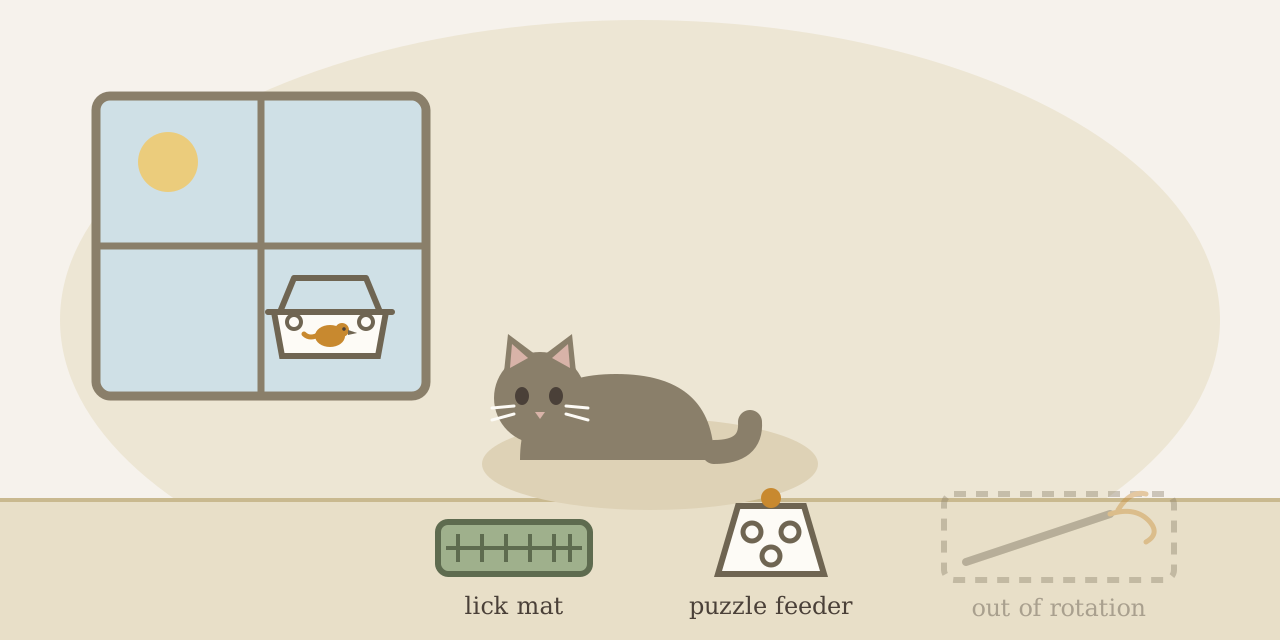
- Foraging. Make the food they already get take longer to obtain. A lick mat or a puzzle feeder turns a thirty-second meal into ten or twenty minutes of work, at zero extra calories
- Observation. A window feeder stuck to the glass is the single highest-value square foot in an indoor cat's house, and it is watched from a sitting position
And the free one that matters most: rotate. If your cat owns twenty toys and is bored of all twenty, the problem is that all twenty are permanently available. Novelty is the active ingredient in most enrichment, and leaving everything out burns it. Put two thirds in a box, bring three things out at a time, swap weekly. This costs nothing and it is why the twenty-first toy will not work either.
If a vet has restricted your cat's activity, everything on this page is designed to be usable from a resting position, but your vet sets the limits, not us. Ask them specifically what is allowed before you introduce anything, including scent items, which do produce a brief burst of rolling and rubbing in responsive cats.
MeowTested has not bench-tested any of this. What follows is published research where it exists, mechanism where it does not, and product specifications from manufacturers and Amazon listing data.
Why the toy shelf stopped working
Two situations bring people to this question and they look nothing alike from the outside.
The first is a cat that has been told to slow down. A vet puts a cat on restricted activity, sometimes for months, sometimes longer, and every piece of enrichment advice on the internet suddenly becomes unusable, because it is all wands and lasers and chase. The owner is not looking for a gentler toy. They are looking for a completely different category, and almost nobody writes it.
The second is a cat that owns everything. Three cat trees, a window shelf, wands, tunnels, a laser, treat puzzles, catnip toys, cat TV, an outdoor pop-up tent. And the cat is still bored, and everything new holds attention for a day. This owner does not need a recommendation. They need to be told that buying is not the lever any more.
Both end up in the same place, because the thing missing from both houses is the same thing: enrichment that is not predation.
A cat's natural day is often described as a hunting cycle, and the toy industry has taken that and sold the exciting part of it. But the actual budget of a free-ranging cat's waking hours goes mostly on patrolling territory, investigating scent, and observing. Hunting is short, intense, and rare. A house that offers only the intense part is offering a cat a narrow slice of what its brain is set up to do, and offering it in ever-increasing quantities does not fix the gap.
Which lever for which cat
| Your situation | Start with | Why it fits |
|---|---|---|
| Vet has restricted activity | Scent rotation and lick mats | Both work entirely from a resting position; check with your vet first |
| Owns everything, bored of everything | Rotation, before buying anything | Novelty is the active ingredient and permanent availability burns it |
| Bored while you are at work | Window feeder and a puzzle feeder | Both run for hours without you |
| Eats a meal in thirty seconds | Puzzle feeder or scatter feeding | Same food, same calories, ten times the duration |
| Catnip does nothing for them | Silver vine | About three quarters of catnip non-responders respond to it |
| Elderly or arthritic | Ground-level foraging and scent | No jumping, no sprinting, no landing impact |
| Destructive rather than bored | Read the routine section first | Scratching and chewing are often outlet problems, not toy problems |
Scent: the lever with actual evidence behind it
This is the most neglected category in the entire cat aisle, and it is the one with the best published support.
The study worth knowing. A 2017 paper in BMC Veterinary Research tested catnip, silver vine, Tatarian honeysuckle and valerian root on 100 domestic cats aged six months and over. The response rates were 79% to silver vine, 68% to catnip, 53% to Tatarian honeysuckle and 47% to valerian. About one cat in three did not respond to catnip at all, and of those non-responders, close to three quarters still responded to silver vine and roughly one in three to Tatarian honeysuckle. Males and females responded about equally.
Why that matters practically. If you have concluded your cat "does not do catnip", you have tested one plant out of four and stopped. The odds are good that at least one of the others works, and silver vine is the one to try next on the numbers alone. Silver vine is sold as matatabi sticks, as a powder, and stuffed into toys; the sticks are the cheapest way to find out whether your cat is a responder.
It is genuinely low-arousal, with one caveat. Scent enrichment is investigated from wherever the cat is. There is usually a short burst of rolling, rubbing, cheek-marking and sometimes a couple of minutes of animation in a strongly responsive cat, then a longer quiet period. If your cat is on restricted activity, that initial burst is exactly the thing to describe to your vet before you introduce it, rather than assuming a smell is automatically safe.
Rotate scents like everything else. Responsiveness fades with constant exposure and comes back after a break. Two or three scent items, offered one at a time for an hour and then put away, will outperform all three left on the floor permanently.
Cat grass belongs in this group too, as an investigate-and-chew outlet rather than a smell, and it is the one item on this page that is genuinely consumed rather than played with. Introduce it slowly and watch how much your cat eats at once.
Foraging: make the food they already get take longer
The cleanest trick in enrichment is that you do not have to add anything to a cat's day. You can take something they already receive, food, and make obtaining it into the activity.
Why it works. Free-ranging cats eat many small meals and spend real effort locating each one. A bowl removes the entire search and delivers the reward in under a minute. Feeding through a puzzle or a mat restores some of the work without adding a single calorie, which matters because the alternative enrichment currency, treats, has a weight cost.
Lick mats are the lowest-effort entry, and the most suitable for a cat that must stay still. A textured silicone mat, a thin smear of wet food or a cat-safe paste, and a thirty-second portion becomes ten or fifteen minutes of steady licking done lying down. Most have suction cups so the mat does not travel across the kitchen. They go in the dishwasher, and freezing a loaded mat makes it last considerably longer.
Puzzle feeders are the step up in difficulty, and the important variable is that difficulty is adjustable. A cat that fails at a puzzle does not persist, it walks away and you conclude puzzles do not work. Start with the setting or design that is nearly too easy, let them win repeatedly, and increase from there. Products with a rotating disc or adjustable openings exist precisely for this.
Scatter feeding costs nothing. Take the dry portion, split it into five or six small piles around a room, and let the cat find them. This is the cheapest foraging enrichment that exists and it works about as well as hardware for many cats. Do it before you spend anything, and if it holds attention, buy the mat.
A note on hygiene, because it is the reason these get abandoned: anything holding wet food needs washing after every use, and a mat left out with dried food on it is both unappealing and a smell source. Buying a two-pack so one is always clean is the difference between a habit and a drawer item.
Observation: the window is the best value in the house
Watching is real enrichment, it occupies a cat for long stretches, and it requires nothing from the cat physically. It is also the one that scales with effort you put in outside.
A window feeder stuck to the outside of the glass is the strongest version. It puts moving, unpredictable, genuinely interesting animals at eye level a few inches from a stationary cat, for hours, without you being home. Acrylic ones with suction cups need no drilling and work on any clean pane. Two practical notes: mount it where the cat has a stable place to sit at the right height, and expect a settling-in period of days to a couple of weeks before birds trust a new feeder.
The honest caveats. Some cats become frustrated rather than absorbed by prey they cannot reach, and a small number redirect that frustration onto another pet in the house. If your cat chatters and settles, it is working; if your cat is agitated and stays agitated, move the feeder further from the glass or stop. Feeders also need cleaning, and seed on a windowsill attracts things other than birds, so pick one with a removable tray.
Do not overlook the free version. A perch at a window that already looks at something, a bird bath, a street, a tree, is most of the benefit for none of the money. Cats will use a windowsill they can actually fit on far more than a purpose-built shelf in the wrong window. Watch where your cat already tries to sit and put the resting spot there rather than where it suits the room.
Cat TV videos are a weak substitute for real windows and a reasonable supplement when there is no view at all. They are two-dimensional, they smell of nothing, and cats habituate to a loop quickly. Treat them as one item in a rotation rather than a solution.
What we would set up
Selected on published specifications, listing data and the research cited above. MeowTested has not bench-tested any of these and claims no measurements of our own; dimensions and pack counts come from manufacturers and Amazon product data. Prices move constantly, so we do not quote them. Buy the cheap end of this list first, because the free step, rotation, may be the only thing you actually needed.
 Try this before another toy
Potaroma silver vine sticks, 3 pack
Matatabi sticks, which is the cheapest way to find out whether your cat is one of the roughly four in five that respond to silver vine. Worth trying specifically if catnip has never done anything, since around three quarters of catnip non-responders in the 2017 study responded to this. Listed at 4.7 in long, sold as three sticks. Offer one, then put it away.
Check price on Amazon Best for a cat on restricted activity
Ulmpp lick mat with suction cups, 2 pack
Textured silicone with suction cups on the back so it stays put, sold as a pair, which matters more than it sounds: one is always clean and the habit survives. Turns a thirty-second wet-food portion into ten or fifteen minutes of licking done lying down. Dishwasher safe, and loading one and freezing it stretches the session considerably.
Check price on Amazon The adjustable puzzle feeder
Catit Senses 2.0 Food Tree
Kibble goes in the top and the cat paws it down through openings to the base. The reason to pick this one over a simpler ball is that the middle disc rotates to change the opening size, so you can start it nearly too easy and make it harder as the cat gets good, which is the single biggest predictor of whether a puzzle feeder gets used or abandoned. Listed at 13.8 x 12 x 10.6 in and about 2.1 lb, with a broad base that resists being tipped over.
Check price on Amazon Highest value per square foot
Window bird feeder, clear acrylic with suction cups
Sticks to the outside of a window pane with suction cups, no drilling, and gives a stationary cat hours of moving, unpredictable, real animals a few inches away. Listed at 11.81 x 3.94 x 7.09 in. Give it one to two weeks before birds trust it, and choose a pane your cat already has a comfortable place to sit at. A Nature's Hangout version with a slide-out tray is the easier one to clean, which is what decides whether it stays up.
Check price on Amazon Scatter feeding, contained
Palksky silicone foraging grass mat
A silicone mat with tall soft fronds that dry kibble falls between, so the cat has to nose and paw food out instead of eating it from a bowl. Effectively a washable version of scattering food on the floor, and easier to justify indoors. Works from a sitting position, and unlike a lick mat it uses the dry food a cat is already fed.
Check price on Amazon The second scent to try
Meowy Janes matatabi chew sticks
A different silver vine presentation, useful because the point of scent enrichment is rotation rather than volume. Two or three scent items offered one at a time and then put away will hold up far longer than the same items left permanently on the floor. Listed at 7 x 0.5 x 5 in.
Check price on AmazonIf your vet has restricted your cat's activity, they set the limits and this page does not. Everything above is chosen to be usable by a cat that is resting rather than running, but "low arousal" is our description of how an activity is normally performed, not a clinical clearance. Two things are worth raising specifically at the appointment: scent items, because a strongly responsive cat will roll, rub and briefly animate when one is introduced, and window feeders, because some cats become agitated rather than absorbed by prey they cannot reach. Describe what you are planning and let them tell you what is in bounds. MeowTested is not a veterinary source and nothing here is medical advice or a treatment for any condition.
The rotation rule, which is why nothing works for long
This is the part that costs nothing and is the reason the cat who owns everything is bored.
Novelty is the active ingredient in most enrichment. A new object gets investigated because it is new. Leave it out and it stops being new within days, at which point it is furniture. Twenty permanently available toys are not twenty enrichment items, they are twenty pieces of furniture that a cat has already fully assessed.
What to do instead:
- Box up two thirds of what you own. All of it, including the expensive things
- Have three or four items in circulation at a time, in different categories: something to forage from, something scented, something to climb or sit on, something to bat
- Swap one or two items weekly. A toy that comes back after three weeks away is close to new again
- Offer scent items in sessions rather than leaving them down, because responsiveness fades fastest of all with constant exposure
Duration beats intensity for a stationary cat. A puzzle feeder that runs for fifteen minutes twice a day contributes more to a cat's day than a two-minute burst of excitement, and it is available to a cat that cannot have the burst.
And keep it predictable. Cats respond well to routine, so the same things happening at roughly the same times, meal foraging in the morning, a scent item in the afternoon, the feeder busy at dusk, gives structure to a day rather than a scattering of unrelated events. If your cat is destructive rather than merely bored, structure usually does more than product: our guides on entertaining a cat while you are at work and stopping furniture scratching both work on that side of it.
One thing to check on the wand toys you already own
Filed here because it is relevant to anyone reorganising a toy box, and because it is the kind of thing that never appears on a listing.
A cat owner recently cut open four wand toys and reported that three had glass fibre rods inside, which splintered at the tip when the rod snapped. That is one person's teardown of four samples, not a study and not something we have reproduced, so treat it as a reason to check rather than as a finding about the category. But the check is free and worth doing: if a wand rod has broken, snapped, or been chewed through, look at the exposed end before it goes back in the box, and if it has splintered into fine fibres rather than a clean plastic break, bin the whole thing rather than trimming it.
The broader habit is the useful one. Wands, like every string-and-stick toy, are supervised-play items rather than leave-out items, and they should go away between sessions anyway. That is also exactly what the rotation rule asks you to do with them, so the safety habit and the enrichment habit are the same habit.
String, ribbon and tinsel deserve the same treatment for a different reason: a swallowed linear object is a genuine emergency rather than a mess, and it is the one hazard in the toy box worth being actively strict about.
Frequently Asked Questions
What enrichment can a cat do without running or jumping?
Scent, foraging and observation, and all three are available to a cat lying still. Scent means silver vine, catnip, Tatarian honeysuckle or valerian offered in short sessions. Foraging means making food take longer to obtain: a lick mat, a puzzle feeder, or simply scattering the dry portion in small piles. Observation means a window with something happening at it, which a suction-cup bird feeder supplies reliably. If a vet has restricted your cat's activity, run your plan past them first, since scent items do produce a brief burst of rolling and rubbing in responsive cats.
My cat is bored of every toy she owns. Should I buy more?
Almost certainly not. Novelty is what makes most enrichment work, and permanent availability destroys novelty, so a cat with twenty toys permanently out has twenty pieces of furniture rather than twenty toys. Box up two thirds of what you own, keep three or four items in circulation across different categories, and swap weekly. Items that come back after a few weeks away are close to new again. Do this for a month before spending anything, then add a category you are missing rather than another version of one you have.
Does silver vine work better than catnip?
On the published numbers, for more cats. A 2017 study of 100 domestic cats found 79% responded to silver vine against 68% to catnip, 53% to Tatarian honeysuckle and 47% to valerian root. The more useful finding for most owners is what happened with the roughly one in three cats that did not respond to catnip at all: close to three quarters of them did respond to silver vine, and about one in three to Tatarian honeysuckle. So "my cat does not do catnip" is a good reason to try silver vine, not a reason to give up on scent.
How do I get my cat to use a puzzle feeder?
Start easier than you think you need to. The failure mode is a cat that tries once, cannot solve it, and never returns, and it is far more common than a cat that finds a puzzle too easy. Begin with the largest openings or the simplest configuration, let the cat succeed several times in a row, and only then increase difficulty. Use food they are already motivated by, feed a normal meal through it rather than adding treats on top, and do it when they are actually hungry rather than after dinner. If a puzzle has failed before, take it back to the easiest setting rather than assuming your cat is not a puzzle cat.
Will a window bird feeder frustrate my cat instead of entertaining her?
It can, and it is worth watching for rather than assuming either way. A cat that chatters at the glass, watches intently and then settles is engaged, and that is the outcome you want. A cat that stays agitated after the birds leave, or that redirects onto another pet in the house, is finding it frustrating, and the fix is to move the feeder further from the glass so the birds are visible but not within apparent reach, or to stop. Also allow one to two weeks before judging it at all, since birds take time to trust a new feeder.
Is scatter feeding as good as buying a puzzle feeder?
For many cats it is close, and it costs nothing, so it is the right first experiment. Split the dry portion into five or six small piles around a room and let the cat find them. If that holds attention, you have learned that foraging is a lever for your cat and hardware is worth buying; if it does not, you have saved the money. The practical advantages of a mat or feeder over scattering are hygiene, containment and adjustable difficulty rather than a fundamentally different activity.
Where to go next
If your cat can still chase and you want the other half of the picture, the toys that suit a high prey drive covers why a hunt has to be allowed to finish, and our interactive toy picks covers the powered end. For the specific problem of a long day alone, how to entertain a cat while you are at work is built around duration rather than intensity, which is the same principle as this page. And if the real complaint is furniture rather than boredom, how to stop a cat scratching furniture treats it as an outlet problem, which is usually what it is.