Best Toys for Cats With High Prey Drive
The best toys for a high prey drive cat let the hunt finish: a wand toy for stalk-and-chase, a kicker toy for the catch-and-kill, and a motion toy that restarts the chase on its own. Skip the laser, which never lets the cat win. Here is what we tested and why.
Some links below are affiliate links. If you buy through them, MeowTested may earn a small commission at no extra cost to you, including as an Amazon Associate, where we earn from qualifying purchases, and as a partner of Whisker, the maker of Litter-Robot. We only recommend products that pass our Fit Analysis — and we publish the ones that don't.
The short answer
For a cat with a serious hunting engine, the best toys complete the full prey sequence — stalk, chase, pounce, catch, 'kill': a wand toy for interactive hunts where the cat wins, a kicker toy for the grab-and-bunny-kick finish, a motion toy like the Potaroma flopping fish that restarts the chase on the cat's terms, and a food puzzle so the hunt ends the way real hunts do — with eating.
What's not on this list: laser pointers. That's not an oversight — it's the hill we'll die on, explained below.
The hunt has to finish — the rule that sorts every toy
A cat's hunting sequence is hardwired: stalk → chase → pounce → catch → consume. Every stage matters, but the catch is where the sequence resolves. When a cat catches, bites, and kicks its 'prey,' the arousal cycle completes and the cat settles.
When the sequence can't finish — endless chasing with nothing to catch — the arousal has nowhere to go. Behaviorists link this thwarted hunting to frustration, redirected aggression (ankle attacks, sibling ambushes), and anxious pacing. A high-prey-drive cat feels this harder than most, because the engine is bigger.
This is why we don't sell or recommend laser pointers, at any margin. A laser dot is uncatchable by design — all chase, no catch, forever. If you love the laser's convenience, a motion toy gives the same self-starting chase with an actual body at the end of it.
Toy types mapped to the hunt
| Toy type | Hunt stage it serves | Best for |
|---|---|---|
| Wand toy | Stalk + chase + catch (you control the prey) | Daily play sessions; bonding; burning real energy |
| Kicker toy | Catch + kill (grab, bite, bunny-kick) | Cats that grab your arm; solo aggression outlet |
| Potaroma Flopping Fish | Chase + pounce + catch, self-starting | Solo play while you work; cats that ignore still toys |
| Food puzzle | Consume (forage for the win) | Ending sessions; slowing fast eaters; scatter-feeding |
Why the flapping squirrel scores well
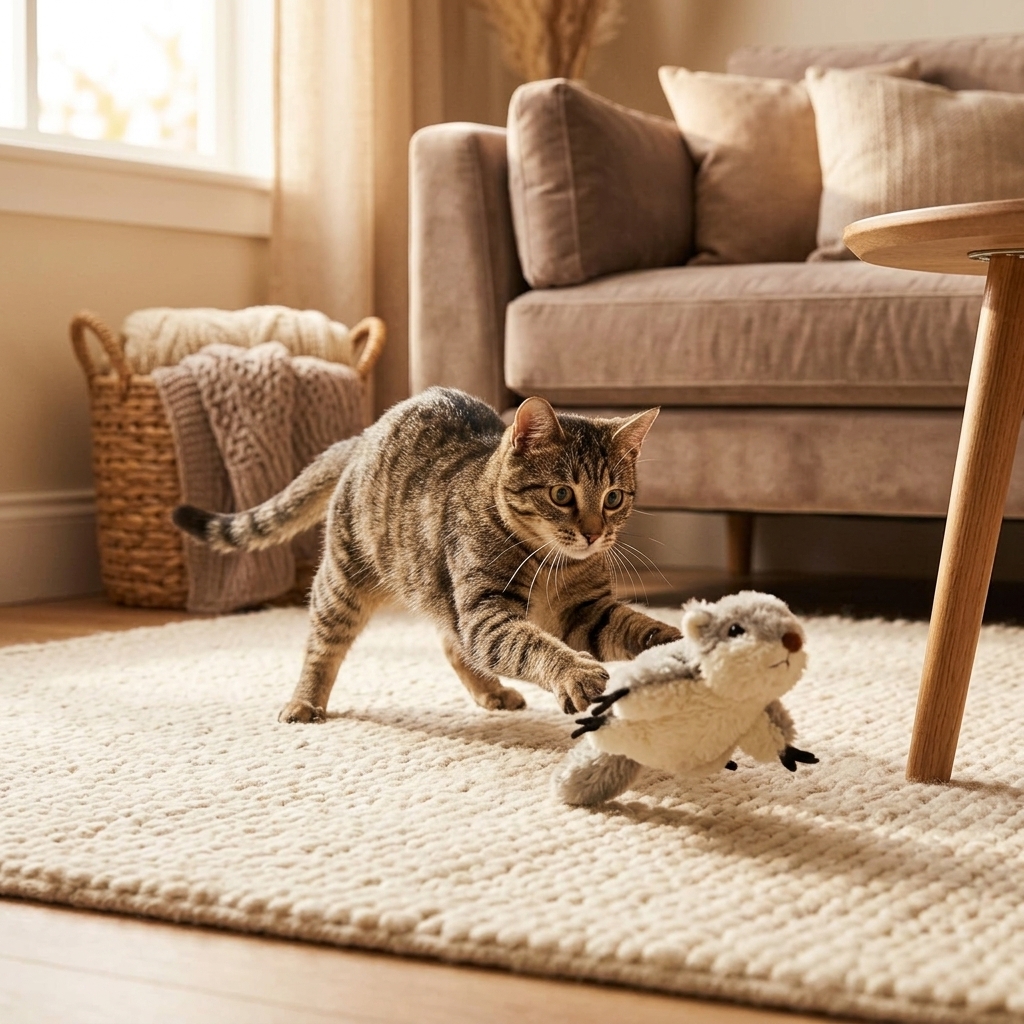
The flapping squirrel earns its place on mechanism, not marketing: a paw tap triggers the flapping, so the cat restarts the chase whenever the drive strikes — and unlike a laser, the pounce lands on something catchable. It scored 4.9/5.0 for engagement in our Fit Analysis, the highest of any toy we've evaluated. Full breakdown here.
How to run a play session a hunter respects
Move like prey, not like a toy. Prey darts away and hides — drag the wand lure behind furniture, freeze it, twitch it. Prey never charges the cat.
Let the cat win. Real catches, several per session. A hunter that never connects learns the game is rigged and quits.
End with the kill and the meal. Let the last catch be a real one, let your cat 'kill' the lure with a few kicks, then serve dinner or a treat — ideally in a food puzzle. Hunt, catch, eat, groom, sleep: you've just run the whole natural cycle on your living room floor.
Two sessions a day like this, 10–15 minutes each, transforms most 'hyperactive' or ankle-attacking cats — the energy was never the problem; the unfinished hunts were.
The prey-drive kit we'd buy
One toy per hunt stage. Prices change — check current pricing at each link.
 🐾 Top prey-drive pick
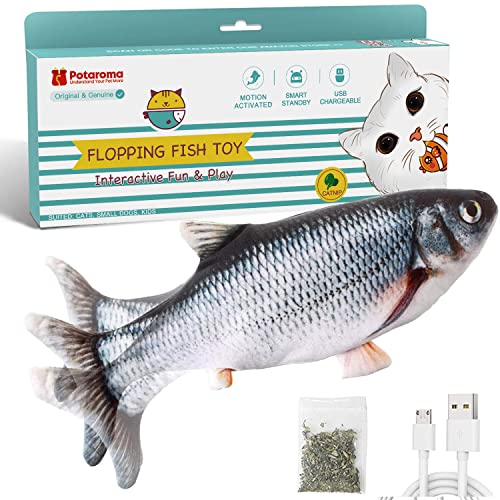
Potaroma Flopping Fish
Motion-activated — lies still until a paw tap, then flops like a landed fish so the cat gets the catch. Rechargeable, built-in catnip.
Check price on Amazon Interactive hunts
Wand toy (Da Bird style)
The gold-standard interactive toy — erratic, feathered, catchable. The one where you're the prey's brain.
Check options on Amazon The airborne hunt
Potaroma Flapping Bird (Sparrow)
Touch it and it chirps and flaps like a downed bird — restarting the stalk on the cat’s terms, with a body they can actually pin. Rechargeable, so no batteries to chase.
Check price on Amazon The kill outlet
Potaroma Saury Fish (3-pack kicker)
Grab, bite, bunny-kick — the finish move, in a catnip-stuffed fish that crinkles when they land it. Three to a pack, so there is always one under the couch.
Check price on Amazon The consume stage
Food puzzle / treat ball
Ends the hunt the way nature does — with foraging and food. Doubles as slow-feeding enrichment.
Check options on AmazonHigh prey drive: FAQ
Are laser pointers bad for cats?
Used as the main toy, yes — the dot can never be caught, so the hunting sequence never resolves, and that thwarted drive is linked to frustration and redirected aggression. If you use one at all, end every session by landing the dot on a real toy or treat the cat can actually catch.
How much play does a high-prey-drive cat need?
Two structured hunt sessions a day, 10–15 minutes each, beats hours of ambient toy access. It's the completed hunts that satisfy the drive, not the minutes.
Why does my cat lose interest in toys so fast?
Habituation — prey that's always lying in the same spot stops reading as prey. Rotate toys weekly, store them out of sight between sessions, and prefer toys that move like prey (darting away) over toys that just exist.
How do I know if my cat has high prey drive?
Ankle ambushes, intense window-watching with chattering, stalking housemates, carrying toys around while yowling, and going airborne for anything that flutters. It's not a behavior problem — it's an engine that needs somewhere to run.
Related reading
The full toy scoring lives in best interactive toys for indoor cats. Working all day? Set up the routine in how to entertain a cat while you're at work. And if the prey drive is currently aimed at your sofa, read how to stop a cat scratching furniture.