Best Interactive Toys for Indoor Cats: Our Scored Picks
Indoor cats need mental stimulation to stay healthy. The interactive toys that actually engage the prey drive — and let the cat catch and resolve it. Scored on our Fit Analysis; lasers rejected.

Some links below are affiliate links. If you buy through them, MeowTested may earn a small commission at no extra cost to you, including as an Amazon Associate, where we earn from qualifying purchases, and as a partner of Whisker, the maker of Litter-Robot. We only recommend products that pass our Fit Analysis — and we publish the ones that don't.
The interactive toys that actually work all trigger the same instinct — the stalk-pounce-catch sequence a bored indoor cat is missing. Three cover it: a motion-activated prey toy for solo play, a feather wand for play with you, and a puzzle feeder that turns food into a hunt.
Skip lasers. A cat can never catch the dot, and that unresolved hunt frustrates more than it enriches — a line we hold across everything we recommend.
The Bored Indoor Cat Epidemic
Indoor cats live an average of 13-17 years compared to 2-5 years for outdoor cats. Keeping your cat inside is unquestionably safer. But safety comes with a cost: boredom.
Without access to the mental stimulation that hunting, climbing, and exploring provide, indoor cats develop behavioral issues — overgrooming, aggression, excessive vocalization, and destructive scratching. Behaviorists call it 'environmental deficit,' and it's one of the most underdiagnosed problems in domestic cats.
If your cat is the high-octane, ankle-ambushing type, we went deeper in best toys for cats with high prey drive.
What Makes a Toy 'Interactive'
Not all cat toys are interactive. A crinkle ball sitting on the floor is not interactive — it's just an object. True interactive toys trigger the prey drive: the instinctive stalk-pounce-catch-rest sequence that satisfies your cat's deepest behavioral needs.
The best interactive toys share three traits:
- Unpredictable movement — mimics real prey behavior
- Autonomous activation — the cat controls when play happens, not the owner
- Tactile reward — the cat can actually 'catch' something (unlike laser pointers, which cause frustration)
How We Evaluated Them
For our Fit Analysis, we assessed interactive toys across five categories — scored on how well each satisfies the hunt, not on hype:
- Motorized mice — battery-powered, random movement
- Laser chasers — automated laser-dot patterns
- Feather spinners — a rotating feather under a cover
- Flopping fish — motion-activated fish with flapping tails
- Motion-activated prey toys — touch-triggered plush animals
We weighed each on safety, how long it holds engagement, repeat use over time, durability, and whether it works without a human on the other end. The one question that sorted winners from frustrations: can the cat actually catch and "kill" it?
"We eliminated the laser chaser immediately. Cats need to physically catch something — an uncatchable dot of light creates frustration, not enrichment." — MeowTested Team
The Winner: Touch-Activated Prey Toys
The motion-activated prey category is the clear winner. These toys lie dormant until a cat taps them, then spring to life with realistic movement — triggering the full stalk-pounce-catch sequence, then going still so the cat actually "wins."
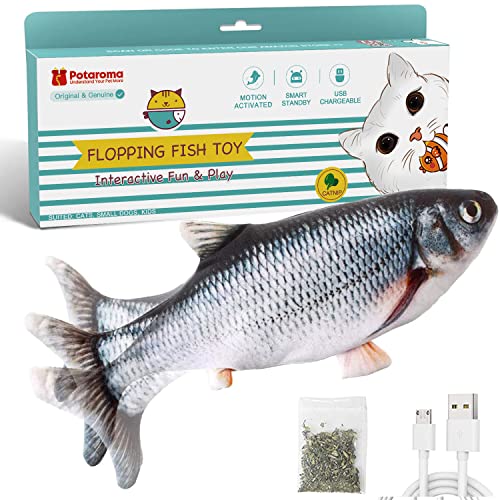
For buy-it-now solo play, the Potaroma Floppy Fish is the category done right: motion-activated, realistic flopping, built-in catnip, USB-rechargeable. That full cycle — stalk, catch, rest — is exactly what a bored indoor cat is missing.
The interactive toys we'd buy
Solo play, play-with-you, and food-as-a-hunt — each lets the cat actually catch the "prey" (no lasers). Prices change; check current pricing at each link.
Best for solo playPotaroma Floppy Fish
Motion-activated: stays still until tapped, then flops like a landed fish. Rechargeable, catnip inside. The cat pounces, catches, and kicks it — the whole sequence.
Check price on Amazon Best with you
GoCat Da Bird Feather Wand
The wand cats treat like a real bird — you control the swoop, the cat gets the catch. The gold standard for daily 15-minute play sessions.
Check price on Amazon Best for foraging
Doc & Phoebe's Indoor Hunting Feeder
Hide the food-filled mice around the house and let your cat hunt each meal — turns eating into mental work. Great for bored or overweight indoor cats.
Check price on Amazon Best rainy-day puzzle
Cat treat puzzle board
A slotted activity board makes your cat paw and problem-solve for kibble — cheap, quiet enrichment for days you can't play. Look for mixed-difficulty compartments.
See options on AmazonThe Cat That Won't Settle at Night
The most common version of the interactive-toy question isn't "which toy" — it's an exhausted owner being woken at 4 AM by a cat parkouring off their face, asking what else there is to try.
Start with biology: cats are crepuscular, wired to be most active at dawn and dusk. The 4 AM zoomies aren't misbehavior, they're a hunt schedule with no hunt in it. The routine that works with that wiring instead of against it:
- Run hunt-catch-eat-sleep at bedtime. A 15–20 minute wand session that ends with a real catch, followed immediately by the evening meal, mirrors the natural sequence: hunt, catch, eat, groom, sleep. Done nightly, it moves the big energy dump to before lights-out instead of 3 AM.
- Move the dawn meal off your alarm clock. If the wake-up is food-seeking, a timed feeder that opens before your cat's usual hour breaks the link between "human wakes up" and "food appears" — our automatic feeder picks cover this.
- Make the last meal slow. For the cat who's chill for twenty minutes after eating and then wound up again, a portion of the evening kibble in a puzzle feeder stretches a thirty-second gulp into unhurried work right before your bedtime.
- Leave out self-play that works without you. This is where the motion-activated category earns its keep overnight: the Floppy Fish lies dormant until the cat taps it, so it's available at 3 AM with no human on the other end. Put it away during the day so it stays novel at night.
- Give the dawn shift something to watch. A window bird feeder puts live cat TV on the glass at exactly the hour your cat is most awake and the birds are busiest.
When the Routine Already Failed
We have to be honest about this part, because the owners asking are often past the standard advice. One owner described doing all of it — "I've got him an auto feeder that schedules meals throughout the night and early morning, made sure we're playing vigorously before bed for 20 minutes with a snack before sleep, taken him to the vet for behavioural concerns - nothing wrong!" — and still being woken at 3:30 every morning. In other threads, owners describe reaching the point of nightly gabapentin just to sleep. No toy on this page fixes that, and we're not going to pretend one does.
What actually helps, in order:
- A vet visit first if the change is sudden — especially in an older cat. New nighttime restlessness in a cat that used to sleep through is a medical question (hyperthyroidism and pain are classic causes) before it's an enrichment question.
- Bedroom exclusion, which is not cruel. Owners agonize over this one, so plainly: a closed bedroom door with the cat's resources set up elsewhere — water, litter, a warm perch, the self-play kit below — deprives your cat of nothing but access to your face at 4 AM. Expect up to a week of protest scratching before it sticks; opening the door during it teaches the protest works. If litter gets flung on the way through the night, a litter mat at least contains that part.
- Time, for the under-twos. A kitten or teenage cat's nighttime energy is developmental. It genuinely fades, usually somewhere between age two and three. The routine manages it; time is what fixes it.
- Patience, after a move. A cat whose nights (or work-hours behavior) changed after a move is reacting to the move, and no product fixes that on its own — settling takes weeks, and the routine above is support, not cure.
- Sedation is a vet conversation. If you're at the point of asking about gabapentin or similar, that decision belongs to your vet and your specific cat — it is not a product choice, and it shouldn't be a substitute for the environmental work above.
One adjacent case keeps coming up: the cat who's fine at night but becomes an attention-seeking wrecking ball during work-from-home hours. That's the day shift of the same problem — a cat with nothing scheduled while you're busy — and we cover it separately in how to entertain a cat while you're at work.
The overnight kit
The two additions that cover the hours you’re asleep — dawn entertainment and slow food. Prices change; check current pricing at each link.
 Best for the dawn shift
Window bird feeder, clear acrylic with suction cups
Sticks to the outside of the glass with suction cups, no drilling, and gives the 5 AM cat moving, unpredictable, real animals a few inches away. Give it one to two weeks for birds to find it, and pick a window your cat already likes to sit at.
Check price on Amazon Best for the food-obsessed
Catit Senses 2.0 Food Tree
Kibble goes in the top and the cat paws it down through the openings. The rotating middle disc changes the difficulty, so you can start it easy and make the evening meal slower as the cat gets good at it. Broad base resists tipping.
Check price on AmazonTips for Keeping Indoor Cats Stimulated
Interactive toys are one piece of the puzzle. Here's a complete enrichment strategy:
- Rotate toys weekly — familiarity kills engagement
- Provide vertical space — cat trees, shelves, and window perches
- Use puzzle feeders — make meals mentally stimulating
- Schedule daily play sessions — 15 minutes of wand toy play burns energy
- Add a window bird feeder — free, endless cat TV
- Consider a companion — many cats thrive with a feline friend
The goal isn't to replace the outdoors — it's to bring the mental stimulation indoors through thoughtful enrichment.
Got a serious hunter? See our picks for high prey-drive cats.