Best Cat Litter Mats for Tracking (2026)
Litter on the bathroom floor isn't a cat problem — it's a mat problem. The designs that actually trap scatter, and the ones that just decorate it.

Some links below are affiliate links. If you buy through them, MeowTested may earn a small commission at no extra cost to you, including as an Amazon Associate, where we earn from qualifying purchases, and as a partner of Whisker, the maker of Litter-Robot. We only recommend products that pass our Fit Analysis — and we publish the ones that don't.
The short answer
Two designs actually work: deep-groove rubber mats like the Gorilla Grip that hold granules in channels until you shake them out, and dual-layer honeycomb mats that let litter fall through the top layer into a sealed pocket. Everything else — flat microfiber, carpet remnants, decorative 'paw' mats — mostly relocates the litter instead of trapping it.
Sizing matters more than brand: the mat needs to cover the launch zone (directly under the box exit) plus at least two cat strides — that's where paws shed most of their cargo. Bigger than looks reasonable is exactly right.
Why litter tracks — and what a mat can actually fix
Tracking happens two ways: granules wedged between paw pads that release over the first few steps, and scatter kicked over the box wall during digging. A mat only solves the first. Scatter is a box-height problem — if litter is flying, you want higher walls or a top-entry box, not a bigger mat.
For paw-carry, texture is everything. The mat has to open the toes slightly as the cat walks — grooves and honeycomb holes do this; flat soft surfaces don't. That's the entire difference between a mat that fills with litter (working) and a mat that stays clean while your floor doesn't (decorative).
Litter choice plays a role too: heavier, larger granules track less than fine lightweight clay. Our odor-control litter picks include low-tracking options.
Litter mat designs compared
| Design | How it traps | Cleanup | The catch |
|---|---|---|---|
| Deep-groove rubber (Gorilla Grip) | Channels hold granules against paw pressure | Shake out or vacuum; hose for deep clean | Grooves need occasional vacuuming to empty fully |
| Dual-layer honeycomb | Litter falls through holes into sealed lower layer | Open and pour back into the box — least waste | Bulkier; the two layers eventually wear at the fold |
| Flat microfiber / carpet style | Surface friction only | Vacuum | Mostly decorative — granules roll off or embed |
Placement: the part everyone gets wrong
Cats exit a litter box in the same one or two directions almost every time — watch once and you'll see the route. The mat goes there, under and beyond the exit, not centered symmetrically under the box for looks.
For enclosed and top-entry boxes, the launch zone is wherever the cat lands — often surprisingly far from the box itself. And in a small space, running the mat wall-to-wall in front of the box turns the entire approach into a trap zone; our small-apartment litter setup uses exactly that trick.
What we'd put down
Amazon links — prices change, check current pricing at each link.
 Top pick
Gorilla Grip Litter Mat
Deep grooves that actually hold granules, rubber that stays put, and a hose-off deep clean. Buy a size larger than feels necessary.
Check price on Amazon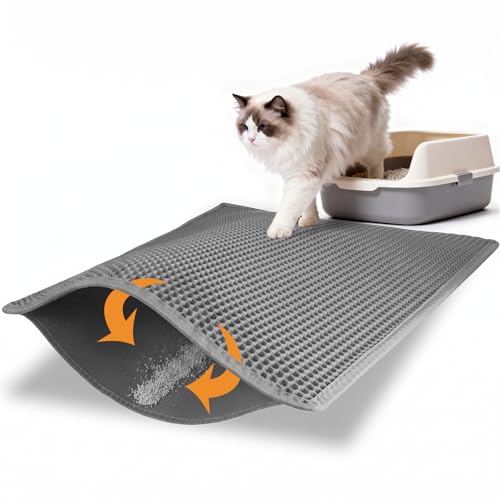 Least waste
Dual-layer honeycomb mat
Trapped litter pours straight back into the box — the thriftiest design if you're paying premium litter prices.
Check options on Amazon Lower-tracking litter
Arm & Hammer Clump & Seal Platinum
Heavier granules that stay in the box better than fine lightweight formulas — the other half of the tracking fix.
Check price on AmazonLitter mats: FAQ
Do litter mats actually work?
The textured designs do — deep grooves and dual-layer honeycomb both measurably cut tracked litter by opening the paws and trapping granules in the first few steps. Flat soft mats mostly don't; they're floor decoration with a pet-store label.
What size litter mat do I need?
Cover the exit direction plus at least two cat strides — roughly 24x36" for most setups, bigger for large cats and top-entry boxes. Undersized mats are the #1 reason people conclude mats don't work.
How do I stop my cat from tracking litter everywhere?
Stack three fixes: a textured mat at the exit, a heavier low-tracking litter, and higher box walls (or top entry) if scatter from digging is part of the mess. No single fix gets all of it; the stack gets most of it.
How do you clean a litter mat?
Shake it into the trash or back into the box (honeycomb designs pour), vacuum the grooves weekly, and hose rubber mats down monthly. If a mat can't take a hose, that's a sign it was the decorative kind.
Related reading
The rest of the litter setup lives in best cat litter for odor control and how to eliminate litter box smell. Considering going automatic? See which self-cleaning boxes are worth it — you'll still want the mat.