How to Eliminate Litter Box Smell: The Complete Guide
Litter box odor is almost always fixable without masking it. The full system — what actually controls smell, ranked by impact, the products worth buying, and the troubleshooting path for a box that smells anyway.

Some links below are affiliate links. If you buy through them, MeowTested may earn a small commission at no extra cost to you, including as an Amazon Associate, where we earn from qualifying purchases, and as a partner of Whisker, the maker of Litter-Robot. We only recommend products that pass our Fit Analysis — and we publish the ones that don't.
To eliminate litter box smell: scoop at least once a day, use a hard-clumping odor-control litter, add a baking-soda deodorizer, keep enough boxes (one per cat plus one), and place them in ventilated spots. Odor is a sign of waste sitting too long or litter that cannot seal it — fix those and the smell goes away without sprays or plug-ins, which only mask it.
If the honest weak link is scooping consistency, the hands-off fix is an automatic box that seals waste within minutes — our automatic litter box guide covers which ones earn it.
Already doing all of it and the box still reeks by day 5? Skip to the troubleshooting section below — litter depth, clump formula, an enzyme deep-clean and the waste bin are the four usual culprits.

What actually controls litter odor (ranked by impact)
| Fix | Impact | Effort | Cost |
|---|---|---|---|
| Scoop daily (or auto-scoop) | Highest | Low–med | Free–$$ |
| Switch to a hard-clumping odor-control litter | High | Low | $ |
| Add baking-soda deodorizer | Medium | Low | $ |
| Enough boxes + right placement | Medium | Low | Free |
| Full litter change on schedule | Medium | Low | $ |
| Litter mat + ventilation | Low–med | Low | $ |
| Scented sprays / plug-ins | Negative (masks only) | Low | $ |
Why your litter box smells
The smell you notice is ammonia from urine and bacteria breaking down waste. It builds when waste sits, when litter does not clump hard enough to trap it, or when there are too few boxes for the number of cats. Scented products do not remove any of that — they add a second smell on top. Everything below removes the source instead.
Step 1: Scoop daily and change litter on schedule
Scooping every day is the single biggest lever — odor is mostly waste left sitting. Scoop morning and night if you can. Do a full litter change every 2–4 weeks for clumping clay (sooner with multiple cats), washing the empty box before refilling — with an enzyme cleaner rather than mild soap if any smell survives the change (more on that in the troubleshooting section below). If daily scooping is the part you skip, a self-cleaning box (Step 4) solves it mechanically.
Step 2: Use an odor-control litter
Litter is the second biggest factor. You want one that forms hard clumps that do not break apart, so urine is sealed and removed whole. Hard-clumping clay (like Dr. Elsey’s Ultra) and baking-soda formulas (like Arm & Hammer Clump & Seal) both perform well. For the full head-to-head, see our guide to the best cat litter for odor control.
Step 3: Add a baking-soda deodorizer
A litter deodorizer (essentially activated baking soda) sprinkled into fresh litter neutralizes acidic odors between scoops. It is cheap, works with any litter, and is the easiest upgrade after scooping and litter choice.
Step 4: Upgrade the box — and consider self-cleaning
A bigger, uncovered box gives cats room and lets you scoop fully. If the daily scoop is your weak point, a self-cleaning box like the PETKIT PuraMax 2 sifts waste into a sealed compartment after each use, which is the most reliable way to keep odor down in a busy home.
Step 5: Placement, litter mat, and airflow
Put boxes in ventilated, low-traffic spots — never boxed into a tiny closet with no airflow. A litter mat traps tracked litter (and the waste dust that smells) before it spreads. Living in an apartment? See our specific playbook for litter box smell in a small apartment.
Want the specific litters with the strongest odor-control record? See our full guide to the best cat litter for odor control.
You did everything right and it still smells: the troubleshooting path
Every step above has a failure mode this page used to skip. A first-time owner on r/CatAdvice ran what is essentially this page’s checklist — an extra-large stainless box, Dr. Elsey’s, baking soda, an air purifier, a Litter Genie — and still reported that the box “starts to REAK of pee after 5 days” despite scooping at least once a day (the thread). If that’s you, work through these in order before buying a different box.
1. Check the litter depth against the bag, not the forum. Arm & Hammer and Dr. Elsey’s print the same direction on their packaging: fill a clean box with 3–4 inches of litter and keep it topped up to that depth. Depth is not a comfort preference — it is working distance. When litter runs shallow, urine reaches the pan bottom before it finishes clumping, smears across the plastic (or the seams of a stainless box), and the clump tears apart when you lift it. If you scoop daily but never top up, the box spends most of the month below the line the litter was designed for. Topping up after scoops matters as much as the starting depth.
2. Try a different clumping formula before a different box. A day-5 smell with daily scooping usually means the clumps are not sealing — either the urine volume per cat is outrunning the formula, or clumps crumble when lifted and leave soaked fragments behind. The test is cheap: lift a clump. If it breaks apart or leaves wet litter stuck to the pan, switch formulas before replacing anything else. Our odor-control litter guide ranks the hard-clumping options; a $25 bag is a better first experiment than a $60 box.
3. Deep-clean with an enzyme cleaner, not just mild soap. Both litter makers’ directions assume a full monthly change of the whole box — and “wash with mild soap” is the advice that fails here, because soap does not break down the urine residue that soaks into scratched plastic and collects in the seams of a stainless pan. An enzymatic cleaner does. Dump the litter, wash the box, soak it in an enzyme cleaner, rinse, and let it dry completely before refilling (enzyme residue plus fresh litter makes clumps stick). Dumping all the litter every five days *would* get expensive fast — and you should not need to. If only a full dump resets the smell, the residue in the box or the clump formula is the real problem, not your schedule.
4. Know what the air purifier can and cannot do. A carbon air purifier near the box absorbs the ammonia that escapes between scoops — it makes the *room* livable, and that is all. It cannot fix the source, so treat it as the last 10%, not a substitute for any step above. Our litter-box air purifier guide covers which units actually carry enough carbon to matter.
5. Seal the scooped waste too. Scooping only moves the problem if the clumps land in an open kitchen bin wrapped in a knotted grocery bag. A sealed disposal pail like the Litter Genie puts scooped waste behind a film barrier — the owner in the thread above says she loves hers “almost more than the cat” — and if the smell seems to follow you out of the litter room, the bin is the first suspect. The full room-by-room version of that diagnosis is in what to fix when someone complains about the smell.
6. If none of this moves the needle, the smell is data. Urine that suddenly smells much stronger — especially from one cat in a multi-cat home — can mean concentrated urine or a urinary tract issue. A box that defeats a correct setup is worth one conversation with a vet before any more shopping.
Products that control litter odor
We do not sell litter products, so these are Amazon links to the items we would actually buy. Prices change — check current pricing at each link.
Best odor litterArm & Hammer Clump & Seal Platinum
Baking-soda formula with 14-day odor control and rock-hard clumps — the strongest odor-first pick in our research.
Check price on Amazon Hard clumper
Dr. Elsey's Ultra (Unscented)
Hard-clumping, 99% dust-free, unscented — and the litter we run in our own two-cat household.
Check price on Amazon Cheap win
Arm & Hammer Litter Deodorizer
Activated baking soda to sprinkle in between changes. Cheapest odor upgrade there is.
Check price on Amazon Less tracking
Gorilla Grip Litter Mat
Traps tracked litter and dust before it spreads odor through the house. See the full mat comparison.
Check price on Amazon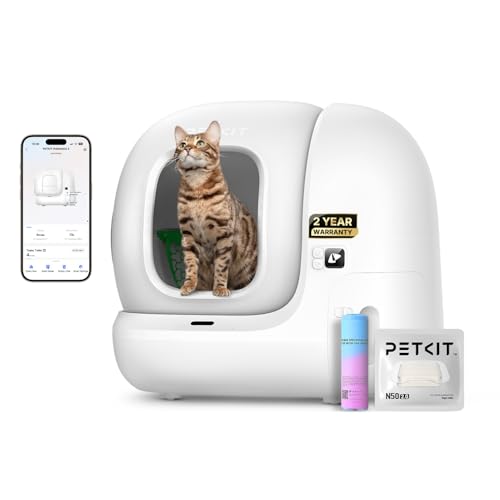 If you skip scooping
PETKIT PuraMax 2 (self-cleaning)
Auto-sifts waste into a sealed bin after each use — the hands-off odor fix.
Check price on Amazon Seals scooped waste
Litter Genie Standard Pail
A sealed film cartridge instead of a knotted grocery bag — the fix when the smell is coming from the trash can, not the box. Budget for refills as a running cost.
Check price on Amazon For the deep clean
Nature's Miracle Urine Destroyer Plus (32 oz)
Enzymatic cleaner for the monthly box wash — breaks down the urine residue that mild soap leaves behind in scratched plastic and stainless seams.
Check price on AmazonLitter box smell: FAQ
How do I stop my litter box from smelling so bad?
Scoop daily, switch to a hard-clumping odor-control litter, add a baking-soda deodorizer, and make sure you have one box per cat plus one in ventilated spots. Avoid scented sprays — they mask odor instead of removing it.
How often should I completely change the litter?
For clumping clay, do a full change every 2–4 weeks (sooner with multiple cats), washing the empty box before refilling. Non-clumping litter usually needs changing about twice a week.
Does baking soda really help with litter smell?
Yes. Baking soda neutralizes acidic odor compounds. A dedicated litter deodorizer is just activated baking soda formulated to mix into litter.
How many litter boxes should I have?
The standard rule is one box per cat plus one extra, spread across different locations. Too few boxes is a common hidden cause of odor and of cats going outside the box.
How deep should cat litter be?
Arm & Hammer and Dr. Elsey’s both print the same direction on the bag: fill a clean box with 3–4 inches of litter and top it up after scooping to keep it there. Running shallow is the common failure — urine reaches the pan bottom before it can clump, smears, and the clump tears when lifted.
Why does my litter box still smell if I scoop every day?
Usually one of four things: litter sitting below the 3–4 inch fill line, clumps that break apart and leave soaked fragments behind, urine residue soaked into the box itself (fix with an enzyme wash, not mild soap), or scooped waste sitting in an open trash can. If a correct setup still smells, a sudden change in urine odor is also worth a vet check.