Best Air Purifiers for Litter Box Smell (2026): Carbon Does the Work
HEPA filters catch particles, and litter box smell is not a particle. Why the carbon layer is the whole purchase, why your current purifier "worked at first and then stopped," and which machines carry enough carbon to matter.
Some links below are affiliate links. If you buy through them, MeowTested may earn a small commission at no extra cost to you, including as an Amazon Associate, where we earn from qualifying purchases, and as a partner of Whisker, the maker of Litter-Robot. We only recommend products that pass our Fit Analysis — and we publish the ones that don't.
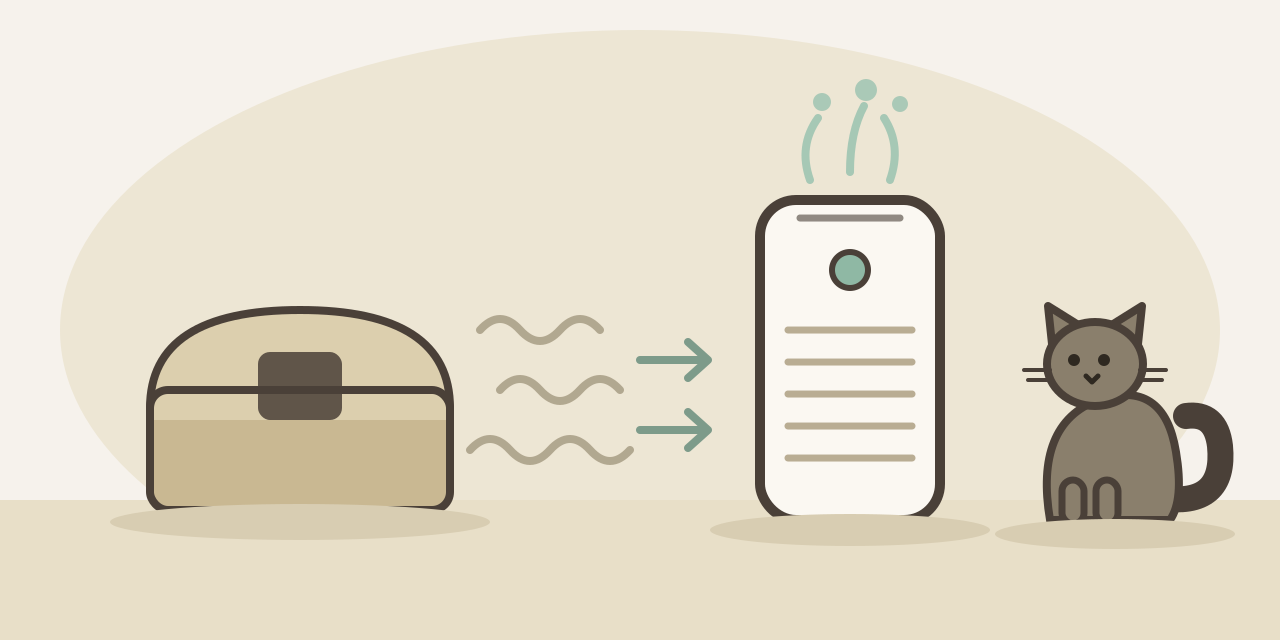
Litter box smell is a gas problem, and HEPA filters do not touch gases. Ammonia and the sulfur compounds coming off a litter box pass straight through a HEPA filter, which is built for particles like dander and dust. The part of an air purifier that removes smell is the activated carbon, and it is the part manufacturers spend the least on. That single fact sorts the whole category.
For most homes, the Levoit Core 400S-P is the buy. It carries a real cylinder of activated carbon rather than a carbon-dusted sheet, its AHAM-verified clean-air numbers are strong for the price, and it is quiet enough to live next to the box. Around $180 street, with a replacement filter roughly every 6 to 12 months.
If the budget is tighter, the Winix 5500-2 is the value answer — its carbon filter is granular, genuinely thick for the price, and washable, which stretches the time between replacements. Its PlasmaWave feature switches off with one button, and we would leave it off in a cat household.
And know what a purifier cannot do. It cleans the room, not the box. If the box itself is the problem, a purifier is a bandage: scooping cadence, the litter itself, and box placement do more, and they cost less. We cover that base layer in our litter odor guide — this page is for when the box routine is already right and the room still needs help.

Why your current purifier "worked at first and then stopped"
This purchase usually starts the same way. One owner in a windowless apartment put it plainly on r/CatAdvice: "I have a small air purifier that seemed to help but now I think I want to upgrade to something more powerful." That worked-then-stopped pattern is so common it is worth explaining before recommending anything, because the fix is often not a bigger machine.
Activated carbon removes odors by adsorption — gas molecules stick to the carbon's internal surface area and stay there. That surface is finite. When it fills, the filter stops adsorbing, and a saturated carbon filter can even re-release what it caught. The fan keeps spinning, the HEPA layer keeps catching dust, the app keeps saying everything is fine, and the smell comes back. Nothing broke. The odor-removing part of the machine was simply used up.
Small purifiers are the worst offenders because their "carbon filter" is often a thin sheet of mesh dusted with carbon powder. There is very little surface to fill, so next to a litter box — a continuous odor source — it saturates in weeks. That is not a defective unit; it is a unit that was never carrying enough carbon for the job.
So the honest first question is not which purifier to buy but whether your current one just needs its filter replaced — and whether the replacement carries real carbon. If you are buying new for a litter box, the amount and form of carbon is the specification that matters. Everything else on the box is secondary.
HEPA is for dander. Carbon is for smell. You want both, for different reasons
A quick sort of what is actually in the air around a litter box, because the marketing runs the two problems together:
Particles: litter dust, dander, tracked fines, airborne clumping agents. This is what HEPA is for — a true HEPA filter captures 99.97% of particles at 0.3 microns. If someone in the house has allergies, or your cat is sensitive to litter dust, the HEPA layer is doing real work.
Gases: the smell itself. Urine odor is dominated by ammonia as urea breaks down; feces adds sulfur compounds. These molecules are orders of magnitude smaller than anything a HEPA filter is built to catch and pass through it unaffected. Only sorbent media — activated carbon, sometimes blended with other sorbents — removes them from the air.
This is why "pet" purifiers with excellent HEPA specs and a token carbon sheet leave owners confused. The dust is genuinely gone. The smell is genuinely still there. Both observations are correct, because they are two different filters' jobs.
What separates the machines on this page from the sea of lookalikes is the carbon stage. There are three broad tiers: carbon-dusted mesh (cosmetic, saturates fast), fibrous filters coated in carbon (better, still thin), and genuine granular or pelletized carbon in a thick bed (the tier that holds up next to a continuous source). Manufacturers rarely publish carbon weight, so the practical tell is physical: a real carbon stage is heavy, rattles slightly if you shake it, and is priced like a real component when you buy the replacement.
Placement: treat the box's room, and put the machine near the source
A purifier pulls air through itself; it does not project cleaning outward. Odor concentration is highest at the box, so the machine belongs in the same room, ideally a few feet from the box, not in the hallway where you happen to notice the smell. Cleaning the air where the smell is strongest, before it migrates, beats diluting it after it has spread through the apartment.
Size the machine to the room using the AHAM Verifide rating rather than the marketing headline. The headline square footage on the box is usually calculated at one air change per hour — fine print for a barely-noticeable effect. The AHAM number reflects tested clean-air delivery; for odor work in the box's room you want a machine whose AHAM rating comfortably covers that room, so it can turn the air over four or five times an hour. All four machines below carry AHAM listings, which is part of why they made the list.
Two practical notes for cat households. First, run it continuously on a low or auto setting rather than blasting it when you notice smell — adsorption works on contact time, and the whole point is to keep the baseline down. Second, expect the cat to sit on it. A tower with a top-facing outlet blowing filtered air upward is, from a cat's perspective, furniture with a breeze. This is harmless, apart from the hair it adds to the pre-filter.
Which purifier for which situation
| Your situation | What to get | Why |
|---|---|---|
| One box in a living room or large studio | Levoit Core 400S-P | Real carbon cylinder, strong AHAM numbers, quiet enough to run continuously where you live. |
| Tight budget, same problem | Winix 5500-2 | Granular washable carbon at the lowest price in the group. Turn PlasmaWave off and it is a plain HEPA-plus-carbon machine. |
| Multi-cat home, hair everywhere | Levoit Vital 200S-P | Washable pre-filter designed for pet hair, so the expensive filter is not killed by fur, plus a pellet-based carbon stage. |
| You want the app and auto mode to just handle it | Winix 5510 | The 5500-2's successor with app support and auto mode; same washable carbon approach. |
| You want the long-service known quantity | Coway AP-1512HH Mighty | A decade-long track record and a 3-year warranty. Its carbon layer is a coated filter — thinner than the others here, and priced accordingly. |
| The smell is really the box, not the room | Fix the box first — our litter odor guide | Scooping cadence, litter choice and box placement remove odor at the source for a fraction of the cost. |
Ionizers, PlasmaWave, and cats: leave the extras off
Two machines on this page ship with an ion-based feature riding alongside the filters — PlasmaWave on the Winix units, a switchable ionizer on the Coway. Manufacturers state these operate within ozone safety limits, and units sold in California clear CARB's ozone certification. We are not going to tell you they are dangerous; that would be overclaiming in the other direction.
But in a cat household we would switch them off, for three practical reasons. First, cats are small, live at floor level where ionized particles settle, and groom whatever lands on their fur. Second, cats with asthma — which is not rare — do best with the fewest airborne variables. The r/CatAdvice owner whose thread prompted this article mentioned exactly this: a cat sensitive enough to litter dust that the vet specified the litter. Third, and decisively: the feature contributes nothing to the job you bought the machine for. Odor removal happens in the carbon. Every unit here works as a straightforward HEPA-plus-carbon machine with the extras disabled, which is exactly how we would run them.
One related caution while you are solving a smell problem: skip plug-in "air sanitizers" and ozone generators entirely. Ozone at odor-removing concentrations is a respiratory irritant for you and your cat, and several such devices have been the subject of regulatory action. A boring filter that traps molecules beats a reactive gas released into the room your cat sleeps in.
What we would buy
Selected on published specifications, AHAM Verifide listings, and the carbon-stage distinctions described above. MeowTested has not bench-tested air purifiers and claims no measurements of our own; dimensions and model numbers come from the manufacturers and from Amazon product data. Prices move constantly, so we do not quote them.
Start hereLevoit Core 400S-P
The default answer for a litter box in a lived-in room. A cylindrical three-stage filter with a genuine activated carbon layer, AHAM-verified airflow that comfortably covers a large room, auto mode driven by a particle sensor, and a sleep mode quiet enough to forget. Listed at 10.8 x 10.8 x 20.4 inches and 12.8 lb. Replacement filter (Core 400S-RF) roughly every 6 to 12 months.
Check price on Amazon Best value
Winix 5500-2
The most carbon per dollar in the group: a washable granular carbon filter ahead of a true HEPA stage, AHAM-rated for a mid-size room. Washing the carbon restores some service life between replacements, which no coated-sheet filter can offer. PlasmaWave switches off with one button; we would leave it off. Listed at 15 x 8.2 x 23.6 inches and 14.8 lb.
Check price on Amazon Multi-cat homes
Levoit Vital 200S-P
The pet-specific build done right: a washable pre-filter that catches hair before it clogs the main filter, a pellet-based carbon stage rather than a coated sheet, and a pet mode that raises airflow on a schedule. Listed at 15 x 8.7 x 19.7 inches and 13.2 lb, model LAP-V201S-WUS. The rational pick when fur, not just odor, is shortening filter life.
Check price on Amazon Known quantity
Coway AP-1512HH Mighty
The machine reviewers have recommended for a decade, with a 3-year warranty and cheap, everywhere-available filters. Its deodorization layer is a carbon-coated filter rather than a granular bed — honest limitation: next to a litter box it will saturate sooner than the Levoit or Winix carbon stages. Listed at 16.8 x 9.6 x 18.3 inches and 12.5 lb.
Check price on AmazonBudget for filters or the purchase fails on schedule. The carbon stage is consumable, and next to a litter box it is consumed faster than the 12-month marketing interval — treat 6 months as realistic for a coated filter and check a granular one when smell starts returning. A purifier whose replacement filter you skip becomes, within a year, exactly the "seemed to help but stopped" machine you are replacing now. When comparing prices, compare the filter price too: the cheapest unit with an expensive proprietary filter usually loses over two years.
Frequently Asked Questions
Will an air purifier eliminate litter box smell completely?
No, and any product page that promises elimination is overreaching. A purifier with a real carbon stage meaningfully lowers the baseline odor in the room and shortens how long a fresh deposit hangs in the air. It cannot outrun a box that needs scooping, a litter that is not controlling ammonia, or a box in an airflow dead zone. Fix those first — they are covered in our litter odor guide — then let the purifier handle what remains.
Where should I put the purifier — next to the box or where I sit?
Same room as the box, a few feet away, with clear airflow around the intake. The concentration of odor molecules is highest at the source, and capturing them there beats diluting them after they have spread. If the box is in a bathroom or closet too small for the machine, put it immediately outside the doorway in the path of the air leaving that space.
Is PlasmaWave or an ionizer safe to run around cats?
Manufacturers state these features operate within ozone safety limits, and California-sold units clear CARB certification. We still recommend switching them off in a cat household: cats live at floor level, groom what settles on their fur, and asthmatic cats do best with fewer airborne variables. The features contribute nothing to odor removal — that is the carbon's job — so turning them off costs you nothing you bought the machine for.
How often do I really need to replace the filter?
Manufacturers say 6 to 12 months, and next to a litter box the carbon is realistically at the short end of that. The HEPA layer usually outlives the carbon's usefulness — the filter still catches dust after it has stopped catching smell. The reliable signal is your own nose: when odor performance fades, the carbon is done regardless of what the filter-life indicator says. The Winix's washable carbon filter is the partial exception; washing restores some capacity between replacements.
Can a purifier help with litter dust too?
Yes — that is the HEPA layer's actual job, and for dust-sensitive cats or owners it is a genuine benefit. Airborne litter fines and dander at 0.3 microns and up are exactly what a true HEPA filter captures. If dust is your main complaint, also look at the litter itself: low-dust formulas remove the source, and our odor-control litter guide covers which clumping litters throw the least.
My purifier has an "odor" or "pet" mode. Does that do anything?
It changes fan behavior, not chemistry. Pet and odor modes raise airflow or bias the auto sensor to run harder, which does help — more air across the carbon means more adsorption per hour. But no mode adds carbon capacity to a filter that lacks it. A thin coated filter on "pet mode" is still a thin coated filter.
Where to go next
The short version: buy one machine with a real carbon stage, put it in the box's room, run it continuously, and replace the filter when smell performance fades rather than when the sticker says. The Core 400S-P is that machine for most homes; the Winix 5500-2 is the same idea at a lower price.
A purifier is the second layer of odor control, not the first. If the box itself is the problem, start with how to eliminate litter box smell — scooping cadence, litter, and placement do the heavy lifting. In a small space, litter box smell in a small apartment covers the layout tricks that matter when there is no spare room to give the box. If the complaint is a housemate's nose rather than yours, when someone in the house cannot stand the litter box is the negotiation guide. And if what you actually want is for the apartment to smell good rather than merely neutral, make your house smell good with cats covers what is safe to add to the air once the purifier has cleaned it.