How to Make Your House Smell Good With Cats (Without Risking Them)
Candles, plug-ins and oil diffusers are the three things everyone reaches for, and all three are the wrong tool in a cat household. What “pet-safe” legally means, the oils vets name by name, and the routine that gets you a good-smelling home without gambling with your cat.
Some links below are affiliate links. If you buy through them, MeowTested may earn a small commission at no extra cost to you, including as an Amazon Associate, where we earn from qualifying purchases, and as a partner of Whisker, the maker of Litter-Robot. We only recommend products that pass our Fit Analysis — and we publish the ones that don't.
You cannot safely add strong fragrance to a cat’s air. You can remove the smell and filter what’s left — and that gets you the same house.
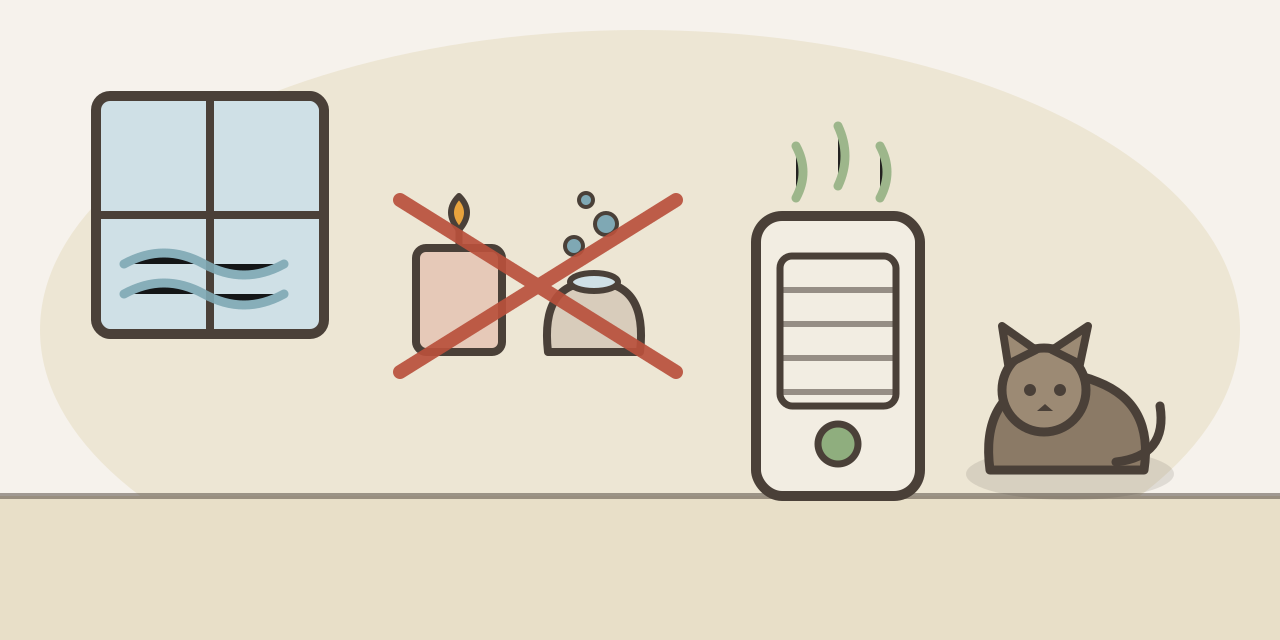
The three products people reach for first are the three worst fits here: ultrasonic oil diffusers, plug-in warmers and scented candles. Cats process phenolic compounds poorly, and an active diffuser doesn’t just perfume a room — it puts oil droplets on a coat that gets groomed.
The routine that actually works is boring and it works permanently: find the source, remove it with the right chemistry, then filter the room. A HEPA-plus-carbon purifier is the single highest-value purchase in this article, because the carbon layer is the only part of a purifier that touches odor at all.
If you still want scent after that, keep it low-risk and keep it in a room your cat can walk out of.

First, the label problem: “pet-safe” is a marketing phrase
There is no regulated definition of “pet-safe” in the United States. No agency certifies it, no test stands behind it, and no one has to substantiate it before printing it on a box. The closest adjacent claim, “non-toxic,” falls under the FTC’s Green Guides, which require competent and reliable scientific evidence — but there is still no set testing standard and no pre-approval, so the phrase does not tell you what was tested, on which species, or at what exposure.
The second problem is the ingredient list, which usually reads “fragrance.” Fragrance blends are protected as trade secrets, so a single word on the back of a bottle can stand in for dozens of undisclosed compounds. You cannot check a fragrance product against a list of oils that are bad for cats, because the product is not obliged to tell you what is in it.
The practical consequence: buy on mechanism, not on the badge. A purifier that pulls air through carbon has a mechanism you can reason about. A plug-in that says “pet-friendly” on the front and “fragrance” on the back does not.
Why cats specifically, and not just “pets”
This is not general pet caution being applied to cats. Cats are the actual outlier.
Cats lack an efficient liver pathway for clearing phenols and phenolic compounds, which are exactly what several common essential oils are built from. Pet Poison Helpline puts it plainly: cats lack an essential liver enzyme that other species use to process these compounds, which is why an exposure a dog shrugs off can matter in a cat.
Then there’s the route in. There are two kinds of diffuser and the difference is not cosmetic:
- Passive diffusers — reed, heat, evaporative, fan — release aroma by evaporation. The main risk is respiratory irritation: watery eyes and nose, coughing, wheezing.
- Active diffusers — ultrasonic and nebulizing — emit actual microdroplets of oil into the air. Those droplets settle. They settle on the floor, on the sofa, and on your cat. A cat grooms, and an inhalation question becomes an ingestion question.
That second mechanism is the reason the popular ultrasonic diffuser is the one product in this category we would not run in a cat’s home at all, at any dilution.
Signs worth knowing, per Pet Poison Helpline: drooling, vomiting, tremors, wobbliness or unsteady walking (ataxia), laboured or fast breathing, low heart rate, low body temperature, and in serious exposures, liver failure. Respiratory signs mean fresh air and an emergency vet, not a wait-and-see.
If you think an exposure has happened: Pet Poison Helpline (855) 764-7661 or the ASPCA Animal Poison Control Center (888) 426-4435. Both charge a consultation fee and both are open around the clock.
The oils worth memorizing
Pet Poison Helpline names these as poisonous to cats: wintergreen, sweet birch, citrus (d-limonene), pine, ylang ylang, peppermint, cinnamon, pennyroyal, clove, eucalyptus and tea tree (melaleuca). Texas A&M’s veterinary school casts a wider net still, naming dozens including lavender and lemon.
Two honest caveats about that list.
First, it is not exhaustive, and treating it as a whitelist is the mistake. “It wasn’t on the list” is not a safety finding. The workable default in a cat household is that no essential oil gets aerosolized into shared air — not that you memorize eleven names and diffuse everything else.
Second, dose and route matter enormously, which cuts both ways. A sealed bottle of tea tree oil in a cupboard is not an emergency. That same oil in an ultrasonic diffuser, running eight hours a day in a closed room, in a house where the cat cannot leave, is a different exposure entirely — and the cat has no way to opt out of it.
Citrus deserves a specific note, because it is the one people are most surprised by. D-limonene is the compound behind orange and lemon scents, and it shows up in cleaning products marketed on how fresh they smell as well as in oils.
Every route to a nicer-smelling room, scored
| Method | What it actually does | Cat risk | Verdict |
|---|---|---|---|
| Ultrasonic / nebulizing oil diffuser | Puts oil microdroplets into the air | Highest — droplets land on the coat and get groomed off | Don’t |
| Plug-in fragrance warmer | Continuous undisclosed fragrance, no off switch | Chronic exposure; chew and short-circuit risk at outlet height | Don’t |
| Reed / passive diffuser | Evaporates scent slowly | Respiratory irritation; the liquid reservoir is a spill and drink hazard | Only in a closed room the cat has no access to |
| Scented candle | Masks with fragrance plus combustion particulate | Fragrance load plus soot; open flame near a tail | Unscented at most, attended, never near a jump route |
| Simmer pot | Steam-releases whatever you put in it | Most of the classic ingredients (citrus peel, clove, cinnamon) are on the list | Skip — the nice-smelling versions are the risky ones |
| Ozone generator / “ionizer” | Produces ozone, which reacts with odor molecules | Ozone is a lung irritant for cats and for you | Never |
| HEPA + activated carbon purifier | Physically removes dander and adsorbs odor gases | None inherent — pick a mechanical, ozone-free unit | Buy this one |
| Enzyme cleaner on the source | Breaks down the proteins causing the smell | None when used as directed and dried | Buy this one |
What actually works: subtract, then filter
Every durable fix in this category is subtraction. Here is the order that gets results, and it matters that it is an order.
1. Find the source before buying anything. Cat-house smell is almost never ambient. It is a place. Walk the house with your nose at knee height, which is where cats live: the box and the area around it, the bag or bin the scoop goes into, soft furnishings near a favourite sleeping spot, the food bowl and mat, and any spot behind furniture that a cat with a past has claimed. Rooms with poor airflow concentrate whatever is already there.
2. Use the right chemistry on it. Urine is the specific case. It needs an enzyme cleaner, which breaks down the odor-causing proteins, rather than a general cleaner that dilutes and spreads them. Soak it properly — enzyme products need to stay wet long enough to work, and the common failure is wiping them off after thirty seconds. Anything ammonia-based is worse than nothing on cat urine, because ammonia smells like the thing you are trying to remove and can invite a repeat visit.
3. Ventilate, honestly. Ten minutes of open windows in the morning does more for a stale room than any product in this article. It is free, and it is the step people skip because it does not come in a box.
4. Then filter. This is where the money goes, and it is worth understanding what you are buying.
- HEPA handles particles — dander, hair, dust. That is a real allergy benefit and it is what purifier marketing leads with, but particles are not what a room smells like.
- Activated carbon handles gases — the odor molecules themselves. A purifier without a meaningful carbon layer is an allergy device, not an odor device. Check that the filter actually lists activated carbon rather than a token coating.
- Size it to the room. Coverage figures are usually stated at a specific air-change rate; a unit rated for a large open plan will be quietly underpowered if you run it on low in a corner. Cat odor is a room-level problem, so a small unit in the right room usually beats a big one two doors away.
- Ozone-free, not “ozone as a feature.” Since 2010, portable indoor air cleaning devices sold in California must be CARB-certified, with electronic air cleaners capped at an ozone emission concentration of 0.050 ppm (50 ppb). CARB publishes the certified list. Purely mechanical filter units — the HEPA-and-carbon boxes — do not generate ozone at all, which is the category you want. Anything sold on “activated oxygen” or an ionizer you cannot switch off is the category you don’t.
- Budget for filters. LEVOIT’s guidance on the Core 300 line is replacement every 6 to 8 months. A saturated carbon filter stops adsorbing and quietly becomes a fan.
5. Only now, if you still want scent. Put it in a room the cat can leave, never in the room the box is in, and keep it passive rather than aerosolized. The reader question behind this article was “I want my home to smell nice” — and the honest answer is that a house with no bad smell and clean air reads as pleasant to visitors far more reliably than a house with a strong pleasant smell layered over a persistent bad one.
The litter half: dust, and where the scoop goes
Two things separate a cat home that smells fine from one that doesn’t, and neither is fragrance.
Dust is an air-quality problem, not just a cleaning one. In a multi-cat household the tracking and airborne dust from a heavy clay litter is genuinely irritating — owners report eye irritation in cats in dusty setups, and the cat is the one with its face in the box several times a day. If you are already buying a purifier because of smell, switching to a low-dust unscented litter attacks the same air from the other end. Unscented matters twice over here: a heavily perfumed litter is a box-avoidance risk, and box avoidance is the worst odor outcome available.
Where the scoop goes is the step most routines skip. Scooping daily and then dropping the clumps in an open kitchen bin relocates the smell rather than removing it. A sealing disposal pail keeps the scooped waste behind a barrier until it leaves the house. It is a small purchase that fixes a specific, daily, recurring smell.
On full changes versus topping up: clumping litter is designed to be scooped and topped up, but the base layer does age, and a box that smells within minutes of a clean scoop is telling you either the litter is spent or the plastic is. Scratched plastic holds ammonia, and a box that has been in service a couple of years is often the actual source people are trying to perfume away.
We cover the box side in depth separately — this article is the room. If your problem is specifically the box, start with how to eliminate litter box smell and litter deodorizers that actually work instead.
What we’d actually buy
Scored with the MeowTested Fit Analysis — our research rubric across room size, cat sensitivities and household layout. These are spec comparisons and user-report synthesis, not bench tests. Prices move, so treat tiers as guidance rather than quotes.
Best for one roomLEVOIT Core 300 Air Purifier
Three-stage filtration — pre-filter, H13 True HEPA, granular activated carbon — at 24 dB with an auto mode. The carbon layer is the part doing the odor work, and this is the cheapest way to get a real one. Filter replacement runs 6–8 months.
Check price on Amazon Best for open-plan
LEVOIT Vital 200S-P
Rated for large spaces up to 1,875 sq ft, AHAM Verifide, with a washable pre-filter that copes with airborne cat hair instead of clogging on it. ≤26 dB in sleep mode and zero ozone emissions — the spec to insist on.
Check price on Amazon Fix the source first
Nature’s Miracle Cat Urine Destroyer Plus
Enzymatic, aimed specifically at cat urine and the sticky yellow residue it leaves. No purifier will out-run an untreated spot behind the sofa. Note the manufacturer’s own exclusions: not for untreated hardwood, leather, suede, silk or wool.
Check price on Amazon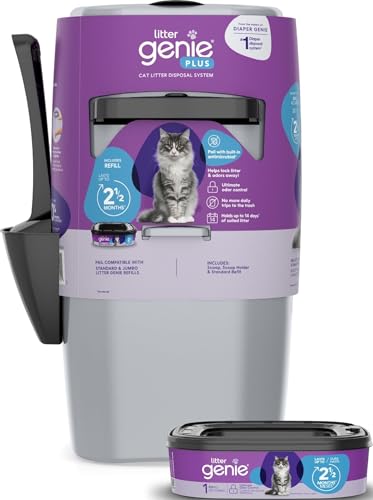 Where the scoop goes
Litter Genie Plus Pail
Sealed multi-layer refill film with a built-in antimicrobial, holding roughly a fortnight of scooped waste for one cat. The cheapest fix for the specific smell that arrives daily at scooping time.
Check price on Amazon Low-dust, no fragrance
Dr. Elsey’s Ultra (Unscented)
Hard-clumping and unscented, which is the combination that matters here: tight clumps mean less residue to smell, and no perfume means no box-avoidance risk in a multi-cat house.
Check price on Amazon Passive and fragrance-free
Bamboo activated-charcoal bags
Not a substitute for a purifier — no fan, no airflow, so they work on the small enclosed volumes a purifier can’t reach: the cupboard the litter lives in, the car, a closet. Fragrance-free by construction, which is the point.
Check price on AmazonThe test for any product in this article is simple: does it remove something, or does it add something? Enzyme cleaners, carbon filters and sealed pails remove. Candles, plug-ins and diffusers add. In a house with a cat in it, subtraction is the only side of that line with no downside.
Cat-safe home fragrance: FAQ
Are essential oil diffusers safe to run around cats?
Active diffusers — ultrasonic and nebulizing — are the ones to avoid outright, because they emit microdroplets of oil that settle on your cat’s coat and get swallowed during grooming. Passive diffusers (reeds, evaporative) are lower risk but can still cause respiratory irritation, and the liquid reservoir is a spill hazard. Cats process phenolic compounds poorly, so the safe default is no aerosolized oils in shared air rather than a list of “approved” oils.
Which essential oils are toxic to cats?
Pet Poison Helpline names wintergreen, sweet birch, citrus (d-limonene), pine, ylang ylang, peppermint, cinnamon, pennyroyal, clove, eucalyptus and tea tree. Texas A&M’s veterinary school lists dozens more, including lavender and lemon. Treat these as examples rather than a complete list — an oil’s absence from a list is not evidence it is safe.
Are plug-in air fresheners bad for cats?
Veterinary guidance is broadly to avoid them. They release undisclosed fragrance compounds continuously into a space the cat cannot leave, which is chronic rather than occasional exposure, and they sit at outlet height where a curious cat can chew the unit. The general veterinary position we found is “in general, it’s good to avoid them.”
Does “pet-safe” on a label mean anything?
Not in any regulated sense. There is no agency definition, no certification and no required testing behind the phrase. The related claim “non-toxic” falls under the FTC’s Green Guides and requires substantiation, but there is still no set testing standard or pre-approval. Buy on mechanism — what the product physically does — rather than on the claim.
Will an air purifier get rid of cat smell?
A purifier with a real activated-carbon stage will meaningfully reduce ambient odor, and the HEPA stage cuts dander at the same time. What it will not do is out-run a source: an untreated urine spot, an aging box, or a bin full of scooped waste will keep re-loading the room faster than any filter clears it. Source first, filter second.
Are scented candles safe if I keep the cat out of the room?
Better, but the fragrance still travels and combustion adds particulate to shared air. If you want a flame, unscented is the lower-risk choice, it should be attended, and it should never sit on a surface that is also a jump route. A purifier running in the same room offsets some of the particulate but not the fragrance load.
Related reading
- How to eliminate litter box smell — the box-level routine this article sits on top of.
- Cat litter deodorizers & additives that actually work — what belongs inside the box, and what each type can actually do.
- Litter box smell in a small apartment — when the room and the box are the same room.
- Best cat litter for odor control — the base-litter decision.
- Best-smelling cat litters — why we’re cautious about scented litter, in detail.