Cat Litter Deodorizers & Additives That Actually Work
Powders, carbon, sprays — the additive aisle is full of promises. We scored what each type can actually do, what none of them can, and which are safe around a scent-sensitive cat.

Some links below are affiliate links. If you buy through them, MeowTested may earn a small commission at no extra cost to you, including as an Amazon Associate, where we earn from qualifying purchases, and as a partner of Whisker, the maker of Litter-Robot. We only recommend products that pass our Fit Analysis — and we publish the ones that don't.
Litter deodorizers work — as a supplement, not a substitute. A baking-soda or activated-carbon additive genuinely extends freshness between scoops on a box that’s already scooped daily. Sprinkled over a neglected box, it’s perfume on a problem.
Order of operations: scoop daily → use a litter that clumps tight → then add a deodorizer for the between-scoop window. And keep additives lightly scented or unscented — a heavily perfumed box can push a cat off it entirely, which is the worst odor outcome there is.

What a deodorizer can and can’t do
Litter box smell has a source: waste sitting in the box, and ammonia forming as urine breaks down. Everything that “works” works one of two ways — removing the source (scooping, clumping) or neutralizing what escapes (baking soda, carbon). Fragrance does neither; it just adds a second smell on top.
A deodorizer can:
- Neutralize odor chemically in the hours between scoops
- Extend how fresh the box stays in a warm room or a small space
- Add a light pleasant scent, if you choose a scented one
A deodorizer cannot:
- Rescue a box that isn’t scooped daily
- Fix a litter that clumps poorly (crumbled residue is the smell)
- Cover a spot outside the box — that’s an enzyme cleaner job, because urine outside the box needs its proteins broken down, not perfumed
If the box smells minutes after cleaning even with good litter, the box itself may have absorbed odor — plastic scratches hold ammonia, and a worn box eventually needs replacing, not treating.
The three types of additive — and which job each does
- Baking-soda powders (the classic sprinkle-in). Sodium bicarbonate neutralizes acidic odor compounds on contact. Cheap, widely cat-accepted, and dose-controllable. This is the default. Plain baking soda from the pantry does a budget version of the same job — a thin layer on the box bottom before litter goes in.
- Activated carbon / charcoal. Adsorbs odor molecules rather than reacting with them — strongest on ammonia, and completely scent-free, which makes it the pick for fragrance-sensitive cats. Comes as granule additives or as passive bags you hang near the box.
- Enzyme products. Break down odor-causing proteins rather than masking them. Overkill inside a scooped box, but the answer for accidents outside it and for periodic box washes.
Two safety rules, whatever you pick:
- Go dust-free. Cats dig, and their noses live at litter level — a dusty additive gets inhaled with every use. Look for “dust-free” or low-dust formulations.
- Skip essential-oil products. Several essential oils are toxic to cats, and a strongly scented box risks avoidance. Light scent or no scent wins — we covered why in our scented litter guide.
Deodorizer types, scored
| Type | Best at | Scent | Watch out for |
|---|---|---|---|
| Baking-soda powder | General freshness between scoops | Unscented or light | Dust level varies by brand |
| Activated carbon | Ammonia; scent-sensitive cats | None | Granules outperform passive bags |
| Enzyme spray/wash | Accidents outside the box; box washes | Usually light | Not a daily in-box additive |
| Heavily perfumed powders | Masking (briefly) | Strong | Box-avoidance risk — we don’t recommend them |
The additives we’d buy
Scored with the MeowTested Fit Analysis — our research rubric across cat sensitivities and room sizes. All picks assume the real fix (daily scooping) is already happening.
Best overallArm & Hammer Litter Deodorizer
The baking-soda standard: neutralizes between scoops, light scent, a few dollars a canister (Amazon currently lists it as a 6-pack), works in any litter you already own.
Check price on Amazon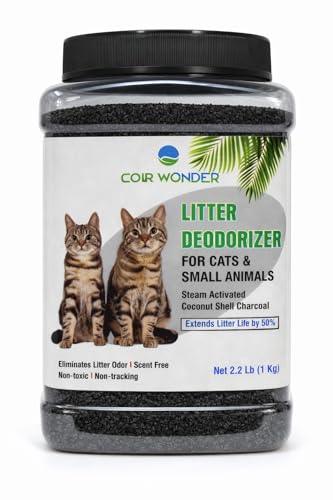 Best scent-free
Activated charcoal odor absorbers
Carbon adsorption with zero fragrance — the pick when your cat rejects any scent, or for hanging near the box in a small room. (Filtered Amazon search — specific pick coming.)
See options on Amazon For outside-the-box accidents
Enzymatic cleaner
Breaks down urine proteins instead of masking them — the only thing that truly ends a repeat-marking spot. Every cat household should own a bottle. (Filtered Amazon search.)
See options on Amazon Fix the litter first
Dr. Elsey’s Ultra (Unscented)
If your current litter clumps poorly, no additive will save it. A tight-clumping unscented base litter plus a pinch of deodorizer beats a mediocre litter drowned in powder.
Check price on AmazonLitter deodorizers: FAQ
Do cat litter deodorizers actually work?
Yes, within their lane: baking-soda and activated-carbon additives genuinely neutralize odor in the hours between scoops. What they can’t do is replace scooping or rescue a poorly clumping litter — an additive on a neglected box just adds a smell to a smell. Scoop daily first; deodorize second.
Is baking soda safe to use in cat litter?
Plain, unscented baking soda is generally considered safe around cats in the small amounts used for odor control — a thin layer under the litter or a light mix-in. Keep it modest (a dusty cloud of anything isn’t good for feline lungs) and avoid versions with added fragrance.
What’s the best dust-free litter deodorizer?
Activated-carbon granules are the most reliably low-dust, fragrance-free option, which makes them the default for cats (or humans) with sensitive airways. Among powders, look for an explicit low-dust or dust-free label rather than the bargain shaker.
Why does my litter box still smell after cleaning?
Usual suspects, in order: the litter clumps poorly and leaves residue; urine has soaked into scratches in the plastic (boxes need replacing every year or two); there’s an undiscovered accident nearby that needs an enzyme cleaner; or the box is under-sized or under-ventilated for the space. Our full litter-box smell guide walks through each.
Related reading
- How to eliminate litter box smell — the complete routine additives slot into.
- Best cat litter for odor control — the base-litter half of the equation.
- Litter box smell in a small apartment — tight-space tactics where additives earn their keep.
- Best-smelling cat litters — if you want scent built into the litter itself.