When Someone in the House Cannot Stand the Litter Box
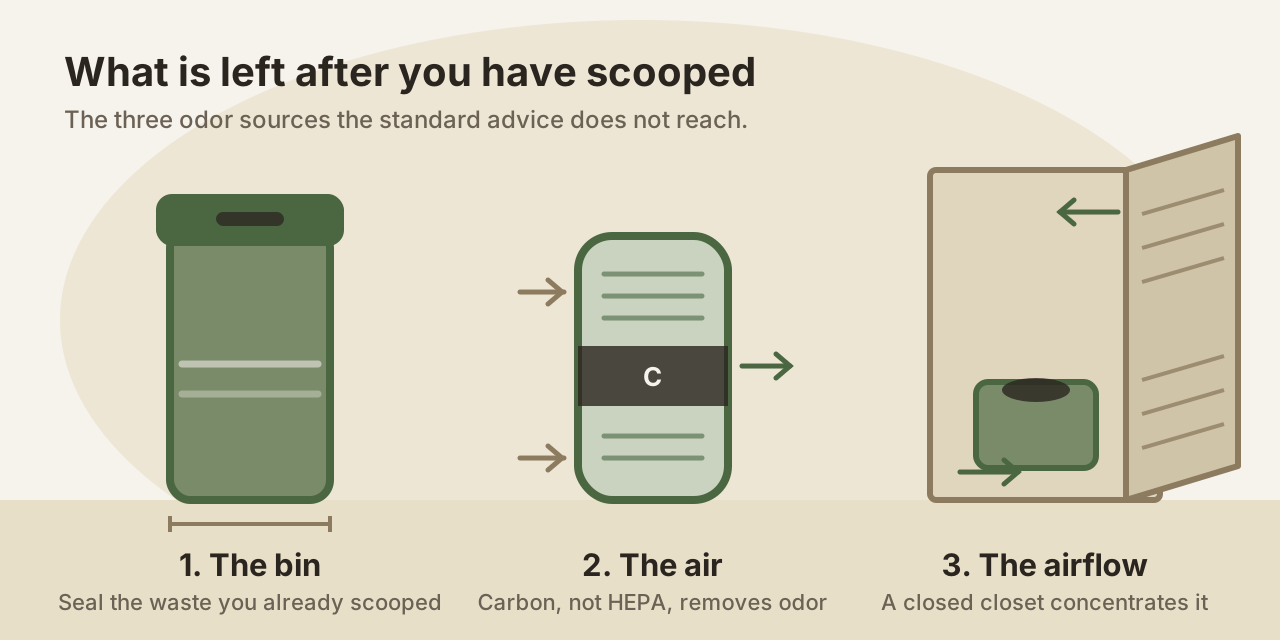
You already scoop every day, you already bought the good litter, and the box is already in the least-bad spot you have. Here is what is left: the bin, the air, and the closet door. Ranked by how much each one actually changes.
Some links below are affiliate links. If you buy through them, MeowTested may earn a small commission at no extra cost to you, including as an Amazon Associate, where we earn from qualifying purchases, and as a partner of Whisker, the maker of Litter-Robot. We only recommend products that pass our Fit Analysis — and we publish the ones that don't.
If you scoop immediately, use a decent clumping litter, and the box is already in the only place it can go, the smell that is left is not coming from the box. It is coming from three places the usual advice skips.
The bin. Scooped waste knotted into a grocery bag and dropped in an open kitchen trash can is a slow leak with a lid on it. A sealed disposal pail like the Litter Genie XL+ puts the waste behind a film seal instead of a knot, and its 9.45 inch square footprint fits beside a box in a closet.
The air. Odor molecules pass straight through a HEPA filter. The part of an air purifier that does anything for litter smell is the activated carbon stage, and the Levoit Core 300-P is the small-room option that carries a real one.
The airflow. A box in a closed entryway closet is in the worst possible airflow situation, which is why the closet feels fine until someone opens the door. That one is free to fix.
If you are here because a partner or a roommate has started avoiding a room, work the list in that order. The bin is usually the biggest single change and the cheapest.
This page starts where the usual advice ends
Most litter odor guides, including ours, give you the same first tier: scoop daily, use a good clumping odor-control litter, add a deodorizer, get a mat, consider a self-cleaning box. That advice is correct and it solves most cases. We wrote it up properly in how to eliminate litter box smell, and the litter comparison sits in best cat litter for odor control.
This page is for the case where you have done all of it and someone in your household still notices. That situation comes up constantly and it has a specific shape: the person is not being unreasonable, and you are not doing anything wrong. There is simply a second tier of odor sources that the first tier does not touch, and nobody writes about them because they are less interesting than litter brands.
The household version of this problem raises the stakes in a way worth naming. When a partner covers their nose and leaves the room, the pressure to solve it fast pushes people toward the two worst options: a scented product that layers perfume over ammonia, or moving the box somewhere the cat will reject. Both make things worse. Scent masking fails because the smell you are covering is still being produced, and a cat that dislikes its new box location starts going outside it, which turns an odor problem into a much bigger one. Work the sources instead.
What is still producing smell after you have done the basics
| Source | Why it survives daily scooping | What actually changes it | Roughly |
|---|---|---|---|
| Scooped waste in the bin | Scooping moves the waste four feet. A knotted plastic bag is not an odor barrier and a kitchen bin lid is not a seal. | A sealed disposal pail with a continuous film, emptied weekly rather than daily. | $20 to $30, plus refills |
| Room air | Odor molecules are gases. They are not filtered by particle filters and they are not removed by scooping. | Activated carbon filtration, sized for the room and replaced on schedule. | $70 to $120, plus filters |
| Trapped air around the box | An enclosed closet or cabinet concentrates everything and then releases it when the door opens. | Any continuous airflow at all: a vented door, a gap, a small quiet fan. | $0 to $40 |
| Litter dust and tracked granules | Dust settles on surfaces outside the box and carries the smell with it. | A trapping mat and a low-dust litter, both already covered on our other pages. | $20 to $40 |
| The box itself | Plastic absorbs odor over time, especially where urine pools in corners and under the rim. | Wash with unscented soap monthly; replace plastic boxes every year or two. | $15 to $40 |
The bin is the biggest thing nobody fixes
Here is the part that surprises people. If you scoop into a plastic grocery bag, knot it, and drop it into the kitchen trash, you have not removed the waste from your home. You have moved it into a container that opens several times a day, in the room where you prepare food, and a knot in thin plastic is close to useless as an odor barrier.
That is why the smell can seem to follow you around the apartment even though the box itself is clean. The source has simply relocated.
A sealed disposal pail solves this differently to a lidded bin. Instead of tying individual bags, you push the waste through a one-way seal into a continuous tube of multi-layer film, and the film closes behind it. You empty the pail once a week or so rather than dealing with the waste daily.
The practical numbers, from the manufacturers' own listings, because footprint is usually the deciding factor when the box lives in a closet:
Litter Genie XL+: 9.45 by 9.45 inches, 22 inches tall, 3.09 lb. Litter Genie states it holds around three weeks of waste for one cat.
Litter Genie Plus: 8.5 by 8.5 inches, 17 inches tall, 3.26 lb. The shorter one, for when 22 inches will not clear a shelf.
Measure your closet before you order. In an entryway closet with a top-entry box already in it, the height of the pail is more often the constraint than the floor space, and the Plus exists for exactly that reason.
One honest caveat on running cost: these pails use proprietary refill cartridges, and that is an ongoing expense of roughly $5 to $8 a month depending on how many cats you have. If that bothers you, the alternative below costs nothing extra and works nearly as well, as long as you are willing to walk outside every day.
If your city got rid of plastic grocery bags
This has become a real problem rather than a niche one, because a lot of cities have now phased out single-use plastic bags at checkout, and a scooped litter clump needs something to go into. People land on produce bags, which are too narrow and tear, or on buying boxes of small kitchen trash bags, which feels absurd and wasteful for one clump a day.
There are three routes that work.
Bags actually sized for a litter scoop. Most pet waste bags are sized for a dog walk and are far too small. The ones designed for litter are much larger and have handles. The Americat plant-based bags measure 16 by 8 inches and are rated to hold 11 pounds of waste, which is enough for a full box change rather than a single clump. They are certified compostable to the OK Compost Home and industrial standards.
Skip bags entirely. This is the underrated option and it is the strongest argument for the sealed pail above: the pail's film cartridge replaces the bag, so there is nothing to buy at the grocery store and nothing to knot. If your bag problem started when your city changed its rules, the pail solves the odor problem and the bag problem in one purchase.
Reuse what already comes into the house. Bread bags, cereal liners, and the bags around produce you have already bought all work and cost nothing. It is not elegant, but it is the honest zero-cost answer and it is what a lot of people quietly do.
Two warnings that matter more than the bag choice, and neither is optional.
Do not flush cat litter or cat waste, and do not put it in a home compost you will use on food plants. Cat faeces can carry Toxoplasma gondii, whose oocysts survive normal home composting temperatures and are not removed by standard wastewater treatment. Certified compostable bags refer to the bag breaking down, not to the waste inside being safe to compost. Most municipal green-bin programmes explicitly exclude cat waste, so check your own city's rules before assuming a compostable bag can go in the green bin. Scooped litter belongs in the regular trash. Separately: the CDC advises that people who are pregnant should avoid changing litter where possible, and scoop daily with gloves and handwashing if there is no alternative, since oocysts take one to five days to become infectious.
What an air purifier can and cannot do here
Air purifiers are sold hard against pet odor and the marketing is vague enough to be misleading, so it is worth being precise about which part of the machine does the work.
HEPA filtration does nothing for smell. A HEPA filter is a mechanical particle trap. Litter odor is ammonia and sulfur compounds in gas form, and gas molecules are far smaller than the particles a HEPA filter captures. They pass straight through. A purifier sold on its HEPA rating alone will reduce dust and dander in the room, which is worth having, and will not measurably change the smell.
Activated carbon is the part that matters. Carbon adsorbs odor gases onto its surface. This is why the pet-specific versions of most purifiers cost more: they carry a heavier carbon stage rather than a token carbon-coated mesh. Levoit's pet-allergy filter for the Core 300 line is the relevant example, and the company positions the extra carbon as the difference.
Carbon saturates, and this is the thing people miss. A carbon filter has a finite number of sites. Once they are occupied the filter stops working, and it gives you no signal when that happens. Levoit recommends replacing filters every six to eight months, and in a room with a litter box you should treat that as an outer bound rather than a target. A purifier with a saturated filter is an expensive fan.
Placement matters more than capacity. Put the unit between the box and the space the person who is bothered actually occupies, not in the far corner of the room. You are trying to intercept air on its way, and the Core 300's 8.7 inch square footprint makes that easy to arrange.
Sized honestly: the Core 300 is a single-room machine. If the box is in an entryway closet and the complaint is about the living room, one unit near the closet is the right buy. It will not deodorize an open-plan floor.
The closet problem, which is free to fix
Putting the box in an entryway closet is a sensible move in a small home and it is often the only spot available. It also creates a specific failure mode: a closed closet has almost no air exchange, so odor concentrates in a small volume, and every time the door opens that volume dumps into the hallway at once. The closet smells worse than the box deserves, and the smell arrives in noticeable pulses rather than as a background level, which is exactly what makes someone react to it.
Three fixes, in order of effort:
Stop closing the door fully. A two inch gap converts a sealed box into a slowly ventilated one. This alone is often the single biggest change available, and it costs nothing.
Cut or fit a vent. A louvered closet door, or a pair of cheap vent grilles top and bottom, sets up a convection path so air moves continuously rather than only when the door swings. Top and bottom together matter: one opening alone does very little.
Add a small quiet fan on a low setting to force the exchange. This is the one to reach for only if the first two are not enough, because a fan blowing across a litter box also lifts dust.
What not to do: do not seal the closet further, do not add a plug-in scented oil inside it, and do not move the box somewhere the cat has to travel further or pass another pet to reach. Cats are conservative about box location and a rejected box is a far worse outcome than a smell.
If the box is already top-entry, you have taken the main enclosure step already. Top-entry boxes cut tracking and contain odor well, and their trade-off is that older cats and cats with joint pain can find them hard to use, which is worth watching for if your cat starts hesitating.
What we would buy for this specific problem
Chosen for the situation where the basics are already handled and someone in the house is still bothered. Selections use the MeowTested Fit Analysis, which is structured research against published specifications and owner-reported patterns, not an in-home lab test. Dimensions are from the manufacturers' Amazon listing data, retrieved 2026-08-18. Prices move constantly, so treat any figure here as approximate.
 Biggest single change
Litter Genie XL+ Pail
A sealed film cartridge instead of a knotted bag, which is the actual fix for waste that has been scooped but not removed from the house. 9.45 inches square and 22 inches tall, 3.09 lb, and rated by Litter Genie at around three weeks for one cat. Buy this one if you have the vertical clearance and more than one cat. Note the ongoing refill cost before you commit.
Check price on Amazon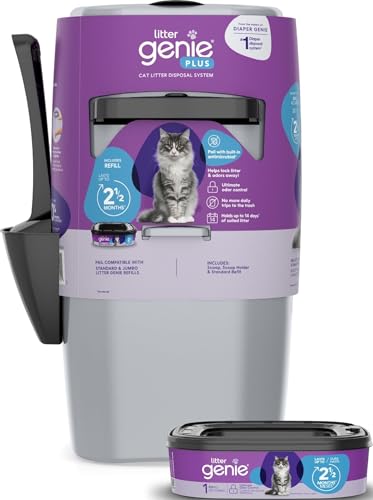 For tight closets
Litter Genie Plus Pail
The same sealing mechanism in a shorter body: 8.5 inches square and 17 inches tall, 3.26 lb. Five inches shorter than the XL+, which is frequently the difference between fitting under a closet shelf and not. Smaller capacity means emptying more often, which is a fair trade if the alternative is the pail not fitting at all.
Check price on Amazon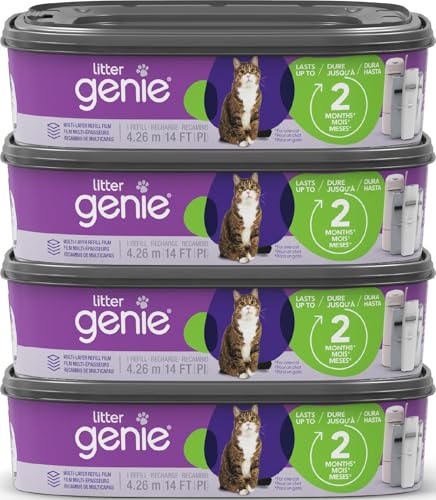 The running cost
Litter Genie Standard Square Refills, 4-pack
56 feet of continuous film across four cartridges, which fits the Standard, Plus and XL+ pails. Worth buying alongside the pail so you see the real cost of ownership up front rather than discovering it in a month. Check compatibility before ordering: the square refills do not fit the Easy Roll or the older XL pail.
Check price on Amazon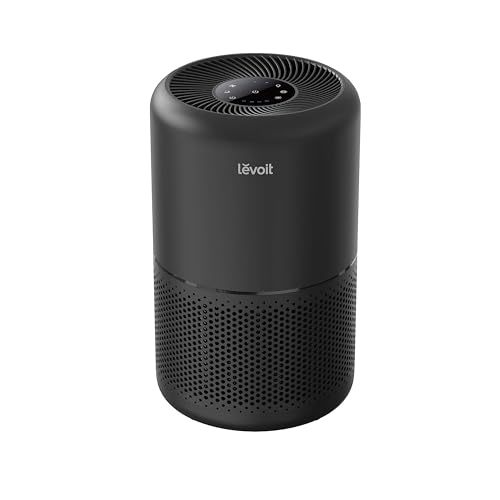 Best small-room air option
Levoit Core 300-P
The pet version of Levoit's small-room purifier, which matters because the pet filter is the one with the heavier activated carbon stage, and carbon is the only part of any purifier that addresses odor. 8.7 inches square and 16.25 inches tall, so it sits easily beside a closet door where it can intercept air. Budget for filter replacements every six to eight months, sooner in a litter room.
Check price on Amazon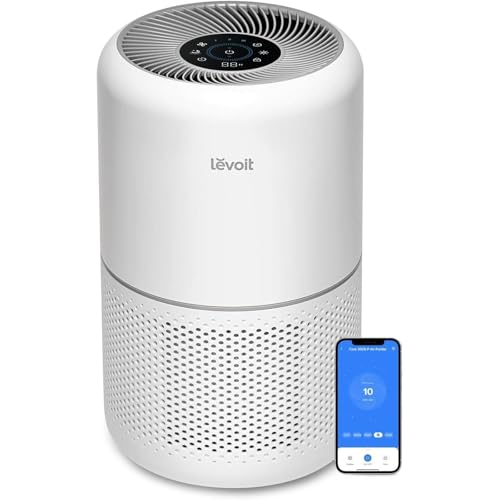 Same machine, scheduling
Levoit Core 300S-P
The connected version of the same purifier, 8.66 inches square and 14.17 inches tall. The only reason to pay the difference is the app: filter-life tracking and scheduling, which sound like frills until you remember that a saturated carbon filter fails silently. If you know you will forget to change filters, this is the one that will remind you.
Check price on Amazon If you have no grocery bags
Americat Plant-Based Litter Bags
Sized for a litter scoop rather than a dog walk: 16 by 8 inches with handles, rated to hold 11 pounds, unscented, and certified to the OK Compost Home and industrial standards. Read the callout above before assuming the certification lets you compost the contents, because it does not. These are for getting waste into the regular trash cleanly when your city no longer hands out plastic bags.
Check price on AmazonHousehold litter odor: FAQ
My partner says it smells and I genuinely cannot smell anything. Who is right?
Both of you. Olfactory adaptation is well documented: continuous exposure to a background smell reduces your perception of it within minutes, while someone who enters the space intermittently gets the full signal every time. Your nose is not the instrument to judge this with, and neither is theirs alone. Use the sources in the table above as the checklist instead of arguing about the smell itself, and treat the person who walks in from outside as the honest sensor.
Will an air purifier fix litter box smell on its own?
No, and any product page implying otherwise is overselling. A purifier with a real activated carbon stage reduces odor already in the room air. It does nothing about the waste sitting in the bin producing more, and it cannot outrun a box that needs scooping. It belongs third on the list, after the bin and after airflow.
Are scented litters or plug-in air fresheners worth trying?
Generally no. They add a second smell rather than removing the first, and the combination is often more noticeable than the original, which is the opposite of what you want when someone is already reacting. Many cats also dislike strongly scented litter and will use the box less consistently. Unscented litter plus source control is the more reliable route. Room scent is a genuinely different topic from box odor and should not be used as a substitute for it.
Can I put the box in a cabinet or a piece of furniture instead?
You can, and the same airflow rule decides whether it helps. Furniture enclosures that are effectively sealed concentrate odor exactly like a closed closet does. If you use one, add vents at the top and the bottom so air moves through continuously. Also check that the entry is easy for your cat: a cat that has to squeeze or jump awkwardly will eventually stop using the box.
How often should the litter box itself be replaced?
Plastic absorbs odor over time, especially where urine reaches seams and the underside of the rim, and no amount of scrubbing recovers a box that has gone. Every year or two is a reasonable replacement interval for a plastic box, sooner if it has visible scratches, since scratched plastic holds odor far more stubbornly than smooth plastic. Wash with unscented soap and water monthly and skip anything ammonia-based, which reads as urine to a cat.
Would an automatic litter box solve this?
It addresses one source well, because it removes waste within minutes instead of within a day, and most of them seal it into a covered compartment. It does not address room air, closet airflow, or what happens to the waste after you empty the compartment, so it is a partial answer at a much higher price. If you are considering one anyway, we compared the cheaper end in best budget automatic litter boxes and the category as a whole in are automatic litter boxes worth it.
Where this page sits
This is the escalation page, for when the standard advice is already in place. If you have not done the first tier yet, start with how to eliminate litter box smell, which covers scooping schedules, box upgrades and airflow basics, and pick a litter with best cat litter for odor control or cat litter deodorizers that work.
If the constraint is square footage rather than a housemate, litter box smell in a small apartment covers the layout side of the same problem.
One boundary worth stating: making a home smell pleasant is a different job from stopping a litter box smelling, and doing the first without the second is how people end up with a house that smells like perfumed ammonia. This page is only about the source.
Our recommendations come from the MeowTested Fit Analysis, a disclosed research and scoring framework described on how we test. We have not run these products in a lab or a home, and we say so rather than implying otherwise.