Best Budget Automatic Litter Boxes (2026): What Under $300 Actually Buys
The cheap end of this category is where the ongoing costs hide. What you give up below $300, which budget boxes are worth it anyway, and when the honest answer is a $50 box you roll by hand.
Some links below are affiliate links. If you buy through them, MeowTested may earn a small commission at no extra cost to you, including as an Amazon Associate, where we earn from qualifying purchases, and as a partner of Whisker, the maker of Litter-Robot. We only recommend products that pass our Fit Analysis — and we publish the ones that don't.
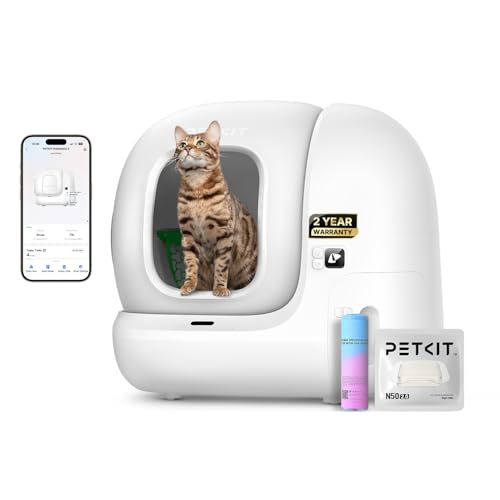
If you want a real automatic box and a budget near $300, the PETKIT PuraMax 2 is the one to buy: a full rotating drum, a proper sensor suite, and no proprietary consumables, at a fraction of what the category flagship costs — the full PuraMax 2 breakdown has the complete verdict. The Neakasa M1 Plus Lite is the open-top alternative for cats that refuse enclosed boxes, and it runs on any clumping litter too.
The PetSafe ScoopFree has the lowest sticker price of the three and the highest running cost, because it only works with the maker's crystal trays. Its cheapness is a financing plan, not a discount.
And if your budget is really under about $150, the most honest recommendation on this page is not a machine at all: a manual sifting box like the Omega Paw Roll 'n Clean plus a hard-clumping litter removes most of the scoop without a motor, an app, or a filter subscription.
Budget in this category is a three-year number, not a sticker
Every other buying guide ranks these by launch price. That ranking is wrong, because two boxes with the same sticker can differ by hundreds of dollars over the time you actually own them.
There are only three recurring costs, and they are the whole game:
Litter. Boxes that take any hard-clumping litter let you buy whatever is cheapest per pound in your area. Boxes that take only the maker's crystal trays do not. That single design decision is worth more, in dollars, than the difference between most models on this list.
Waste bags and filters. Drum boxes use a liner bag in the waste bin and a carbon filter. Generic bags fit some models and not others, so check before you assume you can buy off-brand. Filters are a few dollars a month at most.
Replacement parts and how long they stay available. A budget box that is discontinued in eighteen months with no spare drum, no bin gasket, and no support line is a disposable appliance. This is the least visible cost and the one people regret.
What you actually give up under $300
Below roughly $300 the compromises are real, and they are consistent enough across the category to predict:
Sensor depth. The flagship boxes stack weight sensors with an infrared curtain and pinch detection. Budget boxes still ship sensors, and the good ones publish counts, but the more layers a box has the more ways it has to notice a cat that a single sensor would miss.
Capacity and cycle timing. Smaller drums and smaller waste bins mean you empty more often, and multi-cat households feel that fastest. A bin advertised at two weeks is a two-week bin for one cat.
Noise. Cheaper motors and thinner shells are louder. If the box has to live in a bedroom or a studio, this matters more than any feature on the spec sheet, and it is the single most common reason a cat quits a new box.
App and data. Weight tracking per cat, visit logs, and health trend alerts are the first things cut. That is a genuine loss for multi-cat homes, where per-cat usage data is an early warning system, and no loss at all for a single-cat household that will never open the app twice.
Materials and serviceability. Thinner plastics, fewer seals, fewer replaceable subassemblies. Budget boxes leak at the seams more often, which is why the ones worth buying make a point of their base sealing.
One recent exception to the sub-$200 rule worth naming: the PetPivot AS11, an open-top drum at around $160–200 (verified 2026-09-02: $160 on a limited-time deal, $200 list) that takes any hard-clumping litter and uses plain liners rather than proprietary trays. It gives up the sealed odor containment of the enclosed boxes, but it clears the consumables test that the ScoopFree fails, which makes it the cheapest box on this page we'd actually put in the comparison.
Budget automatic litter boxes compared
| Model | Price tier | Mechanism | Litter it takes | Running cost | The catch |
|---|---|---|---|---|---|
| PETKIT PuraMax 2 | $$ (around $250 to $300) | Rotating drum, seals waste in a lined bin | Any hard clumping | Low: litter, liner bags, filter | The interior reads bigger in photos than it measures. Large cats should check the entry and drum dimensions first. |
| Neakasa M1 Plus Lite | $$$ (~$330–400 — verified 2026-09-02, drifted up from ~$250) | Open-top drum, pull-and-wrap waste bagging | Any hard clumping | Low: litter, bag rolls | Louder than the premium boxes. Open-top means less odor containment between cycles. |
| PetPivot AS11 | $ (around $160–200 (verified 2026-09-02: $160 on a limited-time deal, $200 list)) | Open-top drum with liners; infrared + Hall sensors (listed) | Any hard clumping | Low: litter, liners (a starter pack and a mat ship in the box) | Open-top, so less odor containment; the listing recommends manual mode for kittens under 3 lb |
| PetSafe ScoopFree | $ (lowest sticker here) | Rake sweeps into a covered trap | Maker's crystal trays only | High: a new tray every few weeks, indefinitely | The trays are the product. Price them for a year before you buy the box. |
| Omega Paw Roll 'n Clean | $ (cheapest by a wide margin) | You roll it over, a grate sifts the clumps out | Any hard clumping | Litter only. No power, no filters, no liners | It is not automatic. You still walk over to it, you just never touch a scoop. |
Will it fit? Listed footprint and weight
| Model | Footprint (L x W x H) | Weight |
|---|---|---|
| PETKIT PuraMax 2 | 24.2 x 22 x 22 in | 22 lb |
| Neakasa M1 Plus Lite | 23.2 x 20.2 x 20.6 in | 23.1 lb |
| PetPivot AS11 | 21.5 x 20.3 x 24 in | 22 lb |
| PetSafe ScoopFree | 27.6 x 19.1 x 16 in | 18.1 lb |
| Omega Paw Roll 'n Clean (large) | 18.5 x 21.5 x 20 in | 6.5 lb |
Dimensions and weights are the manufacturers' listed specs as of August 2026, not our measurements. Measure your intended corner before ordering: every automatic box on this page needs clearance on at least one side for waste-drawer access, and the ScoopFree needs the most floor length of the four.
The consumables trap, in actual numbers
The ScoopFree is the clearest example in the category of a low sticker price attached to a high running cost, so it is worth doing the arithmetic rather than repeating the warning.
It does not use clumping litter. It uses the maker's crystal trays, and a tray is consumed on a schedule rather than topped up. One cat goes through them slower than three. Whatever your household's rate turns out to be, multiply a tray's price by how many you will buy in a year, then add that to the sticker price before you compare it to anything else on this page. Do that honestly and the gap between the ScoopFree and a drum box that eats $15 store-brand clumping litter closes fast, and in a multi-cat home it inverts.
That does not make it a bad box. Its rake design is simple, it has been sold for years, and the sealed tray genuinely handles odor well. It makes it a box you should only buy on purpose — because you want the tray convenience and have priced it, not because it was the cheapest number on the shelf.
The same test applies to any budget box: find the part you have to keep buying, price a year of it, and add it to the sticker.
The cheapest automatic litter box is the one whose consumables you can buy anywhere. Every proprietary tray, cartridge, or branded-only bag is a subscription you agreed to at checkout without seeing the total.
When the honest budget answer isn't a machine
If your ceiling is genuinely under about $150, a cheap automatic box is usually the worst way to spend it. At that price you are buying the compromises listed above with none of the engineering that makes them survivable, and the failure mode is not a refund, it is a cat that stops using the box.
The alternative that actually works at that budget is the Omega Paw Roll 'n Clean, or the regular size for cats under about 10 lb. You tip it over, a sifting grate catches the clumps, you tip it back, and you pull out a tray. No electricity, no liners, no filters, no app, nothing to break. It costs a fraction of any powered box and there is no second bill.
What it does not do is work while you are out. It removes the unpleasant part of scooping, not the trip to the box. If what you want from automation is a clean box at 11pm without you doing anything, this is not that, and you should save up for the drum box instead of buying down.
Pair it with a hard-clumping litter such as Arm & Hammer Clump & Seal Platinum. Clump integrity is what makes any sifting design work, powered or not — soft clumps crumble through the grate and defeat the whole mechanism. Our litter for automatic boxes guide explains what to look for.
The screen every box on this page has to pass
Budget does not lower the bar on the things that involve a cat climbing inside a machine.
Published sensor detail. We want a maker that states what the box detects with and how many of each. The PuraMax 2 lists an infrared array plus weight sensors; the Neakasa M1 Plus Lite lists paired infrared sensors and weight sensors on the base. A listing that says only "safety sensor" with no detail tells you nothing you can check.
A stated weight range. Every maker publishes a minimum and maximum cat weight, and those numbers are the sensor's calibration, not marketing. The PuraMax 2 states 3.3 to 22 lb; the M1 line states a wider range with a separate kitten mode. Check yours against your cat before buying, especially at the small end.
The kitten rule is absolute, at every price. Makers say the same thing in the manuals: these boxes are not for kittens or very small cats, and no kitten gets unsupervised access to any automatic box. If your household includes one, the answer this year is a normal open box.
A delay before the cycle starts. A box that waits a few minutes after the cat leaves, rather than moving the moment the weight lifts, is easier for a nervous cat to accept. Cheaper boxes often make this adjustable in the app, which is one of the few app features worth having.
Making the transition stick on a budget box
Budget boxes get returned more often than premium ones, and the reason is usually the introduction rather than the hardware. The protocol is the same one we recommend for any automatic box, and it costs nothing:
Run the new box next to the old one with the power off for the first several days, so it is just a new box that gradually smells familiar. Move a scoop of used litter into it. Turn it on only once your cat is using it, and let the first few cycles run while the cat is out of the room. Retire the old box only after a full week of consistent use.
The one budget-specific addition: listen to the first cycle from where the box will actually live. Cheaper motors are louder, and a noise your cat tolerates in a hallway can be the reason it refuses the box in a bedroom. If it sounds bad to you at 2am, move the box before you decide the cat is the problem.
Our budget picks
Amazon links, correctly tagged. Prices in this category move constantly, so check the current price at each link rather than trusting a number in an article. We have not bench-tested these units; the analysis above is spec comparison plus owner-report synthesis.
Best under $300PETKIT PuraMax 2
The most complete box at this price: rotating drum, published sensor suite, sealed waste bin, ordinary clumping litter. The one to buy if you want a real automatic box without the flagship price.
Check price on Amazon For cats that hate enclosed boxes
Neakasa M1 Plus Lite
Open-top design with paired infrared and weight sensors, and a pull-and-wrap bagging system. Louder than premium boxes, so place it accordingly. The step-up full M1 is also sold bundled with 17.6 lb of Neakasa's mineral litter if you'd rather start with litter in the box.
Check price on Amazon Cheapest open-top that takes any litter
PetPivot AS11
An open-top self-cleaning drum at around $160–200 (verified 2026-09-02: $160 on a limited-time deal, $200 list) that runs on any hard-clumping litter with plain liners — no proprietary trays — and ships with a starter liner pack and a mat. The listing describes infrared and Hall-effect presence sensors and a 16.3" × 15.4" entrance; owner reviews most often praise how quiet it is. Listed at 21.5 × 20.3 × 24 in and 22 lb. Same open-top trade-off as the Neakasa: less odor containment between cycles.
Check price on Amazon Lowest sticker, highest running cost
PetSafe ScoopFree
Simple rake design with a well-sealed waste trap. Only buy it after you have priced a year of its crystal trays, because those trays are the real cost of ownership.
Check price on Amazon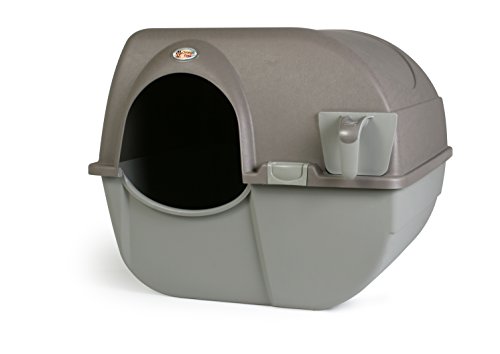 The honest sub-$150 answer
Omega Paw Roll 'n Clean (large)
Not automatic and not pretending to be. Roll it, sift it, empty a tray. No power, no consumables beyond litter, nothing to fail. Also available in a regular size for cats under about 10 lb.
Check price on Amazon The litter to run in any of them
Arm & Hammer Clump & Seal Platinum
Hard clumps that survive a drum rotation or a sifting grate. Clump strength is what makes every mechanism on this page work.
Check price on Amazon Under any box
Gorilla Grip Litter Mat
Automatic boxes do not stop tracking, and budget ones scatter more because the drums sit lower. A mat is the cheapest fix on this page.
Check price on AmazonBudget automatic litter boxes: FAQ
What is the best budget automatic litter box?
The PETKIT PuraMax 2 for most people: it is the cheapest box that still has a rotating drum, a published multi-sensor suite, and no proprietary consumables. The Neakasa M1 Plus Lite is the pick if your cat refuses enclosed boxes. Below about $150, a manual sifting box such as the Omega Paw Roll 'n Clean is a better use of the money than any powered box in that range.
Are cheap automatic litter boxes worth it?
Around the $250 to $300 mark, yes, for multi-cat homes and anyone whose scooping consistency is the weak link. Below about $150, powered boxes start trading away the sensor depth, capacity and build quality that make the design work at all, and the money is better spent on a manual sifting box plus good litter.
What is the cheapest self-cleaning litter box that actually works?
By running cost, the Omega Paw Roll 'n Clean, because it has no running cost beyond litter. By sticker price among powered boxes, the PetSafe ScoopFree, but its crystal trays are a recurring purchase that can exceed the price of the box within a year or two of ownership.
Do budget automatic litter boxes have safety sensors?
The ones worth buying do, and they publish the detail: how many infrared sensors, how many weight sensors, and the cat weight range they are calibrated for. Treat a listing that says only "safety sensor" with no specifics as a listing that has not told you anything. Regardless of price or sensor count, no kitten or very small cat should have unsupervised access to any automatic box.
How much does it cost to run an automatic litter box per year?
For a drum box taking ordinary clumping litter, roughly the cost of the litter you were already buying, plus liner bags and a carbon filter. For a tray-based system, add the trays, which are consumed on a schedule and are the largest line item in the whole calculation. Electricity is negligible on every model.
Can I use regular clumping litter in a budget automatic box?
In the drum-based boxes here, yes, and hard-clumping is what they need. Soft or crumbly clumps break apart during rotation and end up back in the clean litter. Tray-based systems such as the ScoopFree are the exception: they are built around the maker's crystal trays and do not take clumping litter.
Related reading
Still deciding whether to automate at all? Are automatic litter boxes worth it walks the cost math without assuming the answer, and our full automatic litter box roundup covers the premium tier this page deliberately skips.
Whichever box you land on, the right litter is what keeps the mechanism working, and the best litters for odor control handle the half of the problem no machine solves. For small spaces, litter box smell in a small apartment is the room-level playbook.