Leaving Your Cat While You Travel: What Gear Covers, and What It Doesn't (2026)
One night is a non-event. A weekend is a hardware problem. Six days is a people problem that hardware only supports. Here is what to buy for each tier, and the honest line past which a feeder stops being an answer.
Some links below are affiliate links. If you buy through them, MeowTested may earn a small commission at no extra cost to you, including as an Amazon Associate, where we earn from qualifying purchases, and as a partner of Whisker, the maker of Litter-Robot. We only recommend products that pass our Fit Analysis — and we publish the ones that don't.
Under 24 hours, a healthy adult cat needs nothing you do not already own: full bowls, a clean box, a closed window. Two to three days is where hardware earns its money — a locking-lid automatic feeder, a large-reservoir fountain, and a second litter box turn a stressful weekend into a routine one.
Past roughly three days, the honest answer is that gear supplements a person rather than replacing one. Vet-authored guidance is consistent on this: healthy adult cats are fine alone for a normal 8-12 hour day, most professionals treat about 24 hours as the ceiling for a genuinely unattended cat, and anything longer is a sitter or a boarding decision. A feeder can carry the food; nobody has built the thing that notices a blocked bladder, a vomiting cat, or a fountain that tipped over on day two. Buy the hardware to make a sitter's visits shorter and less frequent, not to delete them.

Why this question is asked so badly
The question people search is "how long can I leave my cat alone." The question they actually need answered is "what breaks first, and how long does it take." Those are different, and the second one is buyable.
A cat left alone does not decline steadily. It is fine, fine, fine, and then one specific thing fails: the bowl empties, the water goes stale or gets knocked over, the box gets bad enough that the cat picks a rug instead, or the cat stops eating and nobody sees it for four days. Each failure has a different timeline and a different fix. Sorting the gear by trip length works because trip length is really a proxy for how many of those failures you have to design around.
This guide is research and spec comparison plus what cat owners consistently report — we have not left a cat alone for six days to find out, and you should distrust anyone who says they have as a product test.
What each trip length actually requires
| Away for | What fails first | What covers it | Human needed? |
|---|---|---|---|
| Up to 24 hours | Nothing, for a healthy adult cat | Full bowls, clean box, blinds open | No |
| 2-3 days | Water quality, box capacity, portion control | Automatic feeder, large fountain, second box | One check-in is a good idea |
| 4-6 days | The unwatched problem: illness, a jammed feeder, a spilled fountain | All of the above, plus a camera and a person | Yes — visits every 1-2 days |
| 7+ days | Everything above, compounding | Daily sitter visits; hardware is the backup, not the plan | Yes — daily |
| Kittens, seniors, medicated or CKD cats | The timeline collapses at every tier | Gear does not change the answer | Yes, from day one |
Tier 1: overnight and one full day
A healthy adult cat with food, fresh water and a clean box is genuinely fine for a standard workday and for a single night away. This is the tier where people over-buy.
What matters is boring: leave more litter box than you think you need (a full-size open pan holds more usable surface than a hooded box of the same footprint), leave the blinds up on a window with something happening outside, and leave water somewhere the cat cannot tip it — a wide-based fountain or two bowls in different rooms, so one accident is not the whole supply.
The one purchase worth making at this tier is the one you will use every week anyway: a fountain, because a cat that drinks more is a cat with fewer urinary problems, and that is true whether you are home or not. Our easy-to-clean fountain roundup covers that decision on its own terms.
Tier 2: the two-to-three day weekend
This is the tier hardware was built for, and the tier where the specs actually matter.
The feeder problem is not dispensing, it is defending. Every automatic-feeder thread eventually produces the same complaint: the cat learned to open it, tip it, or paw food out of the chute. That is why a locking or latching lid is a buying spec, not a feature — the PetSafe 6 Meal uses a clear locking lid over a rotating tray carousel, so there is no hopper column for a determined cat to shake loose, and each of its six compartments holds up to a cup. Six meals across a long weekend, with the food physically inaccessible until its slot comes up.
Hopper feeders like the Simply Feed trade that for capacity: 24 cups, portions from 1/8 to 4 cups, up to 12 meals a day. For a trip, the meaningful spec is the portion granularity, not the hopper size — small, frequent meals are what stop a cat inhaling three days of food on day one, and they are also what keep the food in the bowl fresh enough to still be interesting on day three.
Water is the failure people forget. A standard fountain reservoir is often a litre or less, which is fine when you top it up daily and a problem when nobody does. Look for a stated reservoir capacity in litres or ounces before you look at anything else; 2.5 L / 84 oz is enough for one cat for several days with evaporation headroom, and a stainless or ceramic basin holds up better than plastic over a multi-day sit without a clean.
Add a second litter box. This is the cheapest thing on this page and the one that most reliably prevents the expensive outcome, which is a cat that decides mid-trip the box is unusable and re-homes itself onto a rug. Two boxes for one cat over a weekend is not indulgence, it is capacity.
Tier 3: four to six days, and the part nobody wants to hear
Past about three days the constraint stops being supply and starts being observation.
Everything in tier 2 keeps working for six days on paper. What does not scale is the thing that catches problems: a urinary blockage that becomes an emergency in under 48 hours, a cat that quietly stops eating on day two, a feeder that jams on a piece of oversized kibble, a fountain knocked into a rug. None of those announce themselves, and every one of them is caught in about four seconds by a person standing in the room.
So the honest structure for a six-day trip is: hardware carries the routine, a human carries the exceptions. The gear is still worth buying, because it changes what the visits have to accomplish. Without it, a sitter has to come twice a day to feed. With it, a sitter can come every other day to look, scoop, top up water, and confirm the cat is behaving like itself — which is both cheaper and easier to ask of a neighbour.
A camera is what makes that arrangement work, and it is the one product on this page whose value is genuinely proportional to trip length. Two-way audio matters less for the cat than for you: what you are really buying is the ability to check that the cat has moved, eaten, and used the box, and to tell your sitter what to look at before they drive over. Pan-tilt models are worth the difference over a fixed lens for exactly one reason — a cat that is out of frame is not information.
One thing to say plainly, because it is the question underneath the six-day version of this search: a cat that hides for the first two days of your absence is not necessarily a cat in distress. Cats left with a familiar environment, their own smells and a predictable food schedule generally cope better with being at home alone than with being boarded. The stress case for hiring a sitter is not that the cat is lonely; it is that nobody is watching.
The travel kit, by tier
Prices move constantly, so we do not quote them. Buy the tier you actually travel at, not the one you might.
MeowTested PickPetSafe Healthy Pet Simply Feed
The trip feeder. 24-cup hopper, up to 12 meals a day, portions from 1/8 to 4 cups, and a slow-release mode. The fine portion control is the point: small frequent meals beat one enormous one on day one.
Check price on Amazon Best against a determined cat
PetSafe 6 Meal Automatic Feeder
Clear locking lid over a six-compartment rotating tray, up to one cup per slot. No hopper column to shake loose. Runs on D-cells rather than mains power, which also makes it the one to take to a sitter's house.
Check price on Amazon If you want to watch it dispense
PETLIBRO Granary 5L Wi-Fi feeder
5 L capacity, up to 10 meals a day, a low-food sensor and app alerts for empty tank or jammed chute, plus an infrared sensor that stops dispensing if the outlet blocks. The alerting is what you are paying for on a long trip.
Check price on Amazon Reservoir that lasts the trip
PETLIBRO cordless fountain, 2.5 L / 84 oz
Stainless drinking surface and a stated 2.5 L reservoir, which is the spec that matters when nobody is topping it up. Cordless pump means no cable for a bored cat to work on.
Check price on Amazon Ceramic alternative
PetSafe Drinkwell Pagoda
Ceramic basin, 70 oz, dual free-falling streams. Heavier and harder to tip than plastic, and it stays cleaner across several unattended days. Our pick when the fountain lives somewhere it can be knocked.
Check price on Amazon Eyes on the room
Petcube Cam 360
1080p with 360-degree pan-tilt, 8x zoom, night vision to about 30 ft and two-way audio. Pan-tilt is the spec that matters: a cat out of frame tells you nothing.
Check price on Amazon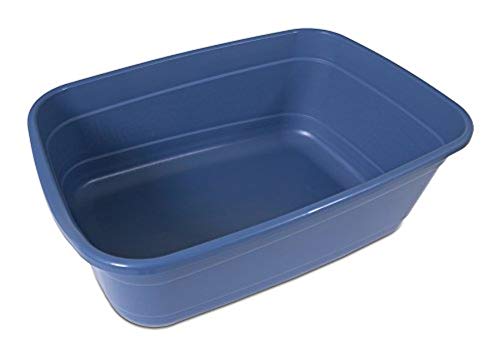 The cheapest insurance here
Petmate Giant Litter Pan
A second, oversized open pan is the highest-value $20 on this page. More usable surface means the box stays acceptable longer, and a cat that rejects one box mid-trip still has somewhere legitimate to go.
Check price on AmazonThe four things that actually fail while you are gone
1. The feeder jams or gets defeated. Large or irregularly shaped kibble is the usual culprit in hopper designs; a cat that has worked out the lid is the usual culprit in everything else. Mitigate both: run the feeder for a full week before the trip with the exact food you will leave, and put a day's backup food somewhere the cat cannot reach but a sitter can.
2. The water goes. Tipped, evaporated, or turned into something the cat will not drink. The fix is redundancy, not capacity — a fountain and a heavy ceramic bowl in a different room. Fountains also need to be started clean; a reservoir that was already due a wash before you left will be worse on day four. Our fountain cleaning guide covers the pre-trip version of that job.
3. The box fills. This is the most common cause of mid-trip accidents and the easiest to prevent. Two boxes, both scooped and topped up the morning you leave. If you run an automatic box, leave a manual one out as well — a jam you would notice in ten minutes at home is four days of no box while you are away.
4. The cat gets sick and nobody knows. This is the one that hardware cannot solve and the reason the tier table has a "human needed" column. Leave your vet's number and your cat's history with whoever is checking, and make sure they have a way in that does not depend on you answering your phone in another time zone.
Test the entire setup a week before you leave, with the cat in the house and you in the next room. Every failure mode on this page is cheap to discover on a Tuesday and expensive to discover from an airport.
The pre-trip checklist
- One week out: run the feeder on its trip schedule with the food you will actually leave. Watch a full cycle dispense.
- One week out: deep-clean the fountain, replace the filter, and confirm the pump is quiet. A noisy pump is a pump about to stop.
- Three days out: confirm your sitter or check-in person can get in, and that they have your vet's details and your cat's medical history.
- Day of: scoop both boxes and top the litter up. Fill the feeder and the fountain. Put a spare day of food somewhere the cat cannot get to.
- Day of: close anything a cat should not be behind for six days — dryers, wardrobes, the room with the houseplants — and leave the blinds up on one good window.
- Day of: leave a rotated-in toy out, not a new one. Novelty helps; a brand-new toy nobody is supervising is a swallowed toy. Our workday enrichment guide has the rotation system.
Frequently Asked Questions
How many days can a cat really be left alone?
Vet-authored guidance clusters around the same answer: a healthy adult cat is fine for a normal 8-12 hour day, roughly 24 hours is the ceiling for a genuinely unattended cat, and anything beyond that should include someone physically checking in. Food and water are solvable past 24 hours; nobody checking on the cat is not. Kittens, seniors, and cats on medication or with kidney or urinary history are outside this rule entirely.
Can an automatic feeder replace a pet sitter for a week?
No. It can replace the feeding half of a sitter's visit, which is genuinely useful — it turns twice-daily visits into every-other-day visits and makes the ask small enough for a neighbour. It cannot notice a jam, a refusal to eat, or a cat that is unwell, and those are the reasons the visits exist.
Is boarding better than leaving a cat at home with a sitter?
For most cats, home with visits is the lower-stress option: familiar territory, familiar smells, no carrier, no transport, no other animals. Boarding makes more sense when the cat needs daily medication, has a condition that requires monitoring, or when nobody reliable can visit. The decision is about supervision needs, not about company.
How much litter box do I need for a five-day trip?
Two boxes for one cat, both scooped and freshly topped up on the day you leave, plus one extra box per additional cat. The standard n+1 rule is a minimum for daily life; when nobody is scooping, treat it as the floor rather than the target. If you use an automatic box, leave a manual one out too — a jam you would fix in minutes at home is days without a box while you are away.
Will my cat be lonely?
Cats vary far more than the stereotype allows, and some are genuinely social with their people. But loneliness is not usually the risk you are managing on a trip — the risks are water, litter capacity, and an unnoticed illness. A camera with two-way audio is worth buying for what it tells you, not for what it says to the cat.
Do I need a Wi-Fi feeder, or is a timer enough?
For a weekend, a good timer feeder with a locking lid is enough. For four days or more, the alerting is what you are paying for: a low-food sensor and a jam notification turn "I hope it is still dispensing" into something you actually know. If your home Wi-Fi is unreliable, a battery-powered timer feeder is more dependable than a smart feeder that needs the router to stay up.
Where to go next
If you are buying one thing from this page, buy the thing you will use every week rather than the thing you will use twice a year: the fountain. Our easy-to-clean cat water fountain guide ranks them on the maintenance that actually determines whether one stays in service, and why cats need running water explains why it matters more than the trip. On the box side, best automatic litter boxes covers the automation decision, and if you are working out whether it is worth it at all, the honest cost math does not assume the answer.