Best Heated Cat Beds and Warm Spots (2026): What Is Safe, and What Is Enough
Your house is colder than your cat wants it, and the gap is bigger than most people realize. The safety criteria worth checking, why a good heated bed feels barely warm to your hand, and when a $20 mat or a sunny windowsill does the same job.
Some links below are affiliate links. If you buy through them, MeowTested may earn a small commission at no extra cost to you, including as an Amazon Associate, where we earn from qualifying purchases, and as a partner of Whisker, the maker of Litter-Robot. We only recommend products that pass our Fit Analysis — and we publish the ones that don't.
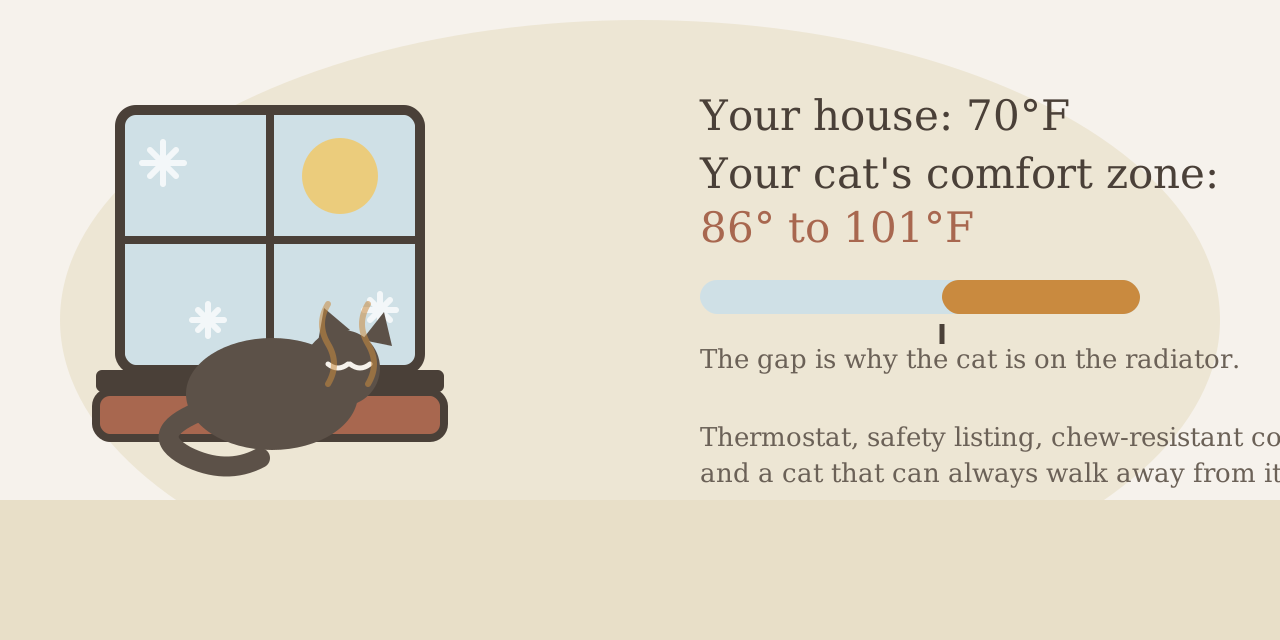
A cat's thermoneutral zone runs roughly 86 to 101°F — the range where they hold body temperature without spending energy on it. Your house is probably 68 to 72. That gap is not a preference, it is the reason your cat is on the radiator, in the laundry, and on your keyboard.
For most indoor cats, buy one thermostatically controlled bed and put it where the cat already sleeps. A K&H Thermo-Kitty Bed runs a 4-watt heater under a washable cover, warms to about 10 to 15 degrees above room temperature when empty, and comes up to the cat's own body temperature once the cat is on it. That last part is why it will feel unimpressive to your hand. It is meant to.
The safety story is real but it is not about pet beds. There is no heated-pet-bed recall. What CPSC acted on in 2026 was a human product: 178,000 heated Sherpa throws sold on Amazon, pulled after 555 reports of melting, sparking or smoking, 27 fires and 15 injuries. The lesson for cat owners is narrow and important — do not substitute a human electric blanket or heating pad for a pet bed. They are built to different assumptions.
And a lot of cats need no electricity at all. A mylar-core self-warming mat reflects the cat's own heat back and insulates from a cold floor, and a window perch in a sunny window is the warmest free thing in your home. Both are honest answers, with real limits, covered below.

Your house is colder than your cat wants it
Start with the number, because it reframes the whole purchase. The American Veterinary Society of Animal Behavior puts a cat's thermoneutral zone at roughly 86 to 101°F — the band where an animal maintains its core temperature without burning extra energy to do it. Dogs sit far lower, around 68 to 95. The AVSAB piece makes the consequence vivid by counting the days one Bay Area home actually spent inside a cat's comfort range in a year: eight.
Domestic cats descend from desert animals and we keep them in rooms heated for people wearing clothes. That is not an emergency, and a healthy cat in a 70-degree house is not suffering. But it does explain a long list of behaviours that owners usually read as personality:
- Sleeping in a tight curl rather than stretched out
- Parking on heating vents, laptops, radiators and the warm patch you just left
- Following the sun around the room through the day
- Burrowing under blankets, or into the airing cupboard
Some cats feel the gap more than others. Kittens, seniors, thin cats, and cats with arthritis, kidney disease or hyperthyroidism have less margin, and for them a warm resting place stops being a comfort item. Arthritic cats in particular tend to settle longer and move more easily off a warm surface.
One honest caution before the shopping. A cat that suddenly starts seeking heat much more than it used to is telling you something. New heat-seeking alongside weight loss, more drinking, a scruffier coat or reluctance to jump is a vet conversation, not a bed purchase. Buy the bed because your cat is a cat, not to manage a change you have not had looked at.
The safety question, answered properly
Search for heated pet beds and you will hit a wall of alarming headlines about heated products catching fire. It is worth separating what actually happened from what it means for a cat bed, because the honest answer changes what you should buy.
There is no heated-pet-bed recall. What CPSC did act on, in 2026, is a human product: Octrot recalled about 178,000 heated Sherpa throws and blankets sold on Amazon after the cord was found able to come off, with 555 reports of melting, sparking or smoking behind 27 fires and 15 injuries.
That matters here for one specific reason. When people find heated cat beds expensive, the common workaround is a human heating pad or an electric throw under a blanket. Do not do that, and the reason is design rather than brand:
- A purpose-built indoor pet bed in this class runs a 4 to 6 watt element through a low-voltage transformer, with an internal thermostat that targets an animal's body temperature. A human electric throw runs a much larger load through fabric and expects a person who will notice discomfort and get up.
- Human heating pads are built for supervised, time-limited use. Many have auto shut-off precisely because they are not meant to run under a sleeping body for eight hours.
- No human product's cord is designed to be chewed by an animal, and cats chew cords.
The useful takeaway from the recall is not "heated things are dangerous." It is that the cheap end of Amazon-sold heated textiles is where the failures cluster, and that a product's listing being full of safety adjectives is not the same as the product being certified.
The five things to check on any heated bed
These are criteria drawn from product documentation and the CPSC notices above. MeowTested has not bench-tested heated beds, and nothing here is a measured result. It is what to look for on the listing before you buy.
- A real safety listing on the whole product, not the cord. MET Labs and UL are the two you will see. K&H's heated line, for example, states MET certification of the complete product rather than just a component. If a listing says "premium safety materials" and never names a certifying body, treat that as unlisted.
- An internal thermostat, not a heat setting. The bed should target a temperature by itself. Anything giving you five manual heat levels is built on a human-blanket assumption: that whoever is on it will notice and adjust.
- Low wattage for indoor use. 4 to 6 watts is normal and correct for an indoor cat bed. Outdoor and garage pads run higher (20 to 40W) because they are fighting real cold, and those should be waterproof-rated and outdoor-listed.
- A chew-resistant cord. The good ones say so specifically. K&H's outdoor pad, for instance, caps the first 18 inches of cord in steel and rounds the pad's edges to reduce chewing surfaces. If your cat is a known cord-chewer, this moves from nice to mandatory, and a no-electricity option becomes the better answer.
- A removable heater and a washable cover. A bed you cannot wash is a bed that becomes a smell. This is more important than it sounds: cat furniture is one of the great hidden odour reservoirs in a home, and the fleece a cat sleeps on every night for a winter holds a great deal. If the cover does not come off, skip it.
And one rule that outranks all five, straight from the AVSAB guidance: the cat must always be able to leave the heat. Never wrap a cat in a heated item, never confine one to a heated surface, and never use a heated pad for a cat that cannot reliably move itself off one.
Which warm spot for which cat
| Your situation | What to get | Why |
|---|---|---|
| Healthy adult cat, ordinary heated house | Thermostatic heated bed in their existing favourite spot | The default. Low wattage, self-regulating, and it moves the cat off your keyboard. |
| Senior or arthritic cat | Heated bed, placed at floor level | Least margin for cold, most benefit from steady warmth, and no jump required to reach it. |
| Cat that chews cords | Self-warming mylar mat — no cord at all | Removes the hazard rather than mitigating it. Nothing to gnaw, nothing to unplug. |
| You do not want a cord across the room | Unheated window perch in your sunniest window | Sunlight is free heat and the cat is already trying to get there. |
| North-facing home, or a dark winter window | Heated window perch | Keeps the view, which is half the appeal, when the sun is not supplying the warmth. |
| Garage, porch, shed or barn cat | Outdoor-rated heated pad | Higher wattage, waterproof, steel-capped cord. An indoor bed is not rated for this and should not be used for it. |
| Cat that cannot move off a heat source by itself | No heated product unsupervised | The thermostat protects a cat that can walk away. The walking away is the actual safety feature. |
Why a good heated bed feels like it is not working
This is the single most common reason people return one, so it is worth stating plainly before you buy.
K&H's own specification for the Thermo-Kitty line is that the internal thermostat warms the surface to about 10 to 15 degrees above the surrounding air when nobody is on it, then brings it up toward the cat's normal body temperature once the cat settles. In a 70-degree room, an empty bed sits around 80 to 85. Put your hand on it and it will feel faintly, unimpressively warm — cooler than your own palm.
That is correct behaviour, not a fault. A pad that feels hot to a human hand is running well above a cat's body temperature, which is where burns and thermal injury come from. The comparison people reach for is a hot water bottle, and the comparison the product is built on is a sleeping littermate.
Two practical consequences:
- Give it a night before judging it. Warmth builds while the cat is on it. Checking it empty tells you almost nothing.
- Placement beats power. A correctly warm bed in a draughty corridor loses to a cool one in the spot your cat already chose. Watch where your cat sleeps for a few days first, then put the bed exactly there. Cats are conservative about sleeping sites, and a new bed in a new location is often read as neither.
The no-electricity tier, honestly assessed
Self-warming mats are the useful budget answer and they are also the most oversold category here, so here is what they actually do.
They contain a mylar or similar reflective layer under a fabric top. Body heat that would radiate down into a cold floor gets reflected back, and the insulating batting stops the floor pulling heat out by conduction. That is it. They generate nothing. A Furhaven ThermaNAP is listed at a quarter of an inch thick, so what you are buying is insulation plus a reflector, not a heater.
Where that is genuinely the right purchase:
- Cord chewers, where an electric bed is simply a bad idea
- Hard floors — tile, laminate, concrete — where a cat is losing heat downward all night
- Carriers and crates, including vet trips, where nothing can be plugged in anyway
- Multi-cat homes, where three mats cost less than one heated bed and warm spots are worth spreading around
And the honest limitation: a self-warming mat only works once the cat is already on it and staying put. A heated bed is warm before the cat arrives, which is exactly what draws a cat over and what makes it useful for a cat you are trying to move off the good armchair. A self-warming mat has no such pull. If your goal is relocating a cat rather than making an existing spot cosier, the electric one earns its price.
The larger Milliard thermal mat at a listed 21 by 17 inches is the version to buy if you want to cover a crate floor or a windowsill rather than give one cat one nest.
The windowsill is the cheapest heat in the house
Before spending anything on watts, look at what your cat is already doing. A sunny window is the warmest surface in most homes for several hours a day, it costs nothing, and it comes with the one enrichment feature no bed provides: something to watch. It is also, usefully, a vertical spot — and vertical territory is the honest answer to a cat that keeps ending up somewhere you would rather it did not, which we cover in how to stop a cat scratching furniture and how to entertain a cat while you are at work.
Three specs decide whether a perch works, and only one of them is about comfort.
- Sill depth. The K&H Kitty Sill mounts to a sill as shallow as 2 inches using hook-and-loop straps, with screws in the box for a permanent fit. Measure before ordering. This is the reason most perch returns happen.
- Weight rating and how it mounts. The Kitty Sill models are rated to 40 lb, which is far beyond any cat and is really a statement about a nervous cat launching off it. Bracket and sill-mounted designs are steadier than suction cups, which fail on textured or cold glass and tend to let go in winter, which is exactly the season you bought it for.
- A removable, washable cover. This is the one people skip. A perch is where a cat sleeps for hours a day in direct sun, and warm fabric plus cat is how a room starts to smell of cat without the litter box being at fault. If it does not come apart for the wash, it is a slow problem. Same logic we apply in how to eliminate litter box smell: the sources people miss are the soft furnishings, not the box.
Heated or unheated? Buy unheated if the window gets real sun. Buy the heated version if your best window faces north, if winter where you live is genuinely dark, or if the sill itself is a cold-air draught in January. Both K&H sills list at 14 by 24 inches, so the footprint decision is already made for you.
What we would buy
Selected on published specifications, stated safety certifications and the CPSC notices above. MeowTested has not bench-tested heated beds and claims no measurements of our own; dimensions and wattages come from the manufacturers and from Amazon product data. Prices move constantly, so we do not quote them.
Start hereK&H Thermo-Kitty Bed (Small, 16in, 4W)
The default indoor answer. A 4-watt element with a dual thermostat sits under a thick pillow base, the heater lifts out so the cover is machine washable, and the whole product carries a MET safety listing rather than just a listed cord. Listed at 16 x 16 x 6 inches and 1.35 lb. The large 20-inch version exists for cats who sleep stretched out rather than curled.
Check price on Amazon No electricity
Furhaven ThermaNAP self-warming mat (Large)
A quilted faux-fur mat with a reflective mylar layer that returns the cat body heat a cold floor would otherwise take. Listed at 36 x 24 inches and a quarter-inch thick, fully machine washable. This is the right buy for cord chewers, tile and laminate floors, crates and carriers, and for spreading several warm spots around a multi-cat house cheaply.
Check price on Amazon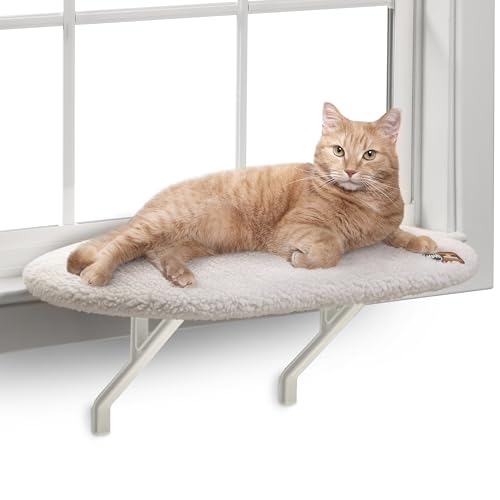 Free heat
K&H Kitty Sill window perch, unheated (24 x 14in)
Sun is the cheapest warmth available and a perch is how a cat gets a whole body into it instead of half. Mounts to a sill from 2 inches deep with straps or screws, rated to 40 lb, washable cover, listed at 14 x 24 inches and 1.45 lb. Buy this rather than the heated version if the window actually gets sun.
Check price on Amazon Dark windows
K&H Heated Kitty Sill (24 x 14in)
The same perch with a removable low-wattage heater and an internal thermostat, MET safety listed. The case for it is narrow and real: a north-facing window, a dark northern winter, or a sill that is a cold draught for four months. If your window gets sun, the unheated one does the same job for less.
Check price on Amazon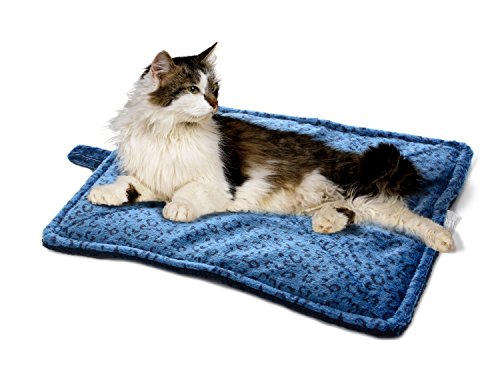 Cover an area
Milliard self-heating thermal mat (21 x 17in)
Same reflective principle, reversible, and shaped for covering a surface rather than nesting one cat. Listed at 21 x 17 x 1 inches and half a pound. Good on a windowsill the cat already uses, in the bottom of a carrier, or on a hard chair seat, and cheap enough to buy two and find out where your cat votes.
Check price on Amazon Garage and outdoors
K&H Extreme Weather Kitty Pad (Small, 12.5 x 18.5in, 40W)
For a garage, shed, porch or feral shelter, where an indoor bed is not rated to go. Waterproof ABS construction, an internal thermostat, MET listed for outdoor use, 40 watts because it is fighting real cold, and the detail that matters most for an unsupervised animal: the first 18 inches of cord is capped in steel and the edges are rounded to give a chewing cat less to work with. Listed at 2.7 lb.
Check price on AmazonTwo cats should not be left on a heated surface unsupervised, whatever the thermostat says: a cat that cannot reliably move itself off one, and a cat that has lost sensation in its feet. That includes very young kittens, cats recovering from sedation or anaesthesia, cats whose mobility has declined to the point where changing position is hard work, and diabetic cats with neuropathy. Every safety system on these products assumes an animal that will get up when it has had enough. If that assumption does not hold for your cat, use an unheated bed in a warm room and ask your vet what they would do.
Frequently Asked Questions
Are heated cat beds safe to leave on all the time?
A thermostatically controlled, safety-listed pet bed is designed for continuous use, which is the difference between it and a human heating pad. The conditions are that the product carries a real listing from a body such as MET or UL, that the cord is intact and not chewed, that it is not run under a blanket or inside a covered space that traps heat, and that the cat can always leave. Inspect the cord at the start of every winter, and stop using anything that has been gnawed rather than taping it.
Can I use a human heating pad or an electric blanket instead?
No, and the 2026 recall of 178,000 heated Sherpa throws sold on Amazon is a good illustration of why the cheap end of that category is the wrong place to economise. Human heated textiles run far more power through fabric, are built for supervised and time-limited use, often rely on the person noticing discomfort, and have cords never intended to be chewed. A 4-watt pet bed with an internal thermostat is a genuinely different product, not a marked-up version of the same thing.
My cat ignores the heated bed. What went wrong?
Almost always placement, occasionally patience. Cats pick sleeping sites for security and habit as much as warmth, so a new object in a new location gets treated as neither. Watch where your cat already sleeps for a few days and put the bed exactly there, ideally replacing something they already like. Give it a week, resist washing it immediately since their own scent is doing recruitment work for you, and remember the bed feels barely warm when empty by design. If they still refuse, a sunny window perch is often what they wanted all along.
Do self-warming mats actually work?
Yes, within a narrow definition. A mylar layer reflects the cat body heat that would otherwise disappear into a cold floor, and the batting slows conduction. It measurably improves a cold hard surface. What it cannot do is be warm before the cat arrives, so it will not attract a cat to a new spot and it will not help a cat that is cold because the room is cold. Buy one for a cord chewer, a tile floor, a crate, or as a cheap way to add several warm spots at once.
How warm should the bed actually feel?
Barely warm, and cooler than your hand. Manufacturers in this class target roughly 10 to 15 degrees above ambient when unoccupied, rising toward the cat body temperature of around 101°F once the cat settles. Something that feels hot to a human palm is running above a cat body temperature, which is the wrong direction. Judge it after a night of use rather than by touching an empty one in the shop.
Is a heated bed a substitute for heating the house?
For a healthy adult cat in a normally heated home, a warm resting place is the efficient answer, since a cat spends most of the day asleep and heating one bed costs a rounding error compared with heating rooms. It is not a substitute in a genuinely cold house. A cat still moves around, eats, uses a litter box and drinks, and a warm pad does nothing during any of that. If your home drops close to freezing, the answer is heat and insulation, and a vet conversation for any senior, thin or unwell cat.
Where to go next
The short version: one thermostatic bed, placed where the cat already sleeps, is the whole purchase for most homes. Add a window perch if you have a sunny window, because it costs less and delivers something a bed cannot. Skip electricity entirely if your cat chews cords.
If the reason you are here is that your cat keeps commandeering somewhere you would rather it did not, warmth is usually only half of the answer, and the other half is vertical space and something to look at: see how to entertain a cat while you are at work and our interactive toy picks for indoor cats. If you are working out how to make a whole house work for an indoor cat, we tested 10 catios is the bigger version of the same question.