How to Get Cat Pee Out of Fabric, for Good
Cat urine survives normal washing because its uric acid crystals don't dissolve in water — which is why the couch still smells on humid days three washes later. The protocol that actually works: find every spot with a UV light, break the crystals down with an enzyme cleaner, and never let heat near it until the smell is gone.
Some links below are affiliate links. If you buy through them, MeowTested may earn a small commission at no extra cost to you, including as an Amazon Associate, where we earn from qualifying purchases, and as a partner of Whisker, the maker of Litter-Robot. We only recommend products that pass our Fit Analysis — and we publish the ones that don't.
Cat urine is the one household mess where the usual cleaning instincts make things worse. Its odor comes from uric acid crystals that don't dissolve in water, so detergent, vinegar, and scrubbing leave them in the fabric — dormant until humidity reactivates them. Heat is worse still: a dryer cycle or steam cleaner bakes the proteins in permanently.
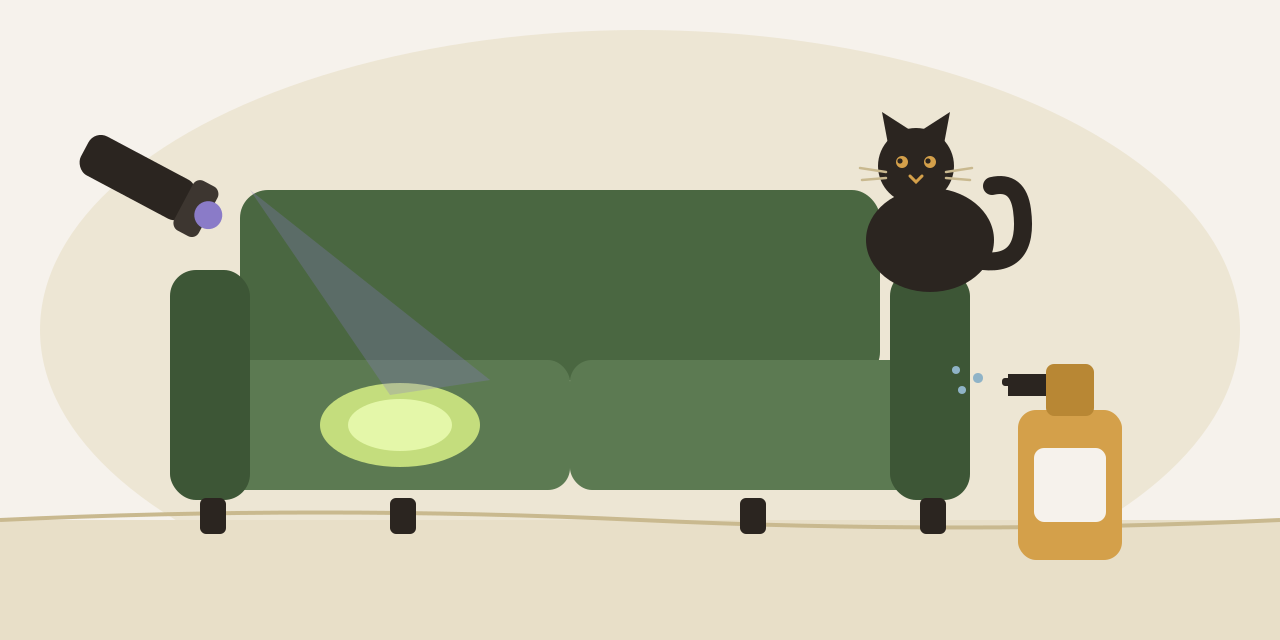
The fix is a protocol, not a product: find every spot with a 365nm UV flashlight (there is almost always more than the one you know about), saturate each one with an enzyme cleaner — not a light misting; the cleaner has to reach everywhere the urine did — keep it wet long enough for the enzymes to work, and air dry only until the smell is fully gone. For the cleaner itself we can speak from experience: when one of our own cats went through an outside-the-box stretch, Nature's Miracle Urine Destroyer Plus paired with a Bissell Little Green extractor is what we used, with good results. The community's other standby, Rocco & Roxie Stain & Odor Eliminator — professional-strength, carpet-institute certified, around $24 — is the strongest spray alternative.
And before you clean anything: a cat who suddenly pees outside the box may be telling you something medical. More on that below — we've been through it with one of our own cats, and the fix wasn't a cleaning product.

Why cat pee beats normal cleaning (the chemistry, briefly)
Cat urine starts as a mix of urea, proteins, and uric acid. The urea and proteins wash out — that's why a freshly washed blanket smells fine coming out of the machine. The uric acid stays, bound to the fabric as microscopic crystals that are essentially insoluble in water, vinegar, and ordinary detergent. Then the first humid day rehydrates them, and the smell is back as if you never cleaned anything.
That one fact explains every rule in this guide:
- Soap and water aren't enough. They clean around the crystals, not through them. Only enzymes (specifically, enzyme-producing bacteria in the cleaner) break uric acid into compounds that evaporate.
- Heat is the point of no return. A hot dryer, an iron, or a steam cleaner bonds the residue into the fibers permanently. Nothing goes near heat until your nose says the job is done — on a *dry* sniff test, since damp fabric masks the smell.
- Ammonia-based cleaners backfire twice. Urine breaks down into ammonia, so an ammonia cleaner smells like a competing cat's mark — an invitation to re-mark the spot. Skip them entirely.
- Cats return to spots that smell like a bathroom. A half-cleaned spot isn't half-fixed; to the cat it's still the bathroom. This is why the "find every spot" step below isn't optional.
If your real problem is a litter box that smells even when the cat is using it faithfully, that's a different page — see eliminating litter box smell.
Step one: find every spot, not just the one you stepped in
Dried urine is invisible on most fabric, but it fluoresces under ultraviolet light. A cheap 365nm UV flashlight (the wavelength matters — 365nm shows biological stains much more clearly than the common 395nm party lights) turns a frustrating guessing game into a two-minute sweep.
The method: wait for dark, kill the lights, and work the beam low and slow across carpet, cushion seams, curtain hems, baseboards, and the lower third of walls near any spot you know about. Urine shows up as a dull yellow-green glow — old spots often look like splatter or drips rather than neat circles. Mark each one with painter's tape so you can find it again with the lights on.
Small rechargeable 365nm lights like the UNROEVS mini run about $10 and are more than enough for this job. One honest caveat: UV lights show *lots* of things — spilled drinks, detergent residue, and some pet-food splatter also glow. When in doubt, the nose test on a marked spot settles it.
Most people who do the UV sweep for the first time find spots they had no idea existed. That's not a failure of housekeeping — it's the reason the smell kept coming back.
The laundry protocol: anything that fits in the machine
For clothes, bedding, blankets, towels, and removable cushion covers:
- Blot fresh urine first — press with paper towels, don't rub. Rubbing spreads it deeper and wider.
- Cold rinse before anything else. Rinse the spot under cold water, or run a cold rinse cycle. No hot water — remember the heat rule.
- Pre-soak with enzymes. Either spray the spots thoroughly with your enzyme cleaner and let them sit 15–30 minutes, or soak the whole load for 30 minutes with a cup of enzyme cleaner in cool water. This is the step that actually breaks the uric acid down — skipping it is why "I washed it three times" doesn't work.
- Wash cold with your normal detergent. Skip fabric softener (it coats fibers and can trap residue).
- Air dry — completely. Line, rack, or flat. Not the dryer.
- Sniff test when fully dry, right at the spot. Any trace of smell means one more enzyme pass. One or two repeats on an old or soaked-in accident is normal, not a sign the method failed.
A detail we loved from the community on this one: a Redditor dealing with cat urine on clothing reported that Dead Down Wind — a scent-eliminating laundry detergent made for deer hunters — worked where pet products hadn't. It makes sense: hunters need *actual* odor elimination, not perfume over the top, so hunting detergents are built around enzyme and odor-neutralizing chemistry. It's a clever option to know about, though at the moment most Dead Down Wind listings are backordered — and a standard enzyme pre-soak with any of the cleaners below does the same job on the same principle.
Couches, mattresses, and everything that can't be washed
Upholstery is where cat urine does its worst work, because the liquid travels: through the cover, into the foam, sometimes out the bottom. A light spritz of cleaner on the surface treats maybe the top 10% of the problem — which is why the spot "comes back" every few weeks.
The rule that makes upholstery treatment work: the enzyme cleaner has to go everywhere the urine went. In practice:
- Unzip and check. If covers come off, treat them as laundry (above) and treat the foam separately.
- Saturate the spot generously — pour, don't mist, on serious soaks. You want the cleaner soaking as deep as the urine did.
- Keep it wet while the enzymes work. The trick the pros use: cover the treated spot with plastic wrap and weigh it down. Enzymes stop working when the spot dries out; trapped under plastic, they keep eating uric acid for a day or two instead of a few hours.
- Air dry for as long as it takes — days, for a cushion. A fan speeds it up. Patience here is the whole game.
- Extract if you can. A small spot-cleaning machine like the Bissell Little Green rinses and pulls the broken-down residue (and the cleaner) back out of the foam, which shortens drying dramatically and leaves less behind. Use it with cool water only — never a steam cleaner, which cooks the proteins into the upholstery for good. This pairing — Urine Destroyer plus a Little Green — is exactly what we used on our own cat's accidents, and the results were good enough that it's the combination we'd buy again.
For mattresses, same protocol, plus a waterproof mattress protector afterward — the honest lesson of most repeat-accident stories is that round two lands in the same place.
For wall-to-wall carpet with a serious history, be realistic: urine that reached the pad or subfloor can't be fully fixed from above. Treat generously, extract, and if the smell persists after two full rounds, the pad under that spot — not the carpet — is usually the culprit.
Which cleaner for which job
| Best for | Rough price | |
|---|---|---|
| Rocco & Roxie Stain & Odor Eliminator (32 oz) | The default: fresh accidents, laundry pre-treat, most spots | around $24 |
| Anti Icky Poo, 1 gallon | The stubborn case — old, soaked-in, or repeat marking | around $44 |
| Nature's Miracle Cat Urine Destroyer Plus, 1 gal | What we used ourselves — volume for big soak jobs | around $32 |
| Nature's Miracle Cat Urine Destroyer Plus (32 oz) | The budget spray, same formula we used | around $13 |
| 365nm UV flashlight | Finding every spot before you treat anything | around $10 |
| Bissell Little Green (1400B) | Extracting treated spots — the machine we used ourselves | around $95 |
The cleanup kit, priced
As an Amazon Associate, MeowTested earns from qualifying purchases. Prices move — treat these as bands and check current pricing.
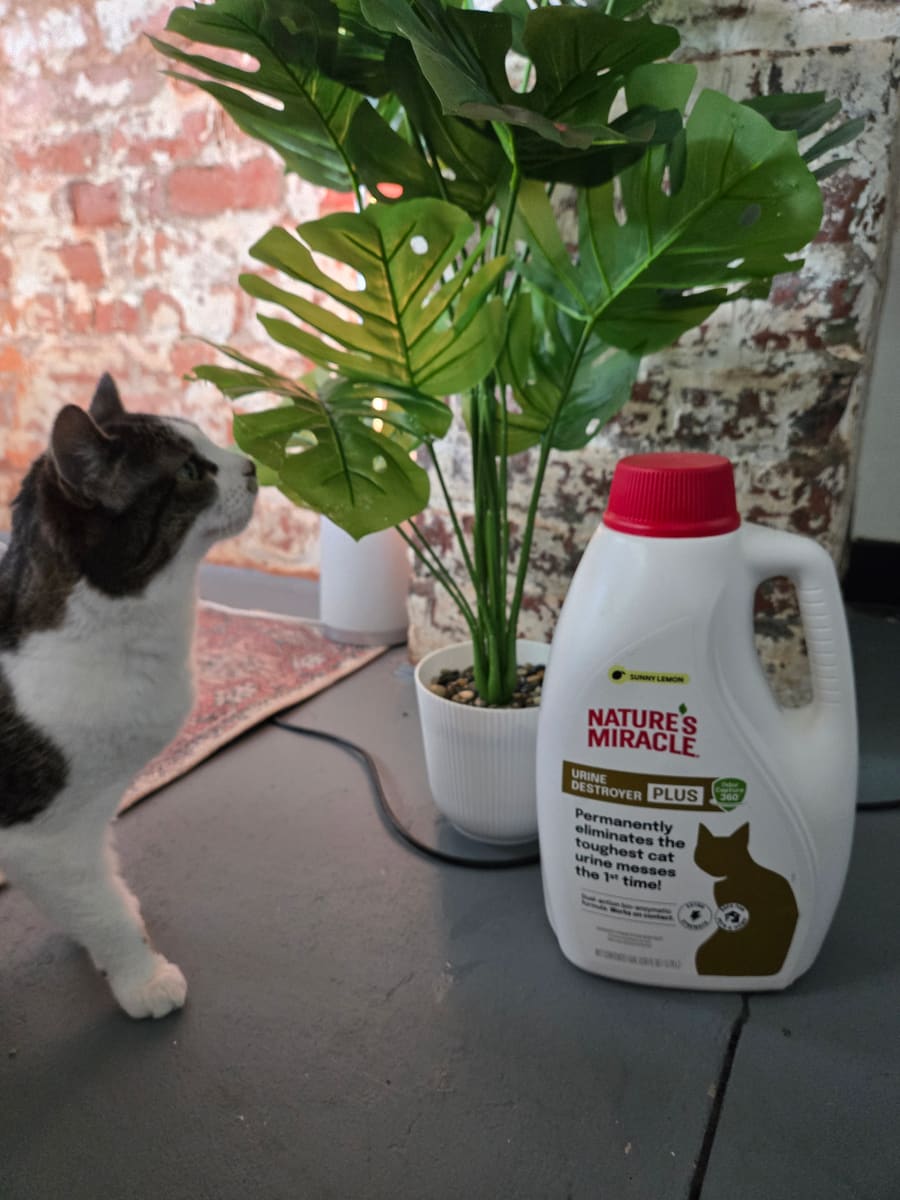
What we usedNature's Miracle Cat Urine Destroyer Plus, 1 gallon
The jug in our photo above: the cat-specific enzyme cleaner we used on our own accidents, pourable by the gallon so you can genuinely saturate a cushion or mattress instead of misting it. Around $32.
Check price on Amazon Budget size
Nature's Miracle Cat Urine Destroyer Plus (32 oz)
The same formula we used, in the everyday spray size. Around $13.
Check price on Amazon Community favorite
Rocco & Roxie Stain & Odor Eliminator
Professional-strength bio-enzymatic spray, CRI-certified safe for carpet, and the single most owner-vouched enzyme cleaner in cat threads. Around $24 for 32 oz.
Check price on Amazon The heavy hitter
MisterMax Anti Icky Poo, 1 gallon
The veterinarian-recommended heavy hitter, around since 1989: live bacteria cultures that keep producing enzymes until old, soaked-in odor is actually gone — sold by the gallon for exactly this kind of job. Around $44.
Check price on Amazon Find every spot
UNROEVS mini 365nm UV flashlight
True 365nm wavelength (not the weaker 395nm), rechargeable, pocket-sized. Dried urine glows dull yellow-green in a dark room. Around $10.
Check price on Amazon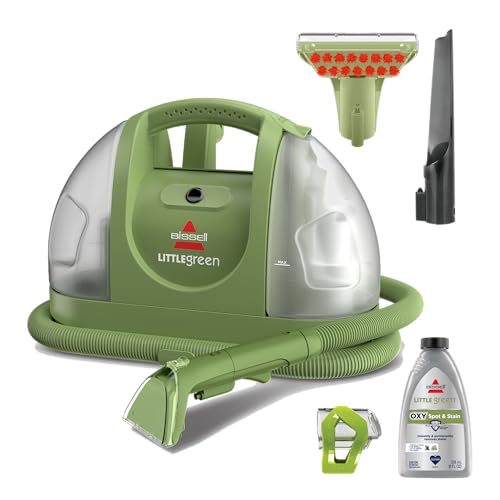 The extractor we used
Bissell Little Green (1400B)
The current version of the small spray-and-suction machine we ran on our own accidents: it rinses broken-down residue back out of cushions and carpet. Cool water only, never steam. Around $95, and it earns its keep on every future mess too.
Check price on AmazonThe part the cleaning aisle won't fix: why the accidents are happening
We can speak to this one first-hand. One of our two cats, Tipper — the more anxious of the pair — went through a stretch of peeing outside the litter box. For the cleanup itself we used Nature's Miracle Urine Destroyer Plus (the gallon jug — it's still on our shelf, below) and a Bissell Little Green, with good results — that's the first-hand basis for the picks above. But what *stopped the accidents* was not a cleaning product. Three changes did it: switching the household litter to Dr. Elsey's Ultra, adding enough litter boxes, and — the one we'd never have guessed — removing the plug-in scent diffusers from the house, which had evidently been stressing her. The accidents stopped, and years later they've stayed stopped.
The general lesson matches what behaviorists say: outside-the-box peeing is information. The usual suspects, roughly in order:
- Not enough boxes. The standard rule is one per cat plus one spare, in different locations — not three boxes side by side.
- The litter or the box changed — new litter texture or scent, a hood added, a liner, a box moved next to a noisy appliance.
- Scent stress. Strong artificial fragrance near the cat's territory (plug-ins, heavily scented litter, carpet powders) can unsettle a sensitive cat. Our experience with Tipper made us permanent believers; it's also why we steer people away from masking smells with fragrance on the house-smell page.
- Stress from change — a new pet, a move, construction, even rearranged furniture.
- An unclean box. If the box fails your nose test at cat height, it failed the cat's an hour ago.
Clean the accident with enzymes so the spot stops advertising itself, then fix whichever of these is the actual cause — otherwise you're scheduling the next cleanup.
A litter-trained cat who suddenly pees outside the box — especially small, frequent amounts, straining, crying in the box, or blood-tinged urine — may have a urinary tract infection, crystals, or a blockage. A male cat straining and producing nothing is an emergency, today. Rule out medical causes before assuming the problem is behavioral; peeing on soft things like laundry piles and bathmats is a classic UTI tell.
Cat urine cleanup: FAQ
Does vinegar get cat pee out of fabric?
Partially, at best. Vinegar neutralizes some of the fresh ammonia smell, which is why it seems to work on day one. But it doesn't break down uric acid crystals, so the core odor source stays in the fabric and returns with humidity. Vinegar is fine as a first-aid rinse on a fresh accident; it is not a substitute for an enzyme cleaner.
Why does the smell come back on humid days?
Dried uric acid crystals are odorless until moisture rehydrates them — then they release their smell again. Humidity, a damp cleaning, or a wet cat sitting on the spot all do it. The smell returning is the proof that a cleaning treated the surface but left crystals behind; it's the signature of every non-enzyme method.
Can I put urine-stained laundry in the dryer?
Only after the smell is completely gone from the fully air-dried item. Dryer heat permanently sets any urine residue that's still in the fabric, and there's no undo. Air dry, sniff test at the spot, repeat the enzyme treatment if needed, and only then return the item to normal laundering.
How long should an enzyme cleaner sit?
Longer than the label's minimum. The enzymes only work while wet — 10–15 minutes handles a fresh surface accident, but an old or deep spot wants hours. For soaked-in upholstery spots, cover the treated area with plastic wrap so it stays wet for 24–48 hours; the enzymes keep working the whole time.
Do OxiClean or hydrogen peroxide work on cat urine?
They help with the visible stain and some of the surface odor — peroxide-based recipes are a reasonable follow-up for discoloration. But oxidizers don't digest uric acid the way enzymes do, and peroxide can bleach or discolor fabric and carpet, so test somewhere hidden first. Enzymes first for the odor, oxidizer after for any remaining stain.
The smell is in the wood floor or subfloor. Now what?
Enzyme-clean the surface generously and let it work, but be realistic: urine that soaked into unsealed wood, plywood subfloor, or concrete often can't be fully extracted. The standard fix once odor persists is sealing — a stain-and-odor-blocking primer over the affected area before refinishing or re-carpeting. Treat the surrounding fabric and pad first so you're not sealing over a fixable problem.
Will cleaning the spot stop my cat from peeing there again?
It removes the invitation — cats re-mark spots that smell like urine, and only enzyme cleaning actually removes that signal. But if the cause is medical, a litter box problem, or stress, the cat will pick a new spot. Clean with enzymes and fix the cause; neither alone is enough.