Do Cat Grooming Gloves Actually Work? An Honest Answer
Mostly yes — but not for every coat and not for every job. Here's what gloves genuinely do well, where they fall short, and when a brush beats one.
Some links below are affiliate links. If you buy through them, MeowTested may earn a small commission at no extra cost to you, including as an Amazon Associate, where we earn from qualifying purchases, and as a partner of Whisker, the maker of Litter-Robot. We only recommend products that pass our Fit Analysis — and we publish the ones that don't.
Yes — for most cats, grooming gloves genuinely work, with one important caveat: they're a tolerance tool, not an extraction tool.
A glove excels at removing loose surface fur from a cat that won't sit still for a brush — which is most of the battle for most owners. It will not reach deep undercoat on a heavy shedder, and it does nothing for mats.
- Cat flees when the brush comes out: a glove is the best first tool you can buy
- Long-haired heavy shedder: pair the glove with a proper deshedding tool
- Cat already tolerates a brush: keep the brush, it removes more fur per stroke
- Mats or tangles: neither one works — use a wide-tooth comb or a groomer
Shopping for one? See our best cat grooming gloves picks, or the 12 cat grooming tools we scored for gloves and brushes together.

Why gloves work when brushes don't
The reason is behavioral, not mechanical. Cats distinguish sharply between being petted and being maintained — and most grooming tools announce themselves as maintenance. A wire brush scrapes. A comb tugs. The cat's response is to leave.
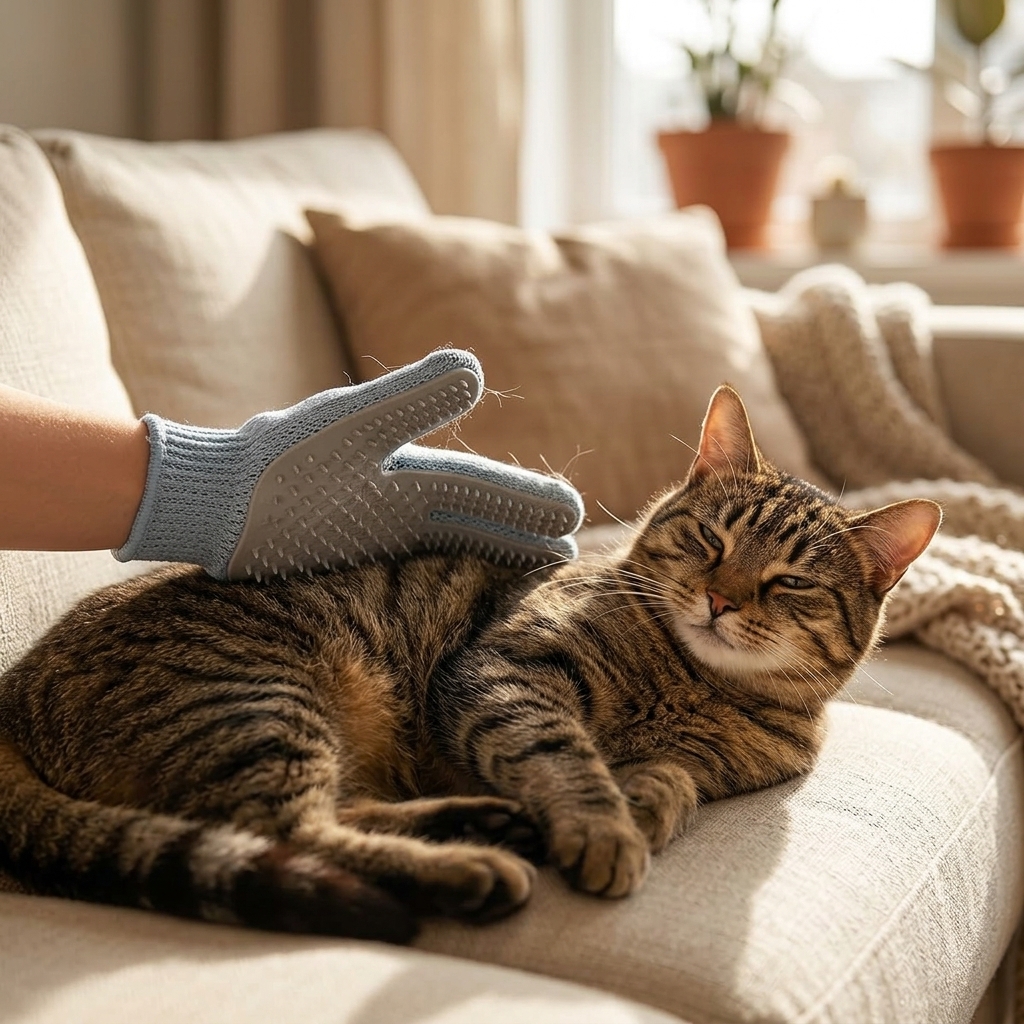
A silicone grooming glove hides the chore inside the petting. The soft nubs distribute pressure across your whole hand, there's no scraping edge, and your hand automatically adjusts around sensitive spots the way no rigid tool can. Loose fur clings to the silicone as you pet, then peels off in a sheet.
It's the mechanism, not magic, that makes it work: the cat experiences petting, and the fur comes off anyway.
Glove vs. brush, by situation
| Your situation | Best tool | Why |
|---|---|---|
| Cat hates brushes / runs away | Grooming glove | Reads as petting, not grooming — tolerance is the whole game |
| Long coat, heavy undercoat | Deshedding tool + glove | Gloves can't reach deep undercoat; use the glove for daily upkeep |
| Mats or tangles | Wide-tooth comb or a professional groomer | Neither gloves nor slickers fix mats — don't pull at them |
| Nervous or skittish short-hair | Glove or KONG ZoomGroom | Soft rubber and silicone feel like massage, not maintenance |
| Fur on couch and clothes | Glove (smooth side) | The same glove doubles as a furniture fur-lifter |
Where gloves fall short — honestly
A glove removes less fur per stroke than a slicker brush or a deshedding edge. If your cat happily tolerates a real brush, the brush is simply more efficient — keep using it.
Gloves also can't reach the dense undercoat on long-haired or double-coated breeds. During a seasonal shedding blowout, a glove alone will leave you behind; a deshedding tool like the FURminator exists for exactly that job.
And quality matters more than it looks: cheap gloves shed their silicone nubs with use, and a detached nub is a swallow risk. It's one of the main reasons most of the gloves we scored didn't earn a recommendation.
How to introduce a grooming glove
Start during normal petting — don't make it an event. Put the glove on, pet your cat exactly the way you always do, and keep the first sessions short. Stroke in the direction of fur growth, stay away from the belly until trust is established, and peel the fur sheet off the glove after each pass.
Most cats accept a glove within a few sessions precisely because nothing about the routine changed except your hand got slightly textured.
The tools we'd buy
Our top pick plus the two tools that cover what a glove can't. Prices change — check current pricing at each link.
2-in-1 Deshedding Glove
255 soft silicone nubs that read as petting. The glove that topped our Fit Analysis for brush-averse cats.
Check price on Amazon For undercoat
FURminator deShedding (Long Hair)
The deep-undercoat tool for heavy and long-haired shedders — the job gloves can't do.
Check price on Amazon For nervous cats
KONG ZoomGroom
Soft rubber brush with a massage feel — a good alternative if your cat distrusts anything glove-shaped.
Check price on AmazonGrooming gloves: FAQ
Do grooming gloves work on long-haired cats?
Yes, for surface fur — but not for the undercoat. Use the glove for daily upkeep and pair it with a deshedding tool for a weekly deep pass. Always stroke in the direction of fur growth on long coats.
Do cats actually like grooming gloves?
Most cats tolerate them, and many actively enjoy them, because the sensation is closer to petting than to brushing. Introduce the glove during normal petting and keep early sessions short. A small number of cats reject every tool — that's a cat thing, not a glove thing.
Are grooming gloves better than brushes?
They're better at different jobs. A brush removes more fur per stroke; a glove gets tolerated by cats that won't accept a brush at all. The best tool is the one your cat lets you use regularly.
How often should I groom my cat with a glove?
A few times a week for most cats, daily during shedding season. Because glove sessions feel like petting, more frequent short sessions beat occasional long ones.
Related reading
Ready to pick one? Start with best cat grooming gloves. For the full 12-tool comparison, see 12 cat grooming tools scored. Fighting fur around the house? Start with how to reduce cat shedding. And if your cat won't accept any tool yet, read how to groom a cat that hates being brushed.
Full Scorecard: Grooming Glove

The 2-in-1 Deshedding Glove
Your cat thinks you're petting them. You're actually grooming.
Check price on Amazon