Best Cat Brushes for Long-Haired Cats (2026)
A long coat is not a short coat with more fur on it. Here is the long hair cat brush kit that keeps a long-haired cat mat-free, which tool reaches which layer, and how often each one is safe to use.
Some links below are affiliate links. If you buy through them, MeowTested may earn a small commission at no extra cost to you, including as an Amazon Associate, where we earn from qualifying purchases, and as a partner of Whisker, the maker of Litter-Robot. We only recommend products that pass our Fit Analysis — and we publish the ones that don't.
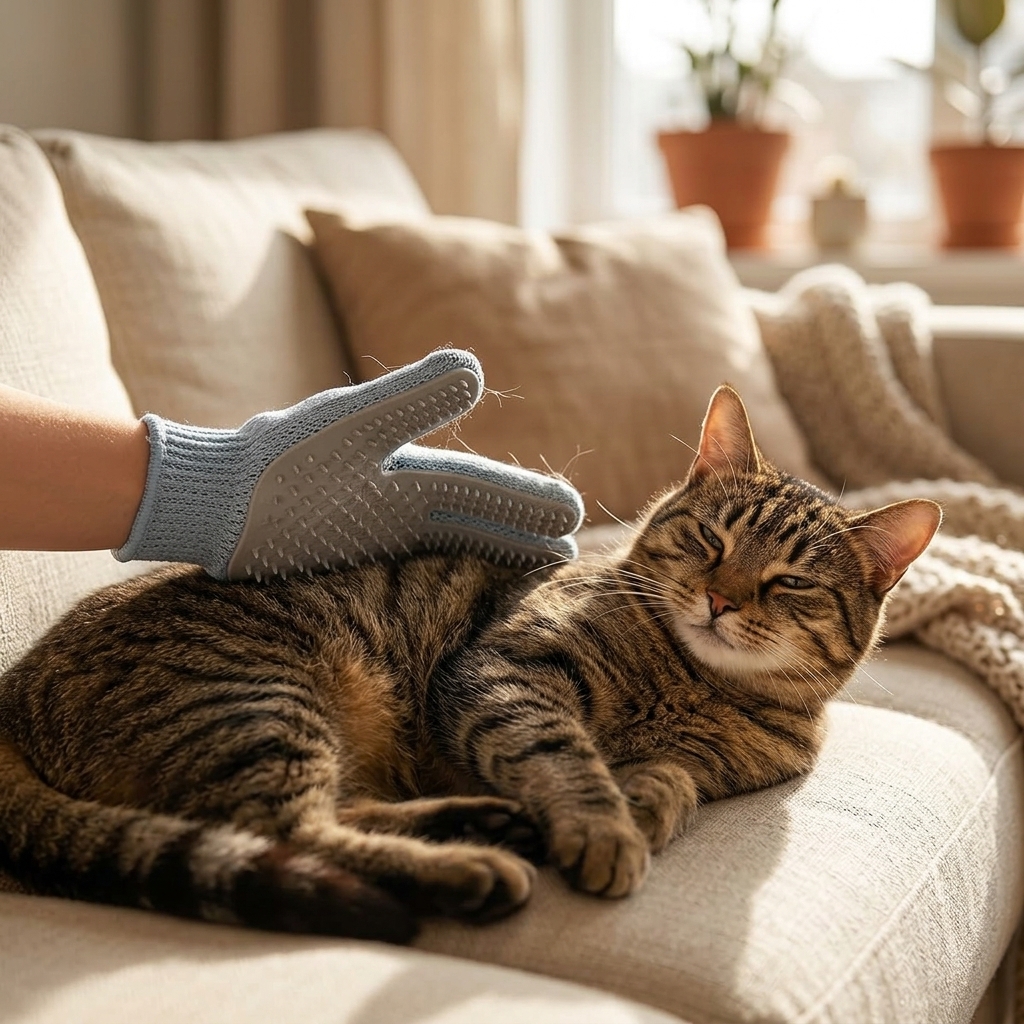
For a long-haired cat you need a small kit, not one brush. Four tools cover every layer of a long coat: a stainless steel comb (the mat detector, and the single most important tool), an undercoat rake for the packed layer underneath, a slicker brush for lifting loose fur out of the topcoat, and a grooming glove for the daily sessions your cat will actually sit through.
If you buy only two things: the steel comb and the glove. The comb finds trouble before it becomes a mat; the glove keeps grooming pleasant enough that your cat keeps showing up for it.
The single most common mistake on a long coat is buying a slicker brush and stopping there. A slicker works the topcoat. On a long-haired cat the problem lives one layer down.

What actually changes when the coat is long
Most cat grooming advice is written for a short coat, and it quietly assumes two things that stop being true on a long-haired cat.
The first is that shed fur falls out. On a short coat, loose undercoat works its way free and lands on your furniture. On a long coat it does not get that far — it snags in the long guard hairs on the way out and stays in the coat, held in place by the fur around it. Your long-haired cat is shedding the same amount; more of it is staying on the cat. That trapped fur is the raw material for every mat you will ever have to deal with.
The second is that you can see the coat you are grooming. You cannot. On a Ragdoll or a Maine Coon the visible topcoat can look immaculate while the layer against the skin is already packing down. This is why long-hair guides are unanimous about leading with a comb rather than a brush: a comb is the only tool in the kit that reaches the skin and reports back honestly.
So the working model for a long coat is two layers with two different problems. The topcoat needs loose fur lifted out of it, which is a slicker's job. The undercoat needs to be thinned before it packs, which is a rake or deshedding tool's job. And the comb sits above both as the diagnostic that tells you which one you actually need today.
Why long coats mat — and where
Long-haired cats carry a dense undercoat under a long topcoat. When loose undercoat sheds but cannot fall free, it tangles with live fur, and friction packs the tangle into felt — a mat.
Mats always start in the friction zones: armpits and the insides of the legs, behind the ears, the ruff, the 'britches' on the back legs, the belly, the base of the tail, and anywhere under a collar. Those are the places where fur rubs against fur or against the floor all day. That is why a quick weekly comb-through of just those zones prevents most mats — you are checking the seven places trouble starts, not grooming the whole cat.
The armpits deserve singling out. Breed-specific grooming guides for Ragdolls in particular flag armpit mats as the ones that develop unnoticed, because the surrounding coat is long enough to close over the mat and hide it completely. If you only check one zone, check there.
Mats are not cosmetic. They pull on skin constantly, hide skin problems underneath them, and get painful fast. Prevention is a five-minute habit; removal is a fight.
Undercoat rake vs slicker brush vs steel comb
| Tool | What it reaches | What it won't do | Main risk |
|---|---|---|---|
| Steel comb | All the way to the skin, one narrow line at a time | Move any real volume of fur — it is a diagnostic, not a deshedder | Almost none. Force it through a tangle and you pull skin |
| Undercoat rake | The packed undercoat layer, via long rounded teeth | Finish or smooth the topcoat | Low. Rounded pins rather than a blade, but it will drag on a mat |
| Slicker brush | Loose fur sitting in the topcoat, plus surface tangles | Reach packed undercoat on a heavy double coat | Fine bent wires on skin — ease off on thin-skinned or sensitive cats |
| Deshedding tool | Loose undercoat, via a fine cutting edge | Work safely anywhere the comb already snagged | Highest of the four. It cuts, so overuse damages guard hairs |
Rake or slicker first? A short decision rule
This is the question that sends most people to a second brush purchase, and it has a simple answer on a long coat: whichever layer is the problem. The comb tells you which one that is.
Run the steel comb through a friction zone, and watch where it stops.
- It glides all the way through. Nothing is wrong today. A glove pass or a light slicker is all the coat needs.
- It catches near the surface and then frees up. That is loose fur sitting in the topcoat. Slicker.
- It stops low, close to the skin, and feels dense rather than knotted. That is packed undercoat, and no amount of slicker work will fix it — the slicker's wires are not long enough to get there. Rake.
- It stops dead on a defined knot. That is a mat, and both the rake and the slicker are now the wrong tool. Skip to the mat ladder below.
If you want the general rule without the diagnosis: on a heavy double coat — Maine Coon, Norwegian Forest, Siberian, most Persians — the rake earns its place first and the slicker becomes the finishing tool. On a lighter long coat like a Ragdoll or a semi-longhair domestic, the slicker plus the comb usually covers it and the rake only comes out during a seasonal blowout.
Long-hair brushes by job
| Tool | Job | How often |
|---|---|---|
| Stainless steel comb | Find tangles early; finish the coat | Weekly friction-zone check |
| 2-in-1 Deshedding Glove | Daily surface fur; keeps grooming pleasant | Daily |
| Maxpower Planet undercoat rake | Thin packed undercoat before it can pack into felt | Weekly on heavy double coats; seasonally on lighter ones |
| Hertzko Self-Cleaning Slicker | Lift loose fur out of the topcoat; fluff the coat | 2–3x weekly |
| FURminator deShedding — Long Hair | Pull loose undercoat with a cutting edge | Weekly at most, light pressure |
| De-matting comb | Break up small mats safely | Only when needed |
Coat type changes the schedule more than it changes the kit
The tools barely change across long-haired breeds. The cadence changes a lot, and getting it wrong in either direction is the usual reason a grooming routine falls apart — too little and you are dematting, too much and the cat stops cooperating.
The pattern breed-grooming guides consistently describe:
Persian and Himalayan — daily, non-negotiable. The densest undercoat relative to body size in the long-haired group, plus a coat texture that packs rather than slides. A Persian that gets groomed weekly is a Persian that gets shaved at the groomer eventually. Daily comb, full depth.
Maine Coon — light most weeks, heavy seasonally. A water-resistant coat that is genuinely uneven: short over the shoulders, long down the sides and britches. The britches and the ruff do almost all the matting. Twice-weekly friction-zone work most of the year, then the rake earns its keep during a spring or autumn blowout.
Norwegian Forest and Siberian — same shape as the Maine Coon, more of it. Dense double coat with a heavy seasonal shed. Rake-led during the blowout, comb-led the rest of the time.
Ragdoll — light weekly maintenance, but check the armpits. Ragdolls carry much less undercoat than their size suggests, which is why the coat feels silky and why weekly is genuinely enough. The failure mode is not volume, it is the hidden armpit mat.
Domestic longhair — assume Maine Coon and adjust down. A mixed-breed long coat can sit anywhere on this range. Comb it weekly for a month and let what the comb finds set the schedule.
One rule cuts across all of them: season beats breed. Every double-coated cat has a few weeks a year where the undercoat comes out all at once, and during those weeks every cat on this list needs the rake more often than its baseline.
The order matters
Long-hair grooming works best as a sequence:
1. Comb test first. Run the steel comb through the friction zones. If it glides, everything else is optional today. If it snags, you have found tomorrow's mat while it is still fixable — and you know which layer to work.
2. Glove to warm up. A few minutes of glove strokes reads as affection, removes surface fur, and settles the cat before any real tool shows up.
3. Rake the undercoat, if the comb said so. Long rounded teeth, direction of growth, moderate pressure. Stop when the rake stops bringing fur out — a rake that is pulling nothing is just dragging pins across skin.
4. Slicker with the coat. Work in sections, always with the direction of growth, to lift what the rake loosened up out of the topcoat.
5. Comb again to finish. The same tool that diagnosed the coat verifies the work. If it glides everywhere now, you are done.
The deshedding tool is a substitute for step 3, not an addition to it. It cuts rather than combs, so if you are already raking weekly you do not also need a weekly FURminator pass. And skip it entirely anywhere the comb snagged — a cutting edge and a tangle are a bad combination.
Mats: the ladder, and what not to do
Never use scissors. Mats sit tighter to the skin than they look, cat skin tents upward when you pull on a mat, and scissor injuries from home mat removal are one of the most common grooming accidents vets see. There is no size of mat where scissors are the right answer.
Work the ladder instead, and stop at the first rung that fails:
1. Loose and moving. If the mat rolls under your fingers and has some give, you can take it apart by hand. Pinch the base of the mat against the skin so nothing pulls, then tease it apart from the outer edge inward, a few hairs at a time. Fingers before tools, always.
2. Firm but not flat to the skin. De-matting comb or a mat splitter, still holding the base. These have hooked or bladed teeth designed to cut *through* the mat rather than pull it, so let the tool do the work and never yank.
3. Flat to the skin, large, or anywhere sensitive. Armpit, belly, groin, or a mat you cannot get a finger under: stop. That is a groomer or a vet with clippers. It costs less than one emergency visit, and your cat forgives clippers a great deal faster than it forgives pain.
Two things that make a mat worse: bathing a matted cat, which shrinks the mat tight like felt, and working a mat while the cat is fighting you, which is how skin gets torn. If your cat will not tolerate the ladder at all, that is a separate problem to solve first — see the related reading below.
And once the mat is gone, it is worth asking why it appeared. A cat that suddenly starts matting in places it never did before is often a cat that has stopped grooming itself there — arthritis, dental pain, or weight gain all show up in the coat before they show up anywhere else. A new matting pattern is worth a vet mention.
The long-hair kit we would buy
Comb first, glove for the daily habit, then the fur movers in the order the comb tells you. Prices change — check current pricing at each link.
Buy firstStainless Steel Grooming Comb
The mat detector. A weekly 5-minute pass through the friction zones prevents the problem every other tool just manages, and it is the only tool here that tells you which of the others you need.
Check options on Amazon2-in-1 Deshedding Glove
Long coats need frequent grooming, and frequency requires tolerance. The glove is the tool cats keep saying yes to — ours included. It also gets into the armpits and leg insides, where a rigid brush head cannot follow.
Check price on Amazon For heavy coats
Maxpower Planet Double-Sided Undercoat Rake
Rounded pins rather than a cutting edge, so it lifts packed undercoat with less skin risk than a deshedding blade. The 9-tooth side breaks up dense fur, the 17-tooth side thins it out. The right first tool on a Maine Coon, Norwegian Forest or Siberian coat.
Check price on Amazon Topcoat
Hertzko Self-Cleaning Slicker
Fine bent bristles that lift loose fur out of long topcoats without raking skin. The self-cleaning button saves real time at long-hair fur volume — you will be clearing the head several times per session.
Check price on Amazon Alternative to the rake
FURminator deShedding (Long Hair)
A cutting edge rather than pins, so it moves undercoat faster and needs more restraint. Pick this or the rake, not both, and keep it to a light weekly pass.
Check price on AmazonLong-haired cat grooming: FAQ
What is the best cat brush for long hair?
There is no single one, and that is the honest answer rather than a dodge. A long coat has two layers with two different problems, so the kit that works is a steel comb to diagnose, a rake or deshedding tool for the undercoat, and a slicker for the topcoat. If you are buying one tool today, buy the comb — it is the only one that tells you what the coat actually needs.
Do long-haired cats need to be brushed every day?
It depends on the coat. Persians genuinely do need daily work. Maine Coons and Norwegian Forest cats need twice-weekly most of the year and daily during a seasonal blowout. Ragdolls are usually fine on weekly. Across all of them, short daily sessions beat one long weekly battle — a few minutes of glove or slicker daily plus a weekly comb-through of the friction zones is the routine that actually survives contact with a real cat.
Undercoat rake or slicker brush for a long-haired cat?
Both, eventually, but the comb decides which one you reach for today. If the comb stops low and the coat feels dense against the skin, that is packed undercoat and you want the rake — a slicker cannot reach that layer. If it catches near the surface and then frees up, that is loose topcoat fur and the slicker is the right tool. On heavy double coats the rake leads and the slicker finishes; on lighter long coats it is the other way round.
What are the best grooming tools for long-haired cats that mat easily?
A steel comb, a de-matting comb or mat splitter, and a grooming glove. That order is deliberate: the comb catches mats while they are still tangles, the de-matting tool handles the ones you missed, and the glove keeps the cat tolerant enough that you can keep checking. An undercoat rake belongs in a chronic-matting kit too, because most mats on a long coat are made of shed undercoat that never got thinned out.
What's the best brush for a Maine Coon or Ragdoll?
The same kit for both, used at different intensities. A Maine Coon needs the rake and real attention to the britches and ruff, especially during a seasonal shed. A Ragdoll carries much less undercoat than its size suggests, so weekly comb-and-slicker work is usually enough — but check the armpits every time, because that is where Ragdoll mats hide.
Slicker brush vs. pin brush for long hair?
Slicker for removing loose fur, pin brush mostly for fluffing and finish. If you own one, own the slicker — a pin brush glides over tangles that a slicker (and especially a comb) will catch. On a long coat a pin brush produces a good-looking topcoat while the layer underneath keeps packing, which is exactly the failure mode long-hair grooming is trying to avoid.
Do grooming gloves work on long-haired cats?
For daily surface fur and for reaching the armpits and leg insides, yes; for undercoat and tangles, no. Use the glove for the daily habit and for acceptance, and pair it with a comb and a rake or deshedding tool. Full answer: see our grooming gloves deep-dive.
How do I get a mat out of a long-haired cat without cutting it?
Hold the base of the mat against the skin so it stops pulling, then work it apart from the outside edge inward with your fingers or a de-matting comb. If it is flat to the skin, larger than a grape, or in the armpit, belly or groin, stop and book a groomer — those are the mats that end in a skin injury. Never scissors, at any size: the skin tents up into the mat and it is far closer to the blade than it looks.
Related reading
The undercoat tools get their own guide in best cat deshedding tools, including how often each one is safe to use. If your long-haired cat will not tolerate any of this yet, start with how to groom a cat that hates being brushed. Glove skepticism answered in do grooming gloves actually work, the buying picks are in best cat grooming gloves, and the full 12-tool comparison is in 12 cat grooming tools scored. Battling loose fur on top of the mats? How to reduce cat shedding has the full ranked system.
Full Scorecard: Grooming Glove

The 2-in-1 Deshedding Glove
Your cat thinks you're petting them. You're actually grooming.
Check price on Amazon